US-Iran Peace Agreement: Structural Undercurrents That Could Challenge the Truce
15 June 2026
While the announcement of the Switzerland memorandum of understanding has brought immediate psychological relief to global energy markets, a forensic analysis reveals deep vulnerabilities. The transition from active conflict to a monitored pause exposes significant US-Iran MoU structural risks. These core friction points involve regional anxieties, economic compliance hurdles, and verification loopholes that threaten to collapse the agreement within its brief 60-day window.
Gulf Coordination and Strategic Hedging
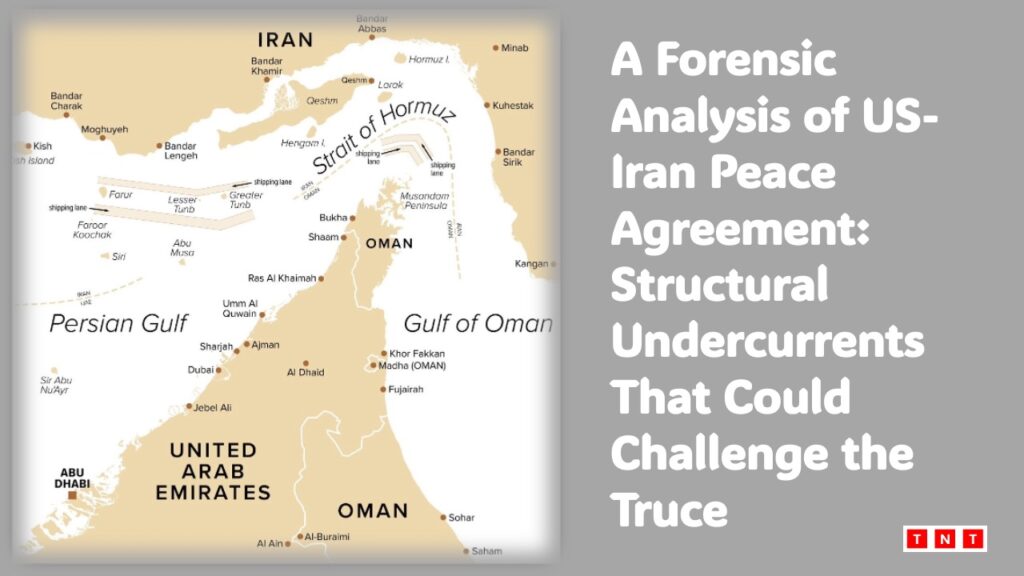
Regionally, the diplomatic breakthrough has triggered a complex wave of strategic hedging among traditional American allies. Saudi Arabia and the United Arab Emirates are reacting with deeply calculated caution. While both Gulf nations profoundly fear Iranian conventional rearmament, their domestic economies remain inextricably shackled to the safety of the Strait of Hormuz.
The 2026 conflict effectively choked their primary oil export routes, forcing Riyadh and Abu Dhabi to rapidly advance parallel, backchannel diplomatic tracks with Tehran. Rather than relying exclusively on a volatile Washington administration, the Gulf states are quietly pursuing localised non-aggression understandings to insulate their critical infrastructure should the truce fracture under mounting US-Iran MoU structural risks.
Israel’s Red Lines and Covert Deterrence
Concurrently, Israel’s official posture toward the Pakistan-mediated MoU is defined by open skepticism and explicit security warnings. Jerusalem views the 60-day negotiation window not as a diplomatic opportunity, but as a dangerous tactical vulnerability. Israel’s unyielding strategic red line remains the absolute prevention of an Iranian nuclear breakout.
Israeli intelligence assessments suggest that a temporary pause in conventional warfare could allow Tehran to quietly advance its uranium enrichment and conceal centrifuge arrays under a veneer of diplomatic immunity. Consequently, this 60-day window is highly likely to prompt an aggressive escalation in covert Israeli sabotage, targeted cyber operations, and clandestine intelligence actions inside Iran designed to disrupt Tehran’s progress without taking overt ownership of a ceasefire violation.
Economic Dimensions of US-Iran MoU Structural Risks
On the economic front, the immediate drop in crude prices reflects short-term market relief rather than long-term systemic stabilisation. In the specialised world of maritime trade, oil traders and insurance underwriters rarely price lasting stability into an unsigned, temporary memorandum.
Maritime Insurance Trajectories
Before the 2026 conflict, war-risk insurance premiums for commercial vessels transiting the Persian Gulf hovered at negligible baseline levels. At the height of active hostilities, however, insurance premiums exploded by 1,000%, adding millions of dollars to the cost of a single commercial transit.
Despite the announced ceasefire, major maritime insurers are refusing to lower these war levies proactively. Underwriters are maintaining elevated rates and demanding explicit, post-signing verification of safe passage before normalizing premiums. Marine insurance costs will remain structurally high, and fully unwinding the shipping backlog will take months, severely dragging down the expected economic benefits of the reopening.
Financial Sanctions Compliance Friction
Furthermore, the Trump administration’s insistence on a strict “pay-for-performance” model introduces severe structural friction into international finance. Because the MoU explicitly avoids upfront cash transfers or the immediate unfreezing of assets, any potential sanctions relief remains entirely contingent upon verified Iranian compliance.
This framework creates an almost insurmountable compliance hurdle for global banking conglomerates and multinational energy corporations. Private companies are deeply hesitant to clear transactions, issue letters of credit, or sign energy purchase agreements for Iranian crude when the underlying US sanctions can automatically “snap back” in 60 days. Corporate entities require long-term regulatory certainty; without it, Iran’s ability to commercialise its oil will remain heavily restricted by private-sector compliance fears.
Verification Vulnerabilities and the Proxy Loophole
The single greatest threat to the longevity of the agreement lies in its profound verification vulnerabilities. The current text notes that the United States will demand “US verification of sites”. In international law and arms control, this phrasing presents a severe operational contradiction.
Bilateral Verification vs. The Multilateral Paradigm
Iran has historically and categorically rejected direct, bilateral US inspections of its sovereign military installations, viewing them as avenues for Western espionage. To make this MoU logistically viable, the implementation text must explicitly rely on the International Atomic Energy Agency (IAEA) to handle on-the-ground inspections. If the Trump administration bypasses the IAEA in favour of a unilateral US mandate, the verification framework will suffer an immediate collapse due to intense political blowback from hardliners in Tehran.
Asymmetric Proxy Warfare Loopholes
Finally, the MoU fails to address the operational grey area of non-state actors and proxy networks. While the ceasefire theoretically covers operations on all fronts, verifying that Tehran has completely halted the clandestine flow of funds and technical missile components to regional proxies within a tight 60-day window is virtually impossible. Tehran utilises complex, informal smuggling routes that afford a high degree of plausible deniability.
Distinguishing between an independent strike by a rogue local militia and a direct, Tehran-ordered violation of the ceasefire is highly ambiguous. This blind spot represents a critical trigger point: a single unauthorised drone strike or rocket launch could be interpreted by Washington or Jerusalem as a definitive breach of faith, instantly triggering the US-Iran MoU structural risks that could collapse the fragile de-escalation process before formal terms are ever finalised.
Also Read
UAE Secret Combatant in Iran Conflict, Report Claims Covert Strike on Strategic Oil Refinery
Iran War 2026 Reshapes West Asia: GCC Split, Saudi-UAE Rivalry Deepens