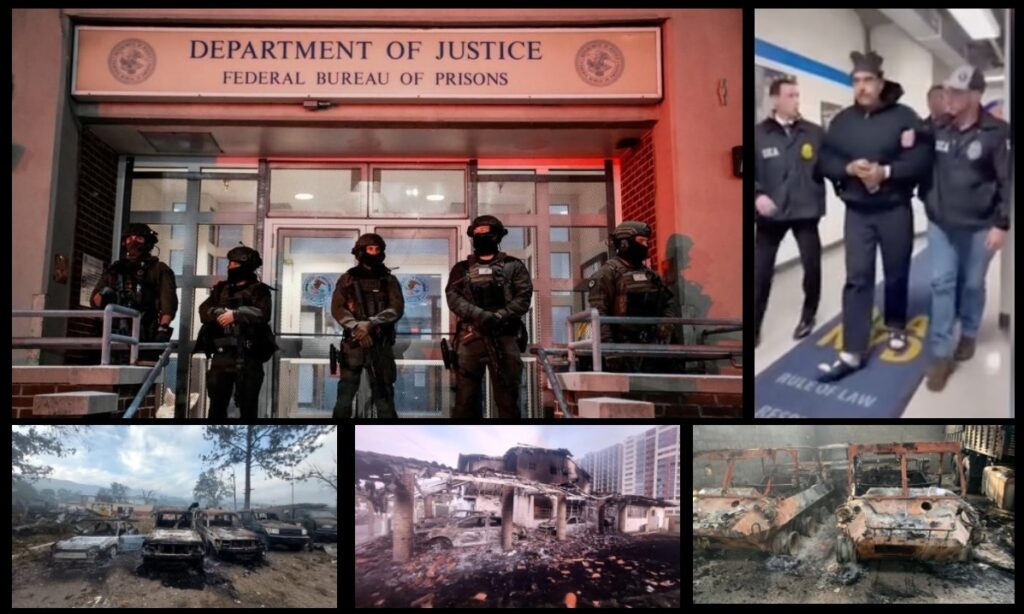
Whispers Behind the Airstrikes: Re-examining the US Intervention in Venezuela
In the early hours of 3 January 2026,
reports emerged of a dramatic US intervention in Venezuela, officially named Operation Absolute
Resolve.
US forces carried out coordinated airstrikes around Caracas, neutralised air defence systems, and detained President Nicolás
Maduro along with his wife, Cilia Flores, during a rapid ground operation. While official statements framed the action as a
targeted counter-narcoterrorism mission, an alternative narrative quickly surfaced across the social media platform
X, raising serious questions about legality, civilian harm, and covert
manipulation.
Across hundreds of posts, activists, analysts, and ordinary users challenged the
portrayal of the operation as precise or justified. Instead, they described a coordinated act of aggression marked
by alleged bribery, internal betrayal, civilian casualties, and imperial overreach. Drawing from these circulating
accounts, this article examines the core claims shaping public scepticism and the broader implications for
sovereignty and international norms.
Allegations of Bribery and the Absence of Military Resistance
A central claim repeated across social media is that the near-total absence of
Venezuelan military resistance was not accidental. Users argue it reflected
deep internal compromise rather than battlefield dominance. Several posts
alleged that key Venezuelan officers were either bribed or coerced into standing down, leaving air defence systems
inactive during the strikes.
One widely shared claim stated that payments were made to senior officials, ensuring
that radar systems remained silent and no anti-aircraft fire was deployed. Others suggested that Maduro was betrayed
by members of his own security apparatus, with some accounts alleging the involvement of foreign intelligence
networks. According to these narratives, the US forces did not defeat Venezuela militarily but entered an already
neutralised space.
This portrayal reframes the operation as a staged display of power, dependent on financial inducements rather than combat. Users described the raid as an
“air assault with zero opposition” and dismissed it as a choreographed spectacle. The implication is damaging: that
national sovereignty can be dismantled through bribery, eroding loyalty within state institutions and exposing the
fragility of governments under external pressure.
Civilian Casualties Amid Claims of Precision
Despite official assertions of surgical accuracy, online accounts repeatedly highlighted
civilian deaths and infrastructure damage resulting from the strikes.
Social media users cited local reports indicating that at least 40 people were killed, including elderly civilians caught in residential areas near military targets.
Eyewitness accounts spoke of explosions across Caracas, widespread blackouts in southern
districts, and strikes near oil facilities. One post expressed hope that civilian casualties would remain at zero, a
hope later contradicted by emerging figures. Other claims referenced Venezuelan health data suggesting over
110 deaths since September 2025, linked to escalating security operations
and alleged extrajudicial killings.
The contradiction troubled many observers. Even with no organised resistance, airstrikes
still caused civilian harm. Users questioned how advanced military systems failed to prevent such outcomes in what
was effectively an uncontested environment. For critics, this exposed the limits of “precision warfare” and
underscored how civilian lives become collateral in geopolitically motivated actions.
Accusations of Illegal Invasion and Regime Change
Beyond the immediate human cost, social media discourse framed the US
intervention in Venezuela as an illegal act of aggression. Posters cited the
deployment of thousands of troops, naval carrier groups, and over 150 aircraft without international authorisation.
Many described the operation as a clear violation of international law and the UN Charter.
Several users alleged that the true objective was regime change, masked under narcoterrorism allegations. Claims circulated that Washington intended to
install a compliant government while securing control over Venezuela’s oil assets. Reports of strikes near
refineries and the seizure of tankers were cited as evidence of economic motives.
The rapid execution of the operation, reportedly completed within two hours, was
condemned as “shock and awe” designed to overwhelm rather than stabilise. Oil prices reportedly spiked by around
15 per cent following the strikes, reinforcing suspicions of market-driven
incentives. International criticism from regional actors, including Brazil and Colombia, was amplified as proof that
the operation destabilised rather than protected the region.
Regime Change by Design: Washington’s Long Game in Venezuela
Critics argue that the current US intervention in Venezuela is not a sudden response to narcoterrorism claims but the latest phase of a
decades-long strategy. They point back to the failed 2002 coup
against Hugo Chávez, followed by years of sanctions, diplomatic isolation,
economic pressure, and open support for parallel power centres, including the Juan Guaidó episode. Each phase, they argue, pursued the same objective through different instruments.
This intent surfaced bluntly in 2017, when
then US President Donald Trump reportedly asked regional leaders why
Washington did not simply invade Venezuela. For sceptics, the remark confirmed that military force had always remained an option.
Within this continuity, Marco Rubio—then a Senator and now Secretary
of State—has been among the most consistent advocates of regime change, maintaining the same position across
multiple administrations.
From this perspective, leadership changes in the White House do not represent policy
shifts but tactical adjustments. Social media commentators argue that US foreign policy operates on a long horizon,
reshaping narratives while pursuing a constant goal: political control and strategic leverage, particularly over energy-rich states. Seen through this lens, the Maduro operation
appears less like crisis management and more like the execution of a plan years in the making.
Distrust of Official Narratives and Global Implications
Underlying these reactions is a deep mistrust of official explanations. Many users
argued that the operation followed a familiar pattern seen in Iraq and earlier Latin American interventions. They
claimed that elite betrayal, external coercion, and civilian suffering remain recurring tools of modern
interventionism.
Posts also highlighted the absence of a credible post-capture plan, warning that
detaining Maduro without addressing Venezuela’s internal divisions could fuel prolonged instability. Others pointed
to unusual market movements and betting platforms as possible indicators of insider knowledge, further intensifying
suspicion.
For these commentators, the episode represents more than a single operation. It
symbolises the erosion of international norms, where military force is deployed at executive discretion and
justified after the fact. As one widely shared post argued, this was not counter-narcotics enforcement but
“constitutional arson disguised as policy”.
The volume and intensity of these voices suggest that global audiences are no longer
willing to accept official narratives at face value. In a digital landscape where alternative accounts travel
instantly, the US intervention in Venezuela has
become a case study in contested truth, power asymmetry, and the enduring human cost of foreign military action.
Whether these claims withstand formal scrutiny or not, they reflect a growing demand for transparency and
accountability in an era shaped by shadows as much as headlines.