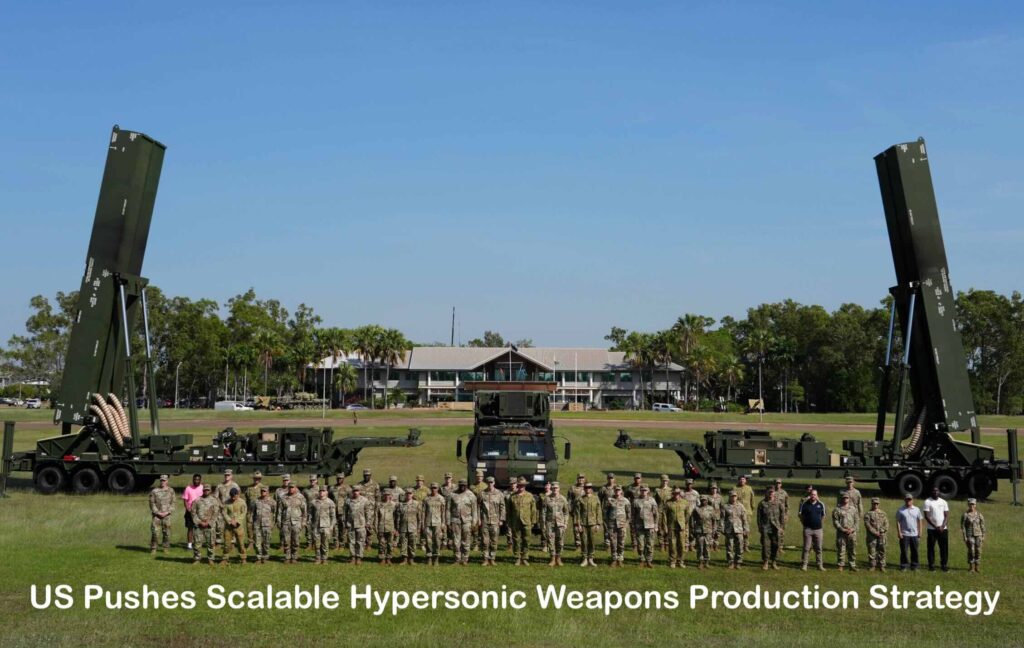
US Accelerates Industrial Push for Hypersonic Weapons Production
Strategic Shift Towards Scalable Hypersonic Weapons
The United States is intensifying its hypersonic weapons production strategy to counter Russia and China,
both of whom already deploy operational systems. This acceleration forms a core part of the Pentagon’s
Acquisition Transformation Strategy under the broader Arsenal of Freedom initiative
led by Secretary Pete Hegseth. The approach prioritises speed, scalability, and industrial capacity, and it aims to
create mass quantities of cost-effective hypersonic weapons rather than limited prototype runs. As a
result, Washington seeks to avoid the high-cost depletion issues seen with expensive defensive interceptors during
recent conflicts. This shift is designed to ensure a credible, resilient, and sustainable deterrence posture rooted in
industrial robustness and technological innovation.
Understanding the Global Hypersonic Landscape
Hypersonic weapons travel beyond Mach 5 and introduce both opportunities and significant challenges. Russia employs
systems such as the Avangard glide vehicle and the Kinzhal missile mainly for nuclear deterrence. China, however,
focuses on regional dominance with the DF-17 missile. The US, in contrast, builds its doctrine around
conventional precision strike capability, which requires large production volumes to neutralise threats in
multiple theatres. Therefore, Washington is expanding its industrial base, fostering private sector partnerships, and
adopting modular manufacturing processes. This ensures the United States can shift hypersonic weapons rapidly from
prototype development to mass production.
Building an Industrial Base for Mass Output
The Atlantic Council’s Hypersonic Capabilities Task Force supports the American approach and highlights the importance
of manufacturing innovation and supply chain resilience. They advocate modular architectures that boost output and
reduce costs. In addition, they stress investment in national infrastructure such as advanced hypersonic wind tunnels
and expanded STEM workforce pipelines. This industrial expansion underpins the ability to build and sustain
high-intensity conflict capability. Furthermore, policy recommendations include encouraging direct supplier negotiations
and offering incentives to defence manufacturers to improve affordability and accelerate delivery timelines.
Lessons from Past Conflicts and the Cost Burden
Recent conflicts have shown the downside of relying on expensive munitions. Large quantities of THAAD interceptors and
Standard Missiles were consumed rapidly, leaving limited deployment options and undermining deterrence. Therefore, the
US defence establishment recognises that hypersonic weapons cannot follow the same costly trajectory. By reshaping
procurement and production practices, Washington shifts towards a framework built on scalable, rapid, and affordable
solutions. This results in a stronger deterrence model supported by mass availability of adaptable hypersonic
weaponry tailored to varying mission requirements. In addition, such a model reduces vulnerabilities within
existing defence systems and introduces far more operational flexibility.
From Prototypes to Production – The New US Hypersonic Model
In essence, the US hypersonic weapons effort is evolving from a prototype-driven development cycle to a
production-centric model. Affordability and scalability now matter as much as raw capability. Therefore, Washington is
positioning itself to match or exceed the operational advancements of geopolitical competitors. The ability to sustain
high-demand scenarios hinges on industrial readiness. As a result, this transition forms a pivotal part of America’s
broader security strategy, ensuring the United States maintains strategic parity or superiority in hypersonic strike
capabilities.
Conclusion
The United States is moving decisively towards an industrial model that supports rapid and scalable hypersonic
weapons production. This evolution aligns with the realities of modern warfare, where deterrence depends not
only on advanced technology but also on the ability to manufacture systems in mass quantities. As Washington enhances
its supply chains, manufacturing processes, and strategic infrastructure, it builds a foundation capable of meeting
future high-intensity threats with confidence, resilience, and flexibility.