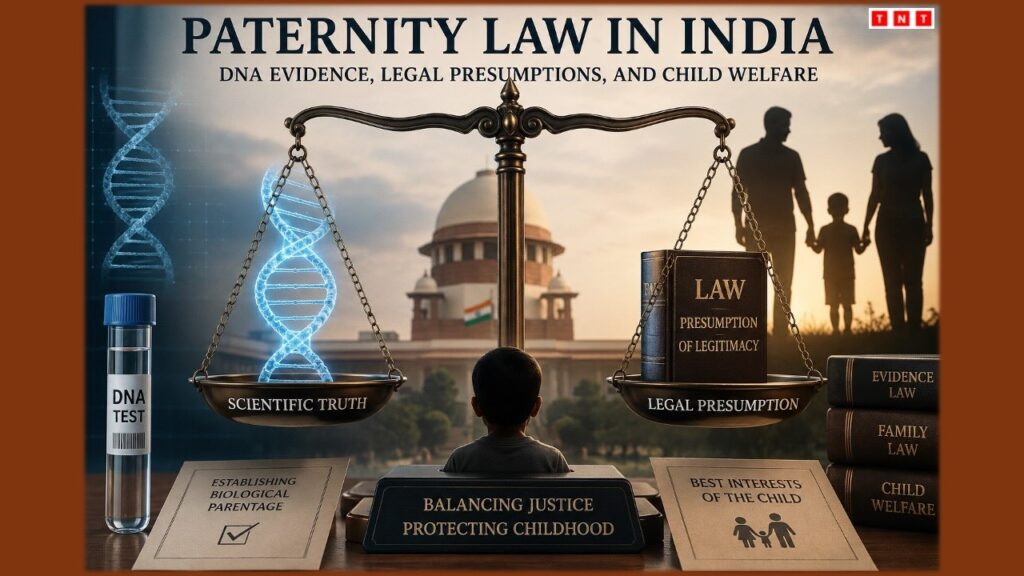
The Paternity Paradox: Reconciling Scientific Truth, Legal Presumptions, and Child Welfare in Indian Family Law
Paternity Law in India is increasingly confronting a difficult question: when modern DNA testing can establish biological parentage with near certainty, how should the law balance scientific truth against longstanding legal presumptions designed to protect children and preserve family stability?
The Supreme Court’s recent decisions in Ivan Rathinam v. Milan Joseph (2025) and Nikhat Parveen @ Khusboo Khatoon v. Rafique @ Shillu (2026) have renewed discussion on how Indian family law should reconcile DNA evidence with the statutory presumption of legitimacy. While the Court has recognised the evidentiary significance of DNA testing in certain circumstances, it has also reaffirmed the strong statutory protection accorded to children born during a valid marriage. Read together, these decisions illustrate the judiciary’s continuing effort to balance scientific advances with longstanding concerns relating to child welfare, privacy, family stability, and constitutional rights.
The broader policy question, however, remains whether the existing framework under Section 116 of the Bharatiya Sakshya Adhiniyam, 2023 which substantially carries forward the principles of Section 112 of the former Indian Evidence Act, 1872, adequately addresses the realities of the DNA era.
The Statutory Presumption and Its Purpose
Section 116 provides that a child born during the continuance of a valid marriage, or within 280 days after its dissolution provided the mother remains unmarried, shall be conclusively presumed to be the legitimate child of the husband.
The presumption may be displaced only through proof of “non-access,” meaning that the husband and wife had no opportunity for sexual relations during the relevant period.
This provision emerged in a very different social and technological context. Historically, it served several important objectives:
- Protecting children from the social consequences of illegitimacy.
- Preserving family stability.
- Preventing speculative accusations against women.
- Reducing intrusive inquiries into intimate family relationships.
Even today, courts have repeatedly emphasised that family law must prioritise the welfare and dignity of children while safeguarding privacy interests protected under Article 21 of the Constitution.
Judicial Interpretation in Different Contexts
The Supreme Court’s jurisprudence demonstrates that the application of the presumption often depends on the context in which paternity is disputed.
Matrimonial Disputes and Children Born During Marriage
In matrimonial disputes involving a child born during a valid marriage, courts have generally accorded substantial weight to the statutory presumption.
In Ivan Rathinam v. Milan Joseph (2025), the Supreme Court reaffirmed that the presumption of legitimacy remains a central feature of Indian family law. The Court emphasised that allegations of adultery or requests for genetic testing cannot automatically displace the statutory protection afforded to a child born within marriage. DNA testing is not intended to become a routine mechanism in matrimonial litigation, particularly where it may adversely affect the child’s dignity, privacy, or social standing.
In practical terms, the ruling reinforces the principle that a child born during a valid marriage will ordinarily be regarded in law as the husband’s child unless non-access is established in accordance with Section 116 of the Bharatiya Sakshya Adhiniyam. This reflects a legislative and judicial preference for preserving legitimacy and protecting child welfare, even where questions regarding biological parentage are raised.
It is precisely this feature of the law that lies at the heart of the present debate. Critics contend that modern DNA technology can establish biological parentage with a high degree of certainty and should therefore play a greater role in determining legal obligations. Others argue that family law serves broader social purposes and that the interests of the child cannot be reduced solely to questions of genetic connection.
The resulting policy dilemma is evident: while advances in genetic science make biological parentage easier to establish than ever before, Indian family law continues to treat the preservation of legitimacy and child welfare as objectives deserving independent legal protection.
Cases Involving Existing DNA Evidence
A different set of considerations may arise where reliable DNA evidence has already been produced and remains unchallenged.
In Nikhat Parveen @ Khusboo Khatoon v. Rafique @ Shillu (2026), the Supreme Court recognised the significance of conclusive genetic evidence in the context of maintenance proceedings. The decision has been viewed as consistent with the principle articulated in Nandlal Wasudeo Badwaik v. Lata Nandlal Badwaik (2014), where the Court observed that scientific evidence may assume decisive importance when its authenticity is not in dispute.
These decisions illustrate the judiciary’s continuing effort to reconcile legal presumptions with advances in scientific knowledge rather than establishing any simple preference for one over the other.
Continuing Importance of Judicial Safeguards
The principles laid down in Goutam Kundu v. State of West Bengal (1993) continue to influence judicial discretion. The Court cautioned against routine DNA testing and stressed that such orders should be supported by strong prima facie grounds. The objective is to prevent unnecessary intrusion into personal privacy while ensuring that courts retain access to reliable evidence when genuinely required.
The Emerging Policy Debate
The current legal framework has generated an important policy discussion.
A husband seeking to challenge paternity of a child born during marriage generally faces a high evidentiary threshold because the law strongly protects legitimacy. By contrast, courts may be more receptive to genetic testing where the purpose is to establish biological parentage and potentially secure rights or support for a child.
Supporters of this distinction argue that the two situations are fundamentally different. Establishing paternity may expand a child’s rights and opportunities, whereas disproving paternity within an existing family structure may risk depriving a child of legal recognition, financial support, and social stability.
Critics, however, contend that the distinction can create practical difficulties in cases where compelling scientific evidence points in a different direction from the legal presumption. They argue that individuals may remain subject to significant legal obligations despite the existence of reliable biological evidence to the contrary. Others note that access to accurate genetic information may be relevant to medical history, personal identity, and future family relationships.
The debate is therefore not merely about biology versus law. It concerns how competing interests should be weighed when both scientific certainty and child welfare carry substantial legal significance.
Why Some Scholars Defend the Existing Framework
Not all legal scholars favour expanding the role of DNA evidence.
Many argue that family law has traditionally recognised social and legal parenthood alongside biological parenthood. From this perspective, the law’s primary concern is not always genetic accuracy but the protection of vulnerable children.
Greater reliance on DNA testing, critics caution, could encourage intrusive litigation, destabilise family relationships, and expose children to disputes arising from adult conflicts. They maintain that the presumption of legitimacy continues to serve an important protective function, even in an age of scientific certainty.
These concerns explain why courts have generally approached genetic testing with caution rather than treating it as the automatic determinant of legal parentage.
The Case for Legislative Clarification
The continuing debate suggests that legislative guidance may help provide greater clarity.
The Law Commission of India, including in its 185th Report, examined whether scientific developments warranted reconsideration of the traditional approach to paternity disputes. Despite such recommendations, the Bharatiya Sakshya Adhiniyam substantially retains the structure of the earlier provision.
Any future reform would need to balance several competing objectives:
- Preserving the protective presumption in favour of children.
- Recognising the evidentiary value of reliable DNA testing.
- Safeguarding privacy and informed consent.
- Providing clear standards for courts when genetic testing is sought.
- Ensuring that child welfare remains the central consideration.
- Reducing prolonged and inconsistent litigation.
A carefully calibrated framework could allow scientific evidence to be considered in appropriate cases while maintaining robust protections against misuse.
Constitutional Dimensions of the Debate
The issue increasingly engages multiple aspects of Article 21 of the Constitution.
On one side lies the child’s dignity, privacy, and entitlement to social protection. On the other lies the growing argument that individuals may have an interest in knowing their biological origins and family history. Courts must therefore balance competing constitutional values rather than merely resolve questions of scientific fact.
As genetic technology becomes more accessible and accurate, these constitutional considerations are likely to assume greater importance in future jurisprudence.
Balancing Science, Law, and Child Welfare
The debate surrounding Paternity Law in India is no longer about whether DNA technology is reliable. Rather, it concerns how legal doctrine should respond to scientific certainty while continuing to protect children and preserve family stability.
The Supreme Court’s decisions in this area reflect a careful attempt to navigate complex and competing interests. The larger policy question is whether a statutory framework developed in an earlier era should be refined to provide clearer guidance for the age of genetic evidence.
The challenge need not be framed as a choice between child welfare and biological truth. The real task for lawmakers is to design a framework that respects both. A thoughtful legislative review of Section 116 may help ensure that Indian family law remains responsive to scientific developments while continuing to uphold dignity, fairness, and the best interests of children.
Editor’s Note: This article is a policy and legal commentary intended to encourage informed public discussion on statutory provisions governing paternity disputes. It does not question the authority of any court or comment on the merits of individual cases beyond publicly reported judicial reasoning. Readers should consult qualified legal professionals for advice on specific legal matters.