From Tomahawk Peers to ICBM Shields: Inside DRDO’s Relentless 2026 Missile Testing Campaign
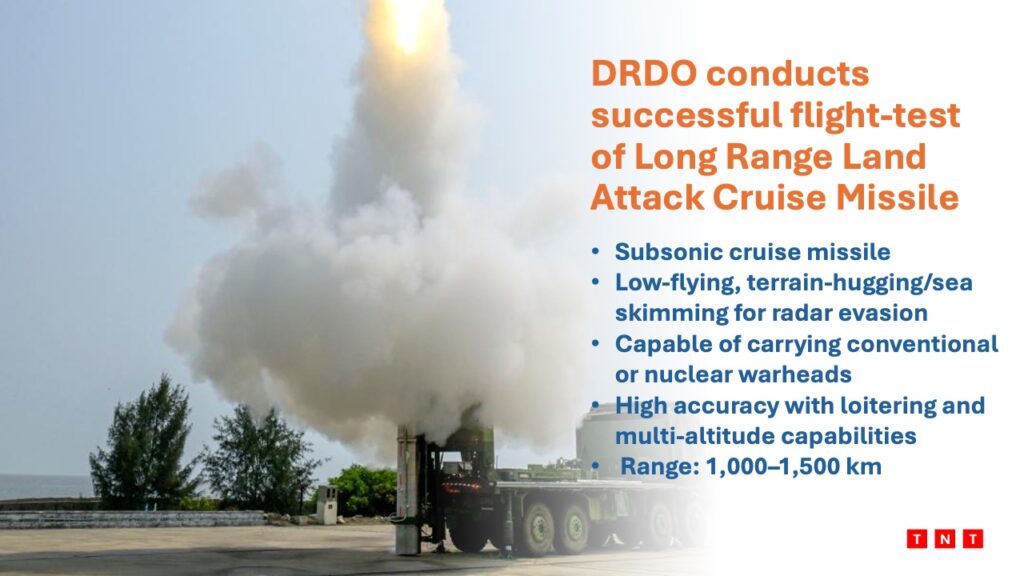
On June 15, 2026, the Defence Research and Development Organisation (DRDO) successfully conducted a follow-on developmental flight test of its indigenously developed Long Range Land Attack Cruise Missile (LRLACM) from Dr. APJ Abdul Kalam Island off the coast of Odisha. This successful operation caps an extraordinarily high-tempo first half of 2026 for India’s strategic defence ecosystem. The flurry of activity underscores a rapid shift toward complete self-reliance (Aatmanirbhar Bharat) in precision-strike, multi-layered air defence, and standoff naval warfare.
India’s Subsonic Cruise Capability (LRLACM)
Led by the Aeronautical Development Establishment (ADE) in Bengaluru as the nodal laboratory, the LRLACM project is engineered with extensive participation from Indian private and public defence industries. It has emerged as a cornerstone of India’s tri-service standoff arsenal, drawing direct comparison to the American Tomahawk class of low-altitude weapons.
Performance and Radar Evasion: The platform features advanced low-flying, terrain-hugging, and sea-skimming flight paths designed specifically to evade enemy radar networks.
Indigenous Propulsion: The system is powered by the local Manik turbofan engine, utilising navigation systems derived from the Nirbhay and ITCM demonstrator programs.
Strategic Flexibility: Open-source defence assessments report an operational strike range of up to 1,500 km. The missile is designed for deployment from ground-based mobile launchers and naval Vertical Launch Systems (VLS), providing a flexible long-range precision-strike capability across multiple operational domains.
Project Inception and Development: The program originally evolved from the baseline Nirbhay cruise missile program which was initiated in the 2010s. While core development wrapped up by the early 2020s, the platform formally advanced into a tri-service weapon project following DAC approvals post-2020 and successful ITCM demonstrator tests.
Operational Progress and Planned Induction: This mid-June launch marked its second known flight test, following a successful maiden launch in November 2024. User trials are progressing steadily with participation from the Army, Navy, and Air Force. Full operational capability and structured inductions are planned for the mid-to-late 2020s, specifically targeting the 2027 to 2028 timeline.
Chronological Index: Major DRDO Missile Tests of Year 2026
India’s defence modernisation index has maintained an unprecedented pace over the last six months. The country expanded capabilities from tactical battlefield ballistic systems to continental-scale defence shields through the strategic validation of the Pralay SRBM, the Solid Fuel Ducted Ramjet (SFDR) Propulsion Test, the Agni-3 IRBM, the air defence system VSHORADS, the Advanced Agni-5 (MIRV), the Agni-1 SRBM, the RudraM-II, the Multi-Layered BMD Shield, the NASM-MR, and LRLACM.
Early January – Pralay SRBM: This solid-propellant, high-precision tactical quasi-ballistic missile has a range of 150 to 500 km (Short Range Ballistic Missile). It cleared user evaluation trials via a rapid double-salvo launch from a single launcher. Development began in the 2010s as a Prithvi replacement. User trials are now cleared, with imminent induction planned for the Indian Army and Indian Air Force in early 2026.
February 3 – SFDR Propulsion Test: This test validated Solid Fuel Ducted Ramjet technology to supply sustained supersonic speeds of Mach 2 to 4+ and an extended range of 50 to 300+ km. It is an ongoing DRDO development effort that feeds directly into future next-generation, highly manoeuvrable long-range air-to-air missile programs.
February 6 – Agni-3 IRBM: The Strategic Forces Command executed a periodic user trial from Abdul Kalam Island to validate operational readiness. Developed in the 2000s and long-inducted into service, this two-stage solid propellant, nuclear-capable system has a range of 3,000 to 5,000 km.
Late February – VSHORADS: DRDO conducted three successive operational flight trials against high-speed aerial threats from Chandipur. This Very Short-Range Air Defence System initiated in the 2010s, this final trial revalidated the operational configuration of the man-portable infrared seeker system (range of about 6 km) ahead of planned induction into the Army and IAF within 2026.
May 8 – Advanced Agni-5 (MIRV): This flight test under Mission Divyastra demonstrated advanced Multiple Independently Targetable Re-entry Vehicle technology. Originating from the baseline Agni-5 program of the 2000s, this second successful MIRV demonstration flight marks ongoing progress toward operationalising the canisterised, ICBM-class MIRV-capable Agni-5 variant with a range exceeding 5,000 km.
May 22 – Agni-1 SRBM: The Strategic Forces Command conducted a routine operational user validation trial from Chandipur. Inducted into active service years ago, this road or rail mobile nuclear-capable ballistic system maintains a deployment range of 700 to 1,250 km.
June 2 – RudraM-II: DRDO completed advanced validation trials of the RudraM-II anti-radiation missile from an IAF Su-30MKI. Designed to destroy enemy radar and air-defence assets from stand-off ranges exceeding 300 km, the missile is expected to move toward production and induction by 2027.
June 10-11 – Multi-Layered BMD Shield and NASM-MR: This twin-milestone event began with three consecutive Phase-II Ballistic Missile Defence interceptor tests, an ongoing program since 1999. They validated endo- and exo-atmospheric defence capabilities to neutralise incoming threats up to ICBM class over 2,000 to 5,000 km ranges, pushing Phase-I close to active induction. Concurrently, DRDO executed the successful maiden test of the subsonic, sea-skimming Naval Anti-Ship Missile-Medium Range, which is currently in active development.
The Big Picture: A Changing South Asian Kill-Web
The intense cadence of testing throughout 2026 highlights a deliberate evolution in India’s military strategy. DRDO is no longer simply validating individual technologies; it is increasingly integrating them into a multi-layered network of offensive and defensive capabilities.
As regional security dynamics continue to evolve across the Indo-Pacific, India’s concurrent development of long-range land-attack cruise missiles, indigenous anti-ship weapons, and layered ballistic missile defence systems signals a significant shift in its defence posture.
Rather than relying primarily on foreign acquisitions, India is increasingly fielding indigenous systems across the full spectrum of strategic warfare, from precision-strike cruise missiles and anti-radiation weapons to advanced ballistic missile defence. The cumulative effect is the emergence of a more self-reliant and technologically integrated deterrence architecture tailored to the region’s evolving security environment.
Also Read:
BrahMos ER 800 km Cruise Missile to Redefine India’s Precision Warfare
Agni-VI ICBM: DRDO Chairman Says Fully Prepared, Awaits Government Approval
Why India Chose BrahMos Over ASBMs: The Doctrine Behind New Delhi’s Missile Logic
Ballistic or Cruise? Why BrahMos Isn’t Agni — And What That Means for India