Updated on May 09, 2026
Framing India: Western Gaze, Narrative Control, and the Politics of Portrayal Series – Part 1
The Lens That Refused to See Us Whole
Every civilisation has the right to tell its own story. Yet for decades, India’s story has been heavily filtered through a foreign lens — one that often sought not understanding, but confirmation of preconceived notions. This series, Framing India, is an attempt to examine, expose, and ultimately move beyond that gaze.
It is not a denial of India’s challenges. Poverty, inequality, and social issues exist and must be confronted honestly. But when outsiders consistently frame these realities as the defining essence of a 5,000-year-old civilisation — while ignoring its resilience, achievements, and aspirations — something deeper is at play: the politics of portrayal and the subtle exercise of narrative power.
This is Part 1 of the Framing India series. Read the full series navigation at the end of this article.
A Winter Morning in Varanasi That Changed How I Saw the World
In the late 1970s, a schoolboy, walking in Varanasi, I witnessed a scene that would stay with me for life. On a crowded street near the ghats of the sacred city — where rituals have outlasted empires — two English photographers were at work. They were not offering biscuits to hungry children out of kindness. Instead, they threw the biscuits at a distance, deliberately provoking desperate scrambles, collisions, and chaotic expressions — all for the perfect dramatic photograph.
At the time, I did not fully grasp the implications. Years later, connecting this memory with the broader archive of Western media coverage of India, the pattern became painfully clear. That single incident was not an aberration. It was a microcosm of a larger system — one where hunger was not relieved, but staged; where suffering was not documented, but manufactured for the lens.
This incident occurred in the late 1970s, but its roots went back further — to the post-Independence decades when Western documentary filmmakers, including those from the BBC, began shaping global perceptions of the newly independent nation.
Objectives of This Series
Through this multi-part series, we aim to:
- Trace the historical origins of selective and often exploitative Western portrayals of India.
- Examine how these portrayals have influenced global opinion, policy, and the Indian psyche itself.
- Highlight the double standards in how poverty, violence, and social issues are framed when they occur in India versus the West.
- Explore the consequences of such narrative control on India’s image, diaspora, and self-perception.
- Ultimately advocate for narrative sovereignty — the right and responsibility of Indians to tell their own story, with all its complexity, pain, and pride.
This is written from an Indian perspective — rooted in civilisational self-respect, not defensiveness. We do not seek to sanitise India’s realities, but to reject the reduction of our nation to a perpetual museum of misery.
From Observation to Orchestration
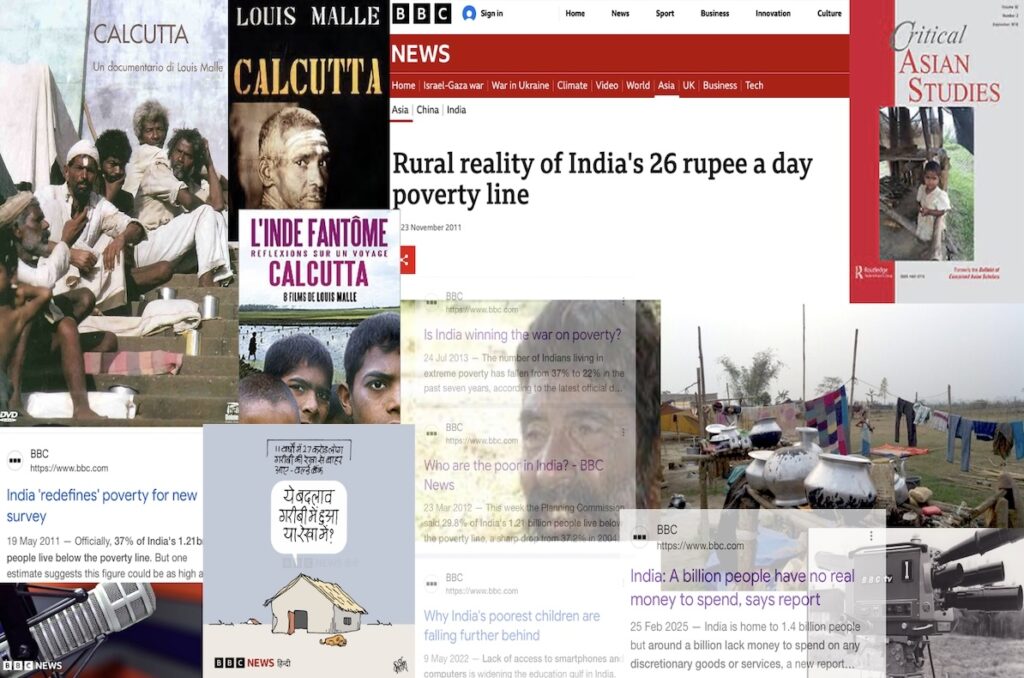
This childhood memory from Varanasi did not occur in isolation. By the 1960s and 1970s, a distinct genre of Western documentary filmmaking had taken shape around India. Filmmakers like Louis Malle with Calcutta (1969), and others behind titles such as India: The Search for Survival and Hunger in India, produced works that relentlessly zoomed in on disease, slums, caste discrimination, famine, and squalor.
The camera was almost always pointed downward — both literally and metaphorically. India was presented as a land of permanent backwardness, a place trapped in cycles of misery, dependent on external salvation. These were not neutral observations. They were carefully framed spectacles that reinforced a clear moral and cultural hierarchy: the enlightened, modern West versus the chaotic, suffering East.
These documentaries became foundational texts in the Western imagination. They shaped public opinion, influenced aid policies, diplomatic attitudes, and even academic discourse. India was rarely shown as the world’s largest democracy, a cradle of profound philosophical traditions, or a nation slowly building scientific and technological capabilities. Instead, it was reduced to images of barefoot children in sewage, silent starvation, and temples standing beside leprosy wards.
Intent vs. Impact: The Moral Mirage
Some defenders argue that these works were meant to raise awareness and generate empathy. Perhaps a few filmmakers genuinely believed this. Yet the actual impact tells a different story. The dominant outcome was not meaningful compassion but condescension and a self-serving Western virtue-signalling culture. India became a convenient backdrop against which the West could affirm its own moral superiority.
There was little to no consent from the subjects. Context was stripped away. Indian agency was rendered invisible. What remained was moral theatre — India’s pain transformed into performance art for Western applause and awards. The poorest citizens became unwitting poster children for a global aid industrial complex that often profited more than it helped.
“Throwing Biscuits” — A Lasting Metaphor
That scene in Varanasi remains seared in memory not merely as a personal anecdote, but as a powerful symbol. The foreign photographers were not capturing reality — they were actively manufacturing drama to fit an expected narrative. They were not feeding the hungry; they were feeding a preconceived story of Indian helplessness.
This metaphor extends far beyond one winter morning. When the Western camera turns toward India, it too frequently captures exactly what it wants to see: poverty without pride, hardship without hope, tradition without intellectual depth. What it systematically omits is equally revealing — India’s thriving middle class, vibrant democratic institutions, scientific achievements, spiritual traditions, and the quiet dignity of ordinary citizens striving despite enormous odds.
Has the Gaze Truly Changed?
Today, the BBC and other Western outlets maintain Indian correspondents and cover aspects of India’s growth — its tech sector, elections, and diaspora success. Yet the underlying mindset often persists. Stories on caste, communal tensions, or governance are frequently presented with minimal historical balance or Indian context. Positive developments are either underreported or framed with suspicion: economic growth as “uneven,” political assertions as “majoritarian,” and space achievements juxtaposed against lingering images of poverty.
The editorial scissors remain sharp. Even when India speaks in its own voice, the Western frame is rarely far behind.
Who Holds the Camera Holds the Power
This is not a call for censorship or denial of problems. It is a call for ownership — of our narrative, our dignity, and our voice. The legacy of these early portrayals continues to influence how Indians are perceived and treated abroad, how development policies are designed, and how our history is recorded.
Poverty exists in every society. The real question is not whether it exists in India, but why India’s poverty is so often aestheticised while poverty in Western societies is largely sanitised. Why does an Indian slum become a symbol of national failure, while Skid Row in Los Angeles is treated as a localised social issue?
The answer lies in who controls the camera — and therefore the narrative.
In today’s rising India, we possess the talent, the platforms, and the civilisational confidence to tell our own story. The biscuits may no longer be thrown, but the gaze still lingers. It is time we reclaim the lens — not to hide our challenges, but to frame our complex, living reality with the honesty, nuance, depth, and self-respect that a great civilisation deserves.
Jai Hind.
Framing India | Western Gaze, Narrative Control, and the Politics of Portrayal Series Navigation:
You are reading Part 1 here on this page→ The BBC and the Origin of Exploitative Documentary Making
Continue to Part 2 here → Slumdog Millionaire Poverty Porn
Continue to Part 3 here → From Mahmudiyah to Nirbhaya, India’s Daughter & Media Double Standards
Continue to Part 4 here → BBC’s Fraught Relationship with India – Bans, Documentaries, and the Politics of Portrayal