NRs 100 Border Shock: Nepal’s Customs Crackdown
Hardship for the Poor or Smart Self-Reliance?
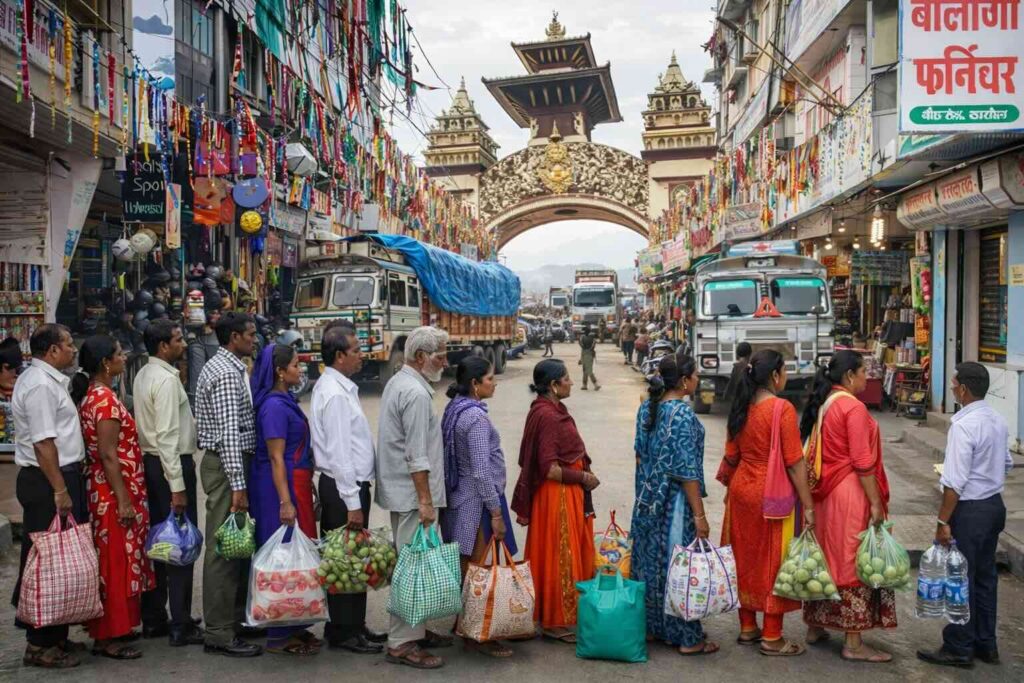
The news on Nepal’s NRs 100 customs crackdown has dominated headlines and social media across Nepal and India in recent days, centred on angry protests erupting along the southern border and in Kathmandu. Starting from Baisakh 1, 2083 (mid-April 2026, coinciding with the Nepali New Year), Nepal’s authorities — the Armed Police Force (APF), Nepal Police, and customs officials — have begun strictly enforcing customs duty on all personal goods valued over NRs 100 (roughly ₹60 INR) brought in from India. What was once a routine, informal practice for border residents — crossing for cheap daily essentials — is now triggering mandatory bag checks, public announcements via loudspeakers, on-the-spot duty payments (5–80% depending on the item), and seizures if unpaid. Even small, everyday purchases have become flashpoints: a few bottles of mineral water, a packet of sugar or oil, an extra pair of shoes, or some additional clothes tucked in a car boot can now lead to long queues, arguments with officials, repeated questioning, and unexpected financial hits. Critics and protesters rightly point out that this low threshold is creating far more harassment and hardship for ordinary poor people — low-income families, daily wagers, and small farmers in the Terai/Madhesh region — than it is curbing sophisticated smuggling networks. This ground-level frustration has fuelled demonstrations in Birgunj, other border towns, and even Kathmandu (Maitighar Mandala on April 18), with ruling-party MPs from Madhesh and Lumbini provinces demanding exemptions for genuine domestic-use items.
Ground Zero: Protests, Queues, and Daily Hassles
The NRs 100 customs crackdown measure is not a brand-new law. It is based on an existing provision in Nepal’s Customs Act, which was updated through a May 2025 gazette notification. What changed in mid-April 2026 is the sudden and rigorous enforcement under Prime Minister Balendra (Balen) Shah’s government. No exemptions are being granted — not for civilians, government employees, NGOs, or even small household items. Joint teams from the Armed Police Force, Nepal Police, and customs officials are now actively inspecting bags and vehicles at major border points such as Birgunj, Kakarbhitta, and Bhimdatta. This marks the end of decades-long informal exemption that had allowed unrestricted cross-border shopping for personal use. Protests broke out almost immediately in Birgunj and spread across the Terai. Madhesi youths demonstrated in Kathmandu on April 18, and a delegation of lawmakers met the Home Minister to press for revisions. The core grievance is practical: in today’s inflated prices, even basic items routinely exceed NRs 100. The policy is already causing real inconvenience and cost for poor border families who rely on cheaper Indian markets. On the Indian side, traders in Bihar (Jogbani, Motihari), Uttar Pradesh, and Uttarakhand report sharp drops in Nepali customers, hitting small shops especially hard during wedding season. Short-term pain is clearly visible on both sides of the open 1,700+ km border.
From Informal Lifeline to Strict Rule: The Backstory
The India-Nepal border has long been unique — open under the 1950 Treaty, with free movement of people and deep economic, cultural, and familial ties, especially in the Terai. Price differences made daily cross-border shopping a lifeline for millions. At the same time, Nepal has run a massive trade deficit with India (over Rs 567 billion in the first eight months of FY 2025/26 alone), much of it from consumer goods entering informally. The government has long complained about revenue leakage from small-scale “aggregation smuggling” (people making multiple trips with small loads that are later resold). Prime Minister Balen Shah’s administration (in office since late March 2026 after youth-led elections) is acting on its 100-point governance reform agenda. A high-level Central Revenue Leakage Control Committee meeting in early April explicitly flagged passenger-carried goods as a major drain. The drive fits Shah’s reformist, self-reliance-focused mandate: plug leaks quickly, promote domestic production, and deliver visible governance wins. It is classic protectionism timed with a new government’s early days.
Border Asymmetry: Why India but Not China?
Importantly, this strict personal-bag enforcement is almost exclusively targeted at the India land border. No equivalent loudspeaker announcements or routine checks at the NRs 100 level have been reported at Nepal-China border points (Rasuwa/Kerung or Tatopani) or at Tribhuvan International Airport for air passengers from China or third countries. Trade with China is overwhelmingly formal commercial cargo (electronics, machinery, clothing) handled under standard customs tariffs and full documentation. The porous, high-volume India border creates a unique informal-shopping loophole that simply does not exist to the same degree on the high-altitude China border. This practical asymmetry is why the crackdown looks India-specific. No credible evidence supports calling the policy anti-India. Official statements frame it purely as an internal revenue and self-reliance measure aimed at the biggest, most exploitable leakage point — the open southern border. Nepal has every sovereign right to enforce its own Customs Act, just as India does on its side. Diplomatic relations remain stable (PM Shah’s India visit is already on the calendar). That said, the visible asymmetry does invite criticism: it burdens communities tied to Indian markets while formal trade routes (including from China) face different scrutiny. A more uniform, tech-driven approach across all borders would reduce such perceptions.
The Real Leakage Problem: Corruption, Big Smugglers, and the Imbalance
It is well-documented that influential Nepali business networks, often with alleged high-level “settings,” have long smuggled higher-value items (automobile parts, medicines, bulk food, electronics, chemicals) through trucks, fake invoices, warehouses, and collusion with some APF and customs officials. In 2025, APF itself faced scrutiny for officer involvement in protecting such rackets; seizures in Parsa district alone ran into tens of millions of rupees. These large operators bypass duties entirely and sell at high margins in Nepali markets. The NRs 100 rule does little to touch these sophisticated channels. The policy explicitly aims to close the “small loads, multiple trips” loophole that feeds small-scale aggregation smuggling. It is the easiest, most visible tool available while deeper reforms (scanners, digital tracking, officer accountability) are rolled out. However, it hits ordinary daily shoppers far harder than the organised business-house networks. This is the central imbalance. The low threshold disproportionately harasses poor Terai families buying essentials while sophisticated rackets (trucks, fake paperwork, high-level connections) can adapt or continue. Local traders have openly suggested that resources would be better spent installing barriers at informal crossings and targeting organised routes rather than routine bag checks on individuals. Without parallel action against big players — raids, prosecutions, and accountability — the policy risks being seen as “punishing the poor while the big fish swim free.” The Balen Shah government’s own sweeping anti-corruption asset-probe panel (formed mid-April) offers an opportunity to address this gap.
True Objectives: Protecting Local Businesses or Catching the Big Fish?
There seems to be no hidden “ultimate aim” to catch big smugglers through this specific rule. The transparent goals are to discourage daily consumer imports from India, generate quick revenue, and give breathing room to Nepali producers and local business houses so they can sell more domestically. Local border traders have largely welcomed it, seeing potential sales gains. While broader anti-leakage efforts are underway, this measure functions as blunt protectionism for local industries rather than a surgical strike on organised smuggling networks.
Will It Harm Nepalis or Indians? How Will It Benefit Nepal?
Short-term harm: Yes — mainly to low-income Nepali border residents (higher costs, hassle) and small Indian traders (lost sales). Longer-term potential benefit for Nepal: Increased customs revenue, reduced trade deficit, stronger local industries, and greater self-reliance — but only if enforcement is paired with real anti-corruption action and practical exemptions for essentials. Economists are divided on whether the ultra-low threshold is sustainable on a porous border; protests may force quick tweaks.
Looking Ahead: Tweaks, Tests, and Long-Term Outcomes
The situation remains fluid. Exemptions for 10–15 daily household items are likely in the coming days or weeks to ease backlash. The policy tests Balen Shah’s reform credibility early. If the government follows through on its parallel anti-graft drive and invests in better border technology, it could deliver meaningful revenue and self-reliance gains. If not, it risks deepening resentment among the very poor communities it claims to serve. For now, the visible effect is greater hassle for ordinary people than a decisive blow against large-scale smuggling. This report synthesises the latest verified developments as of April 20, 2026. The open India-Nepal border has always been a lifeline as well as a leakage point; this policy is Nepal’s attempt to tilt the balance toward its domestic economy — with real short-term costs that deserve careful mitigation.