Ultimate Yogyakarta Travel Guide: Part 2 – Borobudur Temple
History, Travel Tips & Visitor Experience
Updated April 2026
Borobudur Temple stands as one of the most magnificent Buddhist monuments ever built — a colossal stone masterpiece
rising from the fertile Kedu Plain, about 40 km northwest of Yogyakarta (Jogja). Often framed by
the distant silhouettes of Mount Merapi and Mount Sumbing, this ancient structure continues to inspire awe with its
sheer scale, intricate carvings, and profound spiritual symbolism. Whether you’re a history enthusiast, spiritual
seeker, or first-time traveler from India, Borobudur delivers a deeply moving experience that lingers long after you
leave.
This is Part 2 of the Ultimate Yogyakarta Travel Guide series. While Part
1 gave you the complete planning blueprint for Jogja, here we dive deep into Borobudur
— its rich history, the mystery of its abandonment and rediscovery, practical 2026 travel tips, sunrise magic, and
my personal visitor experience.
Complete Series:
- Part 1: Overall Planning
- Part 2: Borobudur Temple (You are here)
- Part 3: Prambanan Temple – History, Travel Tips & Cultural Experience
- Part 4: Mount Merapi – Jeep Safari Adventure & Travel Guide
If you landed directly on this page, I strongly recommend reading Part 1: Overall
Planning first. It covers all the essential basics — how to reach Yogyakarta, best time to visit,
accommodation options, food recommendations (including vegetarian choices), suggested itinerary and number of days
needed, daily budget estimates, and other practical tips for Indian travellers. Start with Part 1
to get the complete big-picture planning for your Jogja trip.
First Impressions & Visitor Experience
The moment Borobudur comes into full view, the word that often escapes visitors is simply
“humongous.” I still remember my first visit back in 1993. As the early morning mist slowly lifted,
the massive stepped pyramid emerged like a stone mandala floating above the landscape. The air felt thick with quiet
reverence. Even after returning decades later, that same sense of wonder and humility returns every single time.
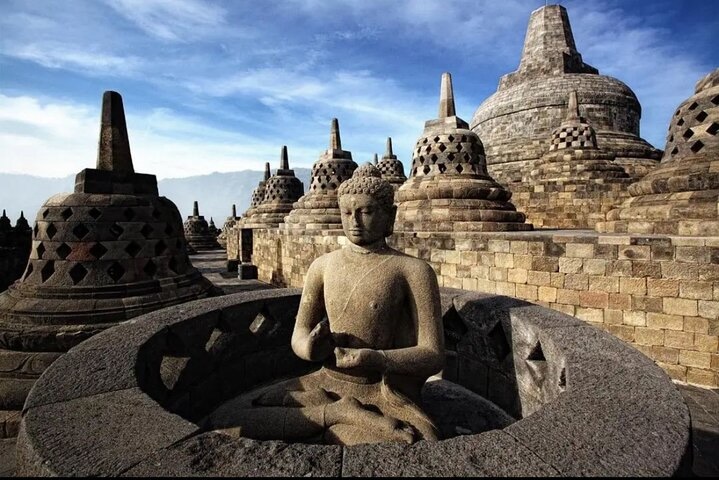
A sunrise visit is the most magical way to experience it. The first golden light touches the 72 perforated stupas
while mist swirls in the valley below. Walking clockwise (pradakshina) through the levels feels like a living
journey — ascending from the world of desire toward enlightenment. The temple invites slow exploration: pause at the
detailed bas-reliefs, sit quietly near a Buddha statue, and absorb the peaceful energy.
For health-conscious or slower-paced visitors:
- Walking from entrance to temple base: 500–700 metres
- Full circumambulation of all nine levels: approximately 1.96 km (~2 km)
- Total steps up and down: around 1,460
- Overall walking for a complete visit (ascent, exploration, descent): 4.5–6 km
Size & Scale of Borobudur
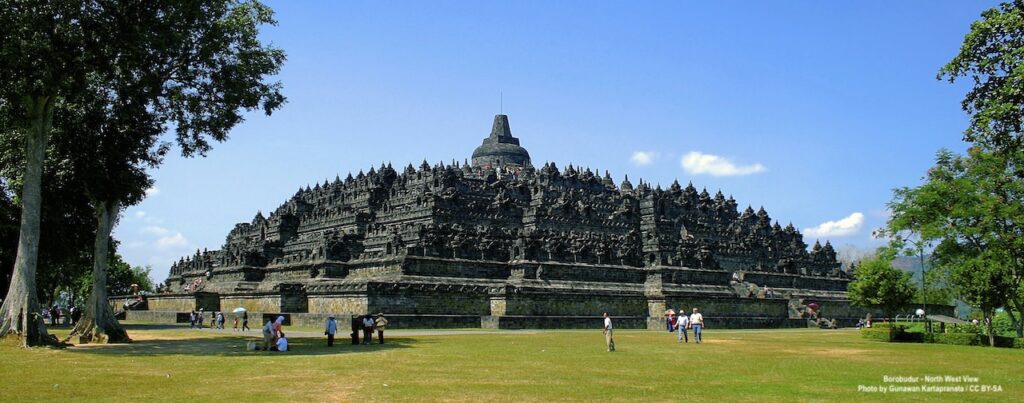
What strikes every visitor first is the sheer humongous size of Borobudur. The temple rises as a
massive step-pyramid structure with a square base measuring 123 metres × 123 metres (roughly 15,129
square metres or 1.5 hectares). It stands 35 metres tall from the ground to the top of the central
stupa.
The entire monument consists of nine stacked platforms — six square and three circular — built using over two million
interlocking volcanic stone blocks without mortar. The whole complex, including gardens, pathways, museums, and
surrounding buffer zone, spreads across approximately 85 hectares (about 210 acres), making it one
of the most imposing Buddhist monuments in the world.
History of Borobudur Temple
History of Borobudur Temple
The meaning of the name “Borobudur” remains uncertain, possibly derived from Sanskrit roots meaning “Complex of
Temples on the Hill,” or according to an inscription dating back to 842 CE, “Boro-budur” could mean
“Accumulation of Virtue in the Ten Stages of the Bodhisattvas.”
Although modern techniques have helped reveal much that was earlier unknown, a considerable amount of speculation and
mystification remains. Neither the name of the ruler who ordered its construction, nor the exact date of start or
completion, nor the duration of construction is certain. Scientific estimates vary between 80 and 200
years. The exact time and cause of its abandonment are also a mystery.
It is believed that the Buddhist sanctuary was ordered to be constructed around 750 CE by a powerful
ruler of the Shailendra Dynasty. However, around 929 CE, King Mpu Sindok moved the
capital of the Mataram Kingdom from Central Java to East Java, possibly due to volcanic eruptions from Mount Merapi,
floods, or political reasons. As a result, construction might have stopped and the region gradually became
depopulated. Several sources mention the period between 926 CE and 1006 CE as the
most likely time of early abandonment.
The timing of Borobudur’s final abandonment remains debated. While some link it to the
10th–11th century shift of power, others connect it to the spread of Islam. Islam
first appeared on the northern coast of Java in the 14th–15th centuries, but in the inland Central
Java region around Yogyakarta, widespread conversion happened mainly in the 15th and early 16th
centuries. Prominent Indonesian archaeologist Raden Soekmono suggested that the temple
was largely abandoned only after the local population converted to Islam in the 15th century.
Further, the monument is mentioned vaguely as “the vihara in Budur” in a text recorded as late as
1365 CE. Interestingly, Raden Soekmono, who researched Borobudur for his entire
life, stated that the temple’s abandonment occurred only after the local population was converted to Islam in the
15th century CE.
Irrespective of the period of abandonment, whether in the 11th century or the 15th century, the monument remained
unnoticed, overgrown by tropical vegetation and buried under volcanic ash for centuries. It was rediscovered
in 1814 CE during the brief British occupation of Java. Restoration efforts began in 1907 CE under
Dutch rule, followed by a major UNESCO project between 1973 and 1984 CE. In 1991, Borobudur was designated a UNESCO
World Heritage Site. Learn more about its World Heritage status here: https://whc.unesco.org/en/list/592/
The temple is structured as a representation of Buddhist cosmology with three main levels:
- Kamadhatu (the base) symbolises the world of desire and contains ~2,672 relief panels depicting
human suffering and daily life. - Rupadhatu (the middle terraces) represents the world of form and illustrates the life and
teachings of the Buddha. - Arupadhatu (the upper circular platforms) signifies the formless realm of enlightenment,
featuring 72 latticed stupas each containing a seated Buddha (originally 504 Buddha statues in total across the
monument).
Today, Borobudur remains not only a historical wonder but also an active Buddhist pilgrimage site drawing devotees
and tourists from around the world.7 r-qvutc0 r-poiln3″>Further, the monument is mentioned vaguely as “the vihara in Budur” in a text recorded as late as 1365 CE. Interestingly, Raden Soekmono, who researched Borobudur for his entire life, stated that the temple’s abandonment occurred only after the local population was converted to Islam in the 15th century CE.
- Kamadhatu (the base) symbolises the world of desire and contains ~2,672 relief panels depicting human suffering and daily life.
- Rupadhatu (the middle terraces) represents the world of form and illustrates the life and teachings of the Buddha.
- Arupadhatu (the upper circular platforms) signifies the formless realm of enlightenment, featuring 72 latticed stupas each containing a seated Buddha (originally 504 Buddha statues in total across the monument).
Practical Travel Tips (2026 Update)
How to Reach
Private car or driver is the most convenient option (round trip from Jogja ≈ IDR 400,000–600,000). Organised sunrise tours are popular and hassle-free.Opening Hours & Tickets
- Regular hours: 06:00 – 17:00 WIB
- Regular foreign tourist ticket: ≈ IDR 455,000 (includes access with timed guided climb sessions — daily quota applies).
- Sunrise ticket: ≈ IDR 1,000,000 (limited to roughly 100 people per day). Includes early entry (~04:30 AM), breakfast, and souvenir.
Booking Advice:
Sunrise slots have strict daily quotas and often sell out 3–4 weeks in advance during peak season (June–August). Book directly on the official portal: https://ticket.borobudurpark.com/en/Best Time & What to Carry:
May–October (dry season) for the best sunrise views. Wear modest clothing (shoulders and knees covered), comfortable walking shoes, hat, sunscreen, and a light jacket for cool mornings.Pro Tips & Common Mistakes to Avoid
- Book sunrise tickets well in advance — don’t rely on last-minute options.
- Start climbing early to enjoy the upper terraces before larger groups arrive.
- Respect the strict “no touching” rule inside the stupas — conservation efforts are rigorous.
- Hire a licensed guide for deeper understanding of the relief carvings.
- Combine with nearby Mendut Temple (just 3 km away) for a peaceful contrast.
- Pace yourself — the total walking distance is significant.
FAQ – Borobudur Temple
Q: What is the Borobudur ticket price in 2026 for foreign visitors? A: The regular entrance fee is approximately IDR 455,000. The sunrise ticket costs IDR 1,000,000 (limited quota, includes breakfast and souvenir). Q: How do I book Borobudur sunrise tickets? A: Book 3–4 weeks in advance during peak season directly via the official site: https://ticket.borobudurpark.com/en/. Quotas are strictly limited. Q: How much walking is involved at Borobudur? A: A full visit involves 4.5–6 km of walking and around 1,460 steps. Comfortable shoes and a relaxed pace are essential. Q: When is the best time to visit Borobudur? A: Sunrise during the dry season (May–October) offers the most magical experience with clear skies and fewer crowds on the upper levels. Q: Is Borobudur worth a full day in the Yogyakarta travel guide? A: Yes — it is the highlight for most travellers, combining stunning architecture, deep history, and a powerful spiritual atmosphere.Final Thoughts
Borobudur is far more than stones and stupas. It is a timeless lesson in devotion, resilience, and the human quest for meaning. Many visitors leave feeling calmer, more reflective, and profoundly moved by a monument that survived centuries of abandonment, volcanic ash, and time itself.Useful Official Links
- Official Tickets for Borobudur & Prambanan: https://ticket.borobudurpark.com/en/
- Borobudur UNESCO World Heritage Page: https://whc.unesco.org/en/list/592/
- Official Yogyakarta Tourism Information: https://visitingjogja.jogjaprov.go.id/en/