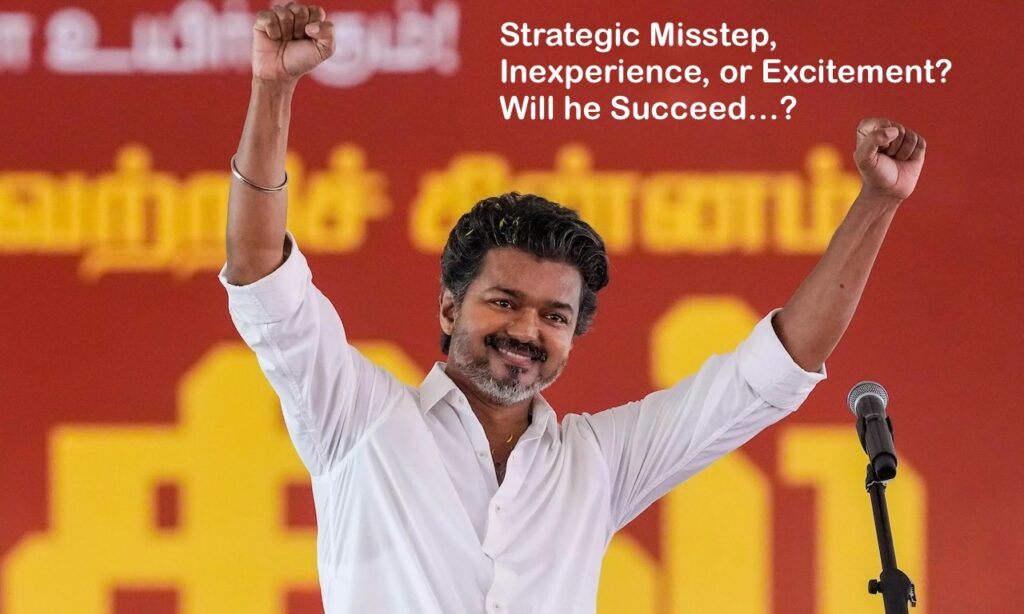
Tamil Nadu 2026 Elections: The Hung Assembly Standoff – A Strategic Misstep or Constitutional Overreach?
Tamil Nadu is witnessing its first-ever hung assembly after the April 2026 elections. With 234 seats and a majority threshold of 118, Tamilaga Vettri Kazhagam (TVK) emerged as the single-largest party with 108 seats – a stunning debut for actor-turned-politician Vijay. DMK secured 59, AIADMK 47, Congress 5, and smaller parties the rest. No single party or pre-poll alliance crossed the majority mark, triggering intense negotiations and a high-stakes constitutional drama at Raj Bhavan.
At the centre of the crisis is a clash between political strategy and constitutional convention. This analysis examines every key aspect of the ongoing standoff.
Strategic Choice, Inexperience, or Excitement? Why TVK Should Have Waited for the Governor to Invite Them
It was a blend of all three — strategic intent, raw inexperience, and the intoxicating rush of excitement — but the scales tip heavily toward the latter two.
TVK entered this hung assembly situation riding an extraordinary wave. As a party barely two years old, they had shattered Tamil Nadu’s decades-old Dravidian duopoly with 108 seats in their very first outing. That kind of debut naturally breeds euphoria. The leadership, many of whom come from cinema and fresh political backgrounds rather than the grinding world of legislative horse-trading, seemed eager to convert momentum into power immediately. The sudden offer of support from Congress felt like a golden bridge — something they grabbed publicly and took straight to Raj Bhavan.
This is where excitement and inexperience showed most clearly. A more battle-hardened team would have paused. They would have let the Governor make the first formal move by inviting them strictly as the single-largest party, as convention demands. That invitation would have bought precious time — days, even weeks — to negotiate quietly with VCK, the Left, independents, and others without revealing their exact shortfall. Instead, by proactively staking a claim that included Congress’s five seats, they walked in with a visible total of around 112–113. The numbers simply didn’t add up to 118, and the Governor seized that opening to demand airtight proof upfront.
There was, no doubt, some strategic thinking behind the move. Announcing the Congress alliance early helped lock that support before DMK could try to reclaim it. It also projected strength and momentum to smaller parties, hoping to trigger a bandwagon effect. In that sense, it wasn’t completely naive. Yet the execution carried the unmistakable mark of a young outfit still learning the subtleties of constitutional power plays. They underestimated how a cautious Governor could turn an incomplete claim into a procedural roadblock.
In Indian politics, especially in a hung house, patience often beats boldness. Veteran players know that once you present incomplete numbers at Raj Bhavan, you lose the protective cover of the “single-largest party gets first chance” convention. TVK’s core team, driven by the adrenaline of their historic mandate, appears to have prioritised speed over that caution.
Why “Single-Largest Party” vs. “Claimed Coalition” Matters – The Constitutional Distinction
This distinction lies at the heart of the current impasse.
Standard Indian convention — as laid down by the Sarkaria Commission, Punchhi Commission, and the Supreme Court in the landmark S.R. Bommai v. Union of India (1994) case — is clear: In a hung assembly, the Governor must first invite the single-largest party. The invited party then gets reasonable time to prove majority on the floor of the House through a vote of confidence. The floor test is considered the only truly democratic way to test numbers.
When a party instead approaches claiming a ready coalition, it changes the game. It signals to the Governor that a specific combination already exists. If those numbers fall short (as they did here), the Governor can insist on documentary proof of majority before granting any invitation or swearing-in. This effectively converts a political negotiation into a pre-invitation numbers test at Raj Bhavan, which many experts view as going beyond normal practice.
By presenting an incomplete support claim upfront, TVK inadvertently gave the Governor stronger grounds to demand solid proof immediately.
Current Ground Reality (as of May 8, 2026)
TVK has submitted letters from roughly 107–108 of its MLAs plus Congress support, reaching around 112–113. Governor Rajendra Vishwanath Arlekar has held firm: the requisite majority has not been established. He continues to insist on 118 signed letters before proceeding with any invitation. The previous Assembly has already been dissolved, and TVK is engaged in active, round-the-clock negotiations with VCK, CPI, CPM, IUML, and independents to close the gap. No Chief Minister has been sworn in yet, and backroom discussions remain intense.
Can Vijay Withdraw the Claim? The Risks Involved
Withdrawing the claim at this stage would be highly risky. It could easily be interpreted as an admission that TVK does not currently command majority support, potentially allowing the Governor to shift focus to the next claimant — most likely a DMK-led combination. Once a formal claim has been made and found deficient, resetting the process as a pure single-largest party request becomes difficult. Public perception could also turn negative, framing it as a retreat. For these reasons, withdrawal is widely considered a high-risk option that could open the door for other parties.
Is the Governor “Right”? The Expert Divide
The answer is debatable. Under Article 164, the Governor has discretion to satisfy himself that the claimant can command the confidence of the House. Given the shortfall in the numbers presented, his demand for proof is constitutionally defensible. However, several senior constitutional experts argue that this approach stretches beyond normal practice. The single-largest party should receive the first invitation, with the actual test of strength reserved for the floor of the Assembly, in line with Bommai precedent and commission recommendations. Legal opinion remains divided, but the weight of convention strongly favours giving the single-largest party an opportunity to prove itself in the House.
Court Option: Can TVK Approach the Supreme Court?
Yes — and reports confirm TVK is actively preparing to do so. They are consulting top constitutional lawyers for a potential Supreme Court petition. While courts cannot directly dictate the Governor’s discretion, they can direct an immediate floor test and examine whether the delay or conditions imposed are arbitrary. Precedents from several states show the Supreme Court stepping in quickly to order floor tests when hung assembly disputes drag on. A well-framed petition could argue for TVK’s right to be invited as the single-largest party and for the House — not Raj Bhavan — to decide the majority.
Political & Broader Implications
Smaller parties and independents have suddenly become king-makers. DMK and AIADMK are reportedly exploring ways to counter TVK, including possible post-poll understandings. The standoff highlights the tension between a strong popular mandate for a new party and traditional constitutional procedures. Prolonged deadlock risks public unrest, accusations of bias, or even President’s Rule under Article 356 — an outcome few want.
What Happens Next? Realistic Scenarios
The most probable path is that TVK secures the additional 5–6 letters in the coming days and returns to the Governor with 118 supporters. If deadlock persists, TVK is likely to move the Supreme Court seeking an urgent hearing and floor test. Withdrawal or invitation to another party remains a lower-probability but high-backlash scenario. In the extreme case, no resolution could lead to fresh elections.
Bottom line: TVK’s decision to approach the Governor with incomplete coalition numbers created a tactical challenge. However, their position as the clear single-largest party, combined with strong constitutional conventions and the possibility of judicial intervention, keeps viable paths open. The coming days will determine whether this results in a swift government formation or a longer constitutional battle. The ultimate test of strength still belongs on the floor of the Tamil Nadu Assembly.
Last updated: May 8, 2026 | Situation remains fluid.