Updated on May 09, 2026
Framing India: Western Gaze, Narrative Control, and the Politics of Portrayal Series – Part 3
Narratives of Convenience – Selling Suffering and Shaping Shame in the Global Media
From Mahmudiyah to Nirbhaya: Inside the Narrative Game
When we discuss sexual violence and impunity, few Indians can forget Nirbhaya — whose brutal gang rape and murder in December 2012 ignited nationwide protests, overhauled laws, and led to the rare execution of her attackers. Yet, how many of us know about the 2006 Mahmudiyah atrocity in Iraq, where American soldiers committed a similar gang rape and murders? For most, Mahmudiyah’s tragedy remains unseen, buried in the shadows of public memory.
Why bring up Mahmudiyah two decades later? Is it just a defensive ‘whataboutism’ to deflect Western criticism? These are valid questions that need honest answers. This is not to deny India’s ongoing struggle with gender violence — which demands fierce, independent reckoning. The real issue is why stories of suffering and shame are so unevenly told — skewed by global media, Western leaders, and sometimes our own press. Are warnings about safety in India about genuine concern, or part of a larger narrative game? As millions of Indians abroad absorb these stories, we must urgently examine who controls these narratives and the damage they inflict.
This is Part 3 of the Framing India series.
Connecting the Dots
In Part 1 we saw how Western cameras manufactured images of poverty. In Part 2 we saw how Slumdog Millionaire turned Indian hardship into cinematic spectacle. This part examines how the same gaze now operates in the coverage of sexual violence — selectively amplifying Indian tragedies while burying or sanitising similar crimes committed by Western actors.
A Forgotten Crime in Mahmudiyah
In March 2006, five U.S. soldiers in Iraq brutally gang-raped 14-year-old Abeer Qassim al-Janabi, murdered her and her family — including her 6-year-old sister — and burned her body to hide the crime. Many readers are learning this for the first time. This premeditated atrocity was carried out by state agents armed with weapons and tasked, purportedly, with spreading democracy.
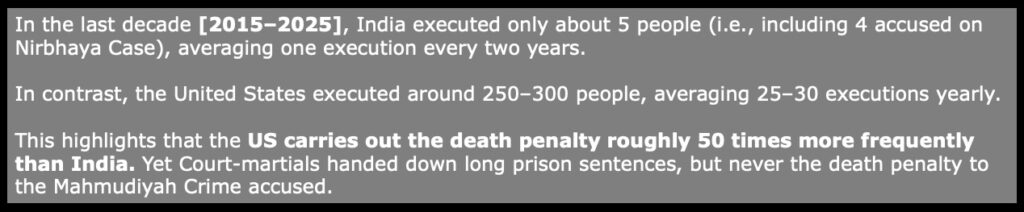
Yet in America — often called the “land of the free,” where the death penalty is more common than in India — none of the perpetrators were executed. Court-martials handed down long prison sentences, but never the death penalty. Western media barely covered the story: no global debates about American morality, no front-page outrage, no campaigns condemning U.S. soldiers or Americans broadly. The crime was framed as an isolated wartime failure, not a reflection of the nation. The Western conscience quickly moved on.
Meanwhile, India and its people faced a very different reality.
The Narrative Divide, The Politics of Shame – And Its Casualties
The world’s reaction to Nirbhaya’s 2012 gang rape and the 2015 BBC documentary India’s Daughter were both powerful — but fundamentally different in tone and impact.
When Nirbhaya’s assault hit headlines on December 17, 2012, the focus was on the appalling cruelty of the crime, the culture of impunity for sex offenders, and the groundswell of public outrage — the massive protests and escalating demands for legal reform captured the world’s attention.
Two years later, the BBC’s documentary revisited the tragedy but shifted the narrative. Instead of focusing on the crime, societal response, legal reforms and the death sentences, it went on to examine the cultural attitude of Indians that enable such violence — most notably through an unfiltered interview with convicted rapist Mukesh Singh. His shocking, unapologetic and misogynistic statements were presented as emblematic of Indian society — turning a horrific crime into a sweeping indictment of the entire Indian culture itself.
Although banned in India, the film aired internationally despite government protests. Global media quickly embraced its narrative, spawning op-eds and panel discussions that generalised its grim portrayal.
A young Indian studying abroad, after watching the film, posted on her social media “I feel ashamed… I feel no patriotism for the country I love. I’m scared to return to a place where rape is seen as a ‘lesson.’ I feel violated, angry, and sad. When will we get the justice we should never have had to demand?”
Her feelings were genuine — reflecting the fear and shame many young Indians, especially abroad, felt after seeing India’s Daughter.

Emotional Reactions Are Real — But Framed
The emotional responses triggered by India’s Daughter — ranging from outrage to shame — were genuine and valid, yet a direct consequence of how the story was framed. The film ignored the fact that this crime was among the “rarest of the rare” in Indian law. It overlooked the massive protests, swift legal reforms, and death sentences handed down by a fast-track court — outcomes rarely achieved even in the West for similar crimes.
Instead, the film gave disproportionate space to a convicted rapist’s unapologetic words, allowing his mindset to be interpreted as representative of Indian society at large. The absence of balancing voices — those of protestors, reformers, or even legal experts — made the narrative not just incomplete, but misleading.
What The Film Left Out — And Why It Matters
BBC’s documentary India’s Daughter was released in March 2015, more than two years after the crime, and nearly a year after the Delhi High Court upheld the death sentences for the convicts. By then, this was no longer an evolving story about a recent crime, but a concluded legal chapter — a fact the film should have emphasised.
Instead, it amplified the rapist’s voice as if it represented an entire society, causing international audiences to mistake one criminal’s mindset for the nation. This begs the question: Was the film meant to inform or to indict?
A Case in Contrast: Mahmudiyah, Iraq
Consider the 2006 Mahmudiyah rapes and murders by U.S. soldiers in Iraq. This wasn’t a crime of opportunity or chaos — it was premeditated. Soldiers planned for days to assault a 14-year-old girl, kill her entire family, and burn her body to cover their tracks. These were trained military personnel acting as agents of the state.
Despite this brutality — also “rarest of the rare” — not one perpetrator was executed, even though the U.S. frequently uses the death penalty, more so than India. Crucially, the narrative was shielded: there was no major documentary, no BBC or Netflix exposé, no global outrage demanding American moral reckoning. Mahmudiyah never became shorthand for American cultural decay.
If this had happened in India — say, in Kashmir or Manipur — global condemnation would have been swift and fierce. India’s institutions, culture, and human rights record would face relentless scrutiny.
Crime Is Universal — Narratives Are Not
All societies struggle with gender violence. The difference is how crimes are framed and amplified. India — vast and complex — is often boiled down to caricatures of a broken society. Meanwhile, similar or worse crimes in Western countries are portrayed as isolated tragedies, not reflections of a cultural flaw.
This selective framing upholds civilisational hierarchies. India is expected to wear its worst episodes as national identity, while the West preserves the privilege of exception.
Who Owns the Narrative?
Millions of Indians — at home and abroad — absorb international portrayals tinged with shame. But this shame isn’t always fact-based; it’s shaped by framing. Feelings like “I feel ashamed” or “I feel no patriotism” aren’t character flaws — they reveal how global media, like the BBC, can colonise the moral imagination of educated, mobile youth.
From Outrage to Opportunity
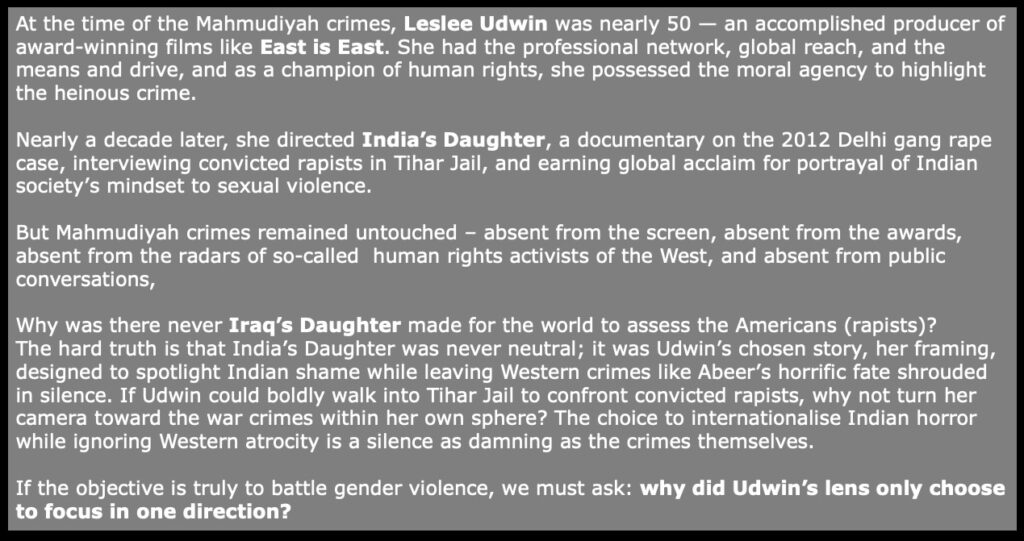
The question about India’s Daughter isn’t just why it was made — but who benefited. Whether driven by filmmaker Leslee Udwin’s pursuit of recognition or the BBC’s broader goals, the documentary was less a moral reckoning and more a calculated media opportunity.
When released in March 2015, India had already seen massive protests, broad legal reforms, and convictions. The producers knew that anything associated with “Nirbhaya” would guarantee maximum visibility, awards, and controversy. It delivered fame and acclaim for its creators. India was left with a lingering distorted global image.
Finally, Justice Needs Balance — In Courts and Cameras
Recent U.S. travel advisories, echoing statements from leaders like Trump, have once again portrayed India as particularly unsafe for foreigners — warnings influenced as much by old stereotypes as by recent headlines.
Similar atrocities have happened worldwide: from Abeer Qassim al-Janabi in Iraq to Anita Cobby in Australia, Junko Furuta in Japan, Peña and Ertman in the United States, and the Grooming Gangs scandal in the UK. Yet Western media have not shown the same moral passion exposing the misogyny behind these crimes as they did with India’s Daughter.
Only certain stories get to define a nation’s character. This asymmetry isn’t accidental — it’s editorial.
India, unlike many nations, has shown it can protest, reform, and ensure justice. What India now needs is narrative sovereignty — the right to be recognized not only for its flaws but also its resistance and progress. Not to deny pain, but to reject distortion. And to demand the world view India with the same fairness, balance, and accountability expected of itself.
It’s time to reclaim the lens.
Jai Hind.
Framing India: Western Gaze, Narrative Control, and the Politics of Portrayal Series Navigation:
Read Part 1 here → The BBC and the Origin of Exploitative Documentary Making
Continue to Part 2 here → Slumdog Millionaire Poverty Porn
You are reading Part 3 here on this page → India’s Daughter Nirbhaya & Media Double Standards
Continue to Part 4 here → BBC’s Fraught Relationship with India – Bans, Documentaries, and the Politics of Portrayal