Updated on May 06, 2026
India Fully Prepared for Agni-VI ICBM
DRDO Awaits Government Approval to Strengthen India’s Strategic Deterrence
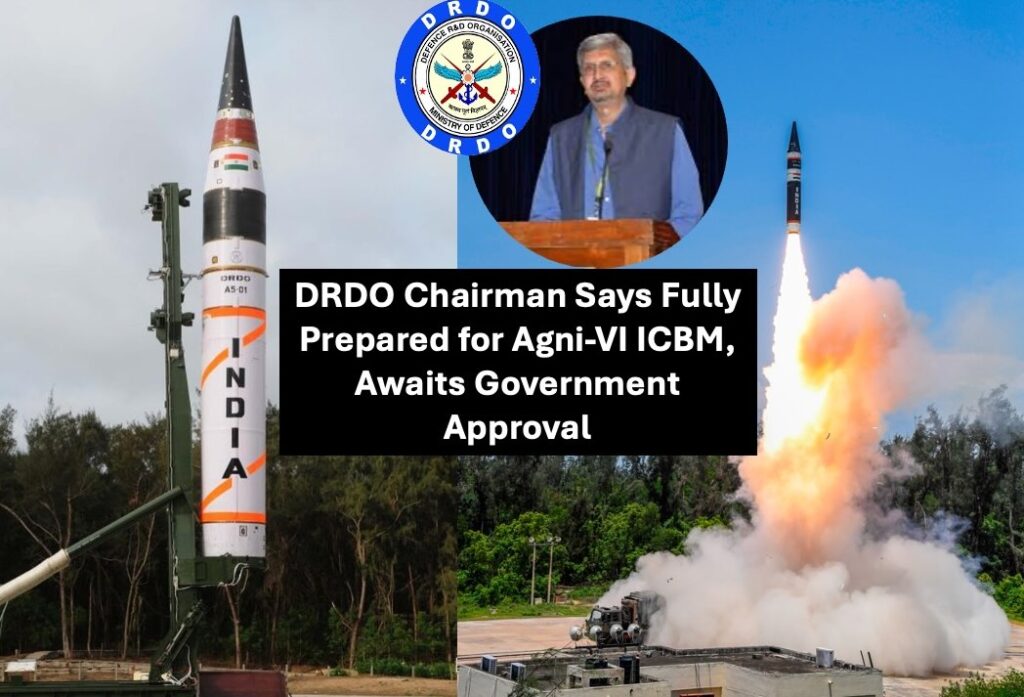
New Delhi, April 30, 2026 — In a significant update on India’s missile arsenal, Defence Research and Development Organisation (DRDO) Chairman Dr. Samir V. Kamat has confirmed that the organisation is “fully ready” to develop the next-generation Agni-VI intercontinental ballistic missile (ICBM), pending a formal decision from the Centre. Speaking at the ANI National Security Summit 2.0 here today, Dr. Kamat emphasised that the programme now hinges solely on government approval.
“It is the government’s decision. We are ready whenever the government gives us the go-ahead,” the DRDO chief stated, underscoring that all preparatory work, including design finalisation and technological groundwork, has been completed.
The Agni-VI is envisioned as a leap forward in India’s nuclear-capable missile series. Expected to feature a strike range of 10,000–12,000 km (with some estimates suggesting even greater reach), it would significantly outpace the Agni-V, which has an operational range exceeding 5,000 km. Sources indicate the Agni-VI could carry up to 10–11 Multiple Independently Targetable Re-entry Vehicles (MIRVs), enabling it to strike multiple targets simultaneously with a single launch — a capability India successfully demonstrated with the Agni-V’s “Divyastra” MIRV test in March 2024. The missile is also likely to support both land-based and submarine-launched variants, enhancing India’s second-strike credibility.
Evolution of the Agni Series: From Tactical to Strategic Powerhouse
The Agni family, named after the Sanskrit word for “fire,” forms the backbone of India’s land-based nuclear deterrence under the Strategic Forces Command. Developed indigenously by DRDO since the late 1980s, the series has progressively extended India’s reach:
- Agni-I & II: Short- to medium-range systems (700–3,000 km) for regional threats.
- Agni-III & IV: Intermediate-range missiles (3,000–4,000 km).
- Agni-V: India’s first true ICBM-class missile (over 5,000 km, with canisterised mobility for rapid deployment). It has undergone multiple successful user trials and now incorporates MIRV technology.
Also Read:
India Successfully Test Fires Nuclear-Capable Agni-5 Ballistic Missile Extending Strategic Reach
Plans for the Agni-VI were first publicly discussed as early as 2013 by former DRDO chiefs, who described it as a multi-stage, solid-fuelled system with enhanced payload capacity (up to 3 tonnes) and MIRV capability. Though the project has seen periodic delays due to policy and funding considerations, DRDO scientists have continued parallel research, including on related technologies like advanced re-entry vehicles and canister launch systems. A 2023 revelation by a DRDO scientist further highlighted ongoing work on the launcher design.
Dr. Kamat’s announcement today signals that the technological hurdles have largely been cleared, positioning Agni-VI as a potential game-changer in an era of multi-domain threats.
Summit Highlights: Hypersonic, Conventional Forces, and Future Readiness
The DRDO chairman’s remarks on Agni-VI came amid a broader discussion on India’s missile ecosystem at the ANI National Security Summit 2.0. He also provided updates on hypersonic programmes, revealing that the Long-Range Anti-Ship Missile (LR-AShM) hypersonic glide vehicle is at an advanced stage, with initial trials expected “fairly soon.”
India is pursuing two parallel hypersonic tracks:
- Hypersonic Glide Missile: Uses a booster for initial velocity, then glides unpowered at speeds exceeding Mach 5.
- Hypersonic Cruise Missile: Powered throughout flight by a scramjet engine.
“The glide missile will come out first… that is at a more advanced stage than the cruise missile,” Dr. Kamat noted.
Additionally, he outlined DRDO’s vision for a proposed multi-layered conventional missile force, echoing Defence Secretary Rajesh Kumar Singh’s earlier comments at the same summit. This force would include short-range ballistic missiles (such as the near-induction Pralay system), medium-range options (up to 2,000 km), cruise missiles, and hypersonic systems for tactical flexibility across land, sea, and air domains.
“Short-range systems like Pralay are in the final stages of testing… some of our strategic missiles can be converted for tactical usage,” Dr. Kamat added, highlighting the shift toward a diversified, atmanirbhar arsenal.
Strategic Significance in a Changing Geopolitical Landscape
The potential induction of Agni-VI would extend India’s nuclear reach well beyond current capabilities, covering vast swathes of Asia, Europe, and Africa if needed. In the context of rising tensions with China (which fields ICBMs like the DF-41 with MIRV) and Pakistan’s expanding arsenal, the missile would reinforce credible minimum deterrence and no-first-use policy.
Experts view it as more than a technical upgrade — it represents a policy signal of India’s growing confidence in its indigenous defence ecosystem. With successful tests of systems like Agni-Prime, the naval anti-ship missile salvo from a helicopter just yesterday, and rapid progress on hypersonic technologies, DRDO is delivering on Prime Minister Narendra Modi’s vision of self-reliance in critical technologies.
Government approval for Agni-VI could accelerate full-scale development, flight-testing, and eventual induction, potentially within the next few years. As India navigates an increasingly complex Indo-Pacific security environment, today’s statement from Dr. Kamat sends a clear message: the scientific foundation is ready; the strategic choice now rests with the political leadership.
(This news article is based on inputs from official statements and open-source defence analysis. All ranges and capabilities cited are based on publicly available DRDO and expert assessments; exact specifications remain classified.)