Understanding India-Nepal Relations: History, Culture, Ethnic Dynamics, and the Psychology of Asymmetry
India-Nepal ties represent one of the world’s most unique bilateral relationships: an open border, deep civilisational bonds through Hinduism and Buddhism, shared Gorkha military traditions, extensive people-to-people contact, and massive economic interdependence. Yet the relationship is often marked by friction, mistrust, nationalist rhetoric, and recurring disputes. Many Indians perceive Nepali attitudes as ungrateful or opportunistic ehsan-faramosh (forgetting favours) while many Nepalis view India as a domineering big brother threatening their sovereignty and identity.
Recent Incidents Concerning India-Nepal Relations
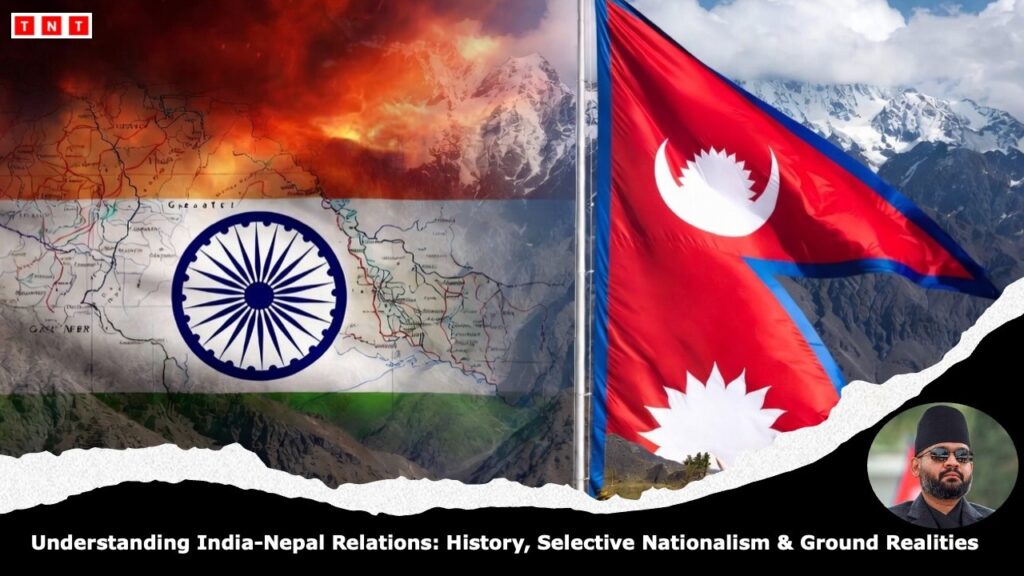
The core issue remains the Kalapani – Lipulekh – Limpiyadhura trijunction area. Nepal claims it based on the 1816 Sugauli Treaty (border along the Mahakali River), though the treaty is silent on the exact origin of the river. India administers the territory based on post-1950s maps, revenue records, and practical control, using Lipulekh for the Kailash Mansarovar Yatra and strategic connectivity.
Nepal updated its official map in 2020 to include these areas (~335 sq km). Balendra (Balen) Shah’s government, which rose through the Rastriya Swatantra Party and a Gen-Z surge, has strongly reiterated this claim, cautioning both India and China against using the route without consent.
Balen Shah has a history of assertive statements against India (and China/US) since his time as Kathmandu mayor, including film bans over perceived cultural slights. As Prime Minister, his government issued diplomatic notes on the Yatra route and he reportedly refused to meet Indian Foreign Secretary Vikram Misri, insisting on PM-level talks only. India has rejected Nepal’s claims as untenable.
This is not entirely new Nepal has raised Kalapani for years, especially after the 2015 blockade and the 2020 map update. However, Balen Shah’s prominence has amplified the issue amid Nepal’s internal political shifts.
Understanding the India-Nepal relationship requires going beyond surface-level diplomacy and examining its deep history, Nepal’s culture, and the mindset of its people. This article explores historical realities, ethnic dynamics, and recurring behavioural patterns that explain why ties between the two nations remain both deeply intertwined and persistently strained.
Historical Foundations (Mid-18th to Early 19th Century) of India-Nepal Relations
Modern Nepal emerged from the Gorkha expansion under Prithvi Narayan Shah (1723-1775). Starting as ruler of the small principality of Gorkha, he conquered the fragmented Malla kingdoms of the Kathmandu Valley and unified or absorbed dozens of hill principalities. He shifted the capital to Kathmandu and forged a centralised Himalayan state.
Prithvi Narayan Shah’s campaigns were ambitious and aggressive. Starting from the small principality of Gorkha, his forces expanded far beyond their original homeland, conquering Kumaon and Garhwal in the west (parts of present-day Uttarakhand) and pushing eastward toward Sikkim territories that had never been part of Nepal before the Gorkhali conquests. At its peak, the expanding Gorkha empire stretched from near the Sutlej River in the west to Sikkim in the east, significantly larger than present-day Nepal.
In his famous Divya Upadesh (Divine Counsel), Prithvi Narayan Shah described Nepal as a yam between two boulders referring to the Qing Empire of China to the north and the rising power to the south (initially the Mughals, and later the British East India Company). He advised maintaining cautious friendship with both, while particularly warning against the clever and expansionist southern neighbour of his time. This cautionary approach toward the southern power continues to deeply influence Nepali strategic thinking and nationalist discourse even today.
This Gorkhali expansion eventually collided with the rising British East India Company. The Anglo-Nepalese War (1814-1816) was hard-fought. Despite the impressive resistance and bravery displayed by the Gorkha forces, the British ultimately prevailed through their superior numbers, resources, logistics, and artillery. Nepal lost the war, and the conflict formally ended with the signing of the Treaty of Sugauli in 1816.
Nepal ceded territories west of the Kali (Mahakali) River, including Kumaon and Garhwal, claims in Sikkim and areas influencing Darjeeling, and parts of the Tarai. The treaty fixed Nepal’s western boundary along the Kali River, though the exact source of the river was not clearly defined the root of today’s dispute.
The decades following Sugauli saw pragmatic realpolitik. A pivotal moment came during the 1857 Indian Rebellion. Prime Minister Jung Bahadur Rana dispatched a large contingent of Nepali troops (reportedly 9,000-12,000) to support the British, participating in operations which assisted British forces in key operations, including actions in the Gorakhpur, Azamgarh, Jaunpur, and the recapture of Lucknow. Gorkha soldiers fought alongside British troops against the Indian freedom fighter (the so-called rebels). As a direct reward, the British signed the Nepal-Britain Treaty of 1860, restoring the western Tarai districts of Banke, Bardiya, Kailali, and Kanchanpur (Naya Muluk) to Nepal.
Selective History and Nationalist Hypocrisy
Nepali education and popular discourse heavily emphasise heroic resistance and victimhood. Prithvi Narayan Shah is glorified as a visionary unifier and defender of Himalayan Hindu identity. The Anglo-Nepalese War is taught as a saga of Gorkha bravery against overwhelming odds, while the Treaty of Sugauli (1816) is portrayed as a humiliating colonial robbery of legitimately conquered Nepali lands.
This selective narrative fuels Greater Nepal romanticism claiming Kumaon, Garhwal, Darjeeling, parts of Sikkim, and even some border areas of Uttar Pradesh as historically Nepali. The Kalapani-Lipulekh-Limpiyadhura dispute is presented not as a technical trijunction issue but as the last remnant of historical injustice, with India painted as the inheritor of British imperialism.
This version of history is deeply inconsistent.
If territorial claims are to be based on past conquests, why does the historical clock start only with the Gorkha expansions? Large parts of Nepal’s present-day Tarai, including Lumbini (Gautam Buddha’s birthplace), were under the Maurya Empire more than 2,300 years ago a far older and deeper connection than the brief period (roughly around 20-25 years) of Gorkha control Kumaon and Garhwal. Yet this is never used to argue that those Maurya’s period areas belong to India.
Even more glaring is the Nepali silence on the 1860 Treaty. The districts of Banke, Bardiya, Kailali, and Kanchanpur were returned to Nepal as a direct reward for supporting the British against Indian rebels in 1857. This territory, received as a prize for backing the colonial power, is quietly accepted as eternal Nepali land.
This is not objective history it is convenient, selective nationalism designed to nurture pride, victimhood, and sustained anti-India sentiment. Leaders like Balendra (Balen) Shah effectively tap into this sentiment. His strong assertions on sovereignty, protocol disputes, and the Kalapani issue resonate powerfully with Pahadi-urban nationalist constituencies.
Are There Balanced Nepali Historians?
While truly detached voices are rare in mainstream Nepali discourse, some balanced and critical academic works do exist on the margins.
Mahesh Chandra Regmi, Nepal’s most respected economic historian, moved beyond heroic biographies. In his works, particularly Imperial Gorkha: An Account of Gorkhali Rule in Kumaun (1791-1815), he examined the exploitative and extractive nature of Gorkhali rule, its heavy taxation, forced labour, and negative impact on conquered populations.
Kumar Pradhan’s seminal book The Gorkha Conquests: Process and Consequences of the Unification of Nepal (with special reference to eastern Nepal) provides a more critical analysis. He challenges the dominant national unification narrative and highlights the process as one of military conquest, domination, and its social-economic consequences on diverse communities.
Social and Ethnic Divides Shaping Attitudes
Nepal is not monolithic. Ethnic and regional differences strongly influence attitudes toward India-Nepal Relations:
Pahadi (Hill) Upper Castes and Newars: Bahun, Chhetri, and influential Newar communities have historically dominated the state and narrative. They shaped a hill-centric identity that emphasizes distinctiveness from India. This group often voices the strongest ideological anti-India sentiments including ‘dhoti’ slurs, distrust of Indian cunning, and occasional flag desecration incidents.
Madhesis (Terai Plains People): Culturally closer to Bihar and Uttar Pradesh, they maintain deep business and family ties with India. They tend to be more pragmatic, though they face discrimination from the Pahadi-dominated state.
Janajatis (Gurung, Magar, Tharu, etc.): Many have positive links with India through Gorkha recruitment, pensions, and employment. Border communities often maintain cordial daily relations.
While border areas remain functional due to interdependence, Kathmandu’s elite-driven politics and Pahadi-urban discourse largely shape the national narrative.
The Ehsan Faramosh Perception: Aid, Selective Gratitude, and Opportunism
In 1951, Nepal became the first country to receive Indian aid after Independence. India has been Nepal’s largest development partner, building much of its core infrastructure Tribhuvan International Airport, major highways, irrigation projects, hospitals, and universities. This support continued with massive post-2015 earthquake relief through Operation Maitri and over $1 billion in reconstruction assistance.
Nepal enjoys exceptional advantages:
Reliable and uninterrupted supply of petroleum products (fuel and LPG), even during global crises.
- A fully open border allowing visa-free travel, work, residence, and property rights.
- Preferential access to Indian higher education.
- Significant recruitment into the Indian Army (Gorkha regiments) with pensions.
- Transit facilities through Indian ports and strong trade links.
- Hundreds of thousands of Nepalis working freely across India and sending back substantial remittances.
Despite these deep, long-standing benefits, public acknowledgment from Nepali leaders and elites is often muted or absent in domestic politics. Gratitude tends to be short-lived, quickly giving way to new demands, complaints of big brother interference, or border assertions.
The 2015 informal blockade is remembered far more bitterly than the massive Indian aid that preceded and followed the earthquake.
This pattern stems from asymmetry psychology dependence on a much larger neighbour breeds resentment and humiliation combined with domestic politics where nationalism wins votes, elite incentives to hedge with China, and a historical lens that makes accepting Indian help feel subordinating.
Broader Realities and the Path Ahead
Civilisational ties – shared festivals, intermarriage, and pilgrimage – along with deep economic interdependence continue to act as ballast. However, the relationship has been strained by a fundamental mismatch: India long approached Nepal with sentimental brotherly expectations rooted in civilisational and religious affinity, while Nepal often responded with selective gratitude, opportunistic behaviour, and assertive nationalism.
India has shown considerable maturity by not repeatedly weaponising uncomfortable historical chapters, such as Nepal’s support to the British during the 1857 Rebellion. Yet this one-sided restraint has not been reciprocated. Nepal continues to aggressively promote selective narratives around the Sugauli Treaty and lost territories while conveniently forgetting the territorial gains it received in 1860 as a reward for that support.
Decades of generous aid, open-border facilities, and strategic accommodation have often produced entitlement rather than goodwill. The image of the big brother who gives but doesn’t discipline has eroded India’s leverage and reinforced the ehsan faramosh perception among many Indians.
The relationship must now be rebuilt on hard interests rather than emotions. India should adopt a more realistic and pragmatic policy based on:
- Principled firmness on core issues (border, security, water rights, and trade reciprocity);
- Quiet conditionality on aid and projects;
- Reduced dependence on Nepali goodwill and stronger parallel leverage (especially with Madhesis and Janajatis);
- Clear red lines instead of unlimited generosity.
Respect in such deeply asymmetric relationships usually comes from demonstrated strength and reciprocity, not endless accommodation. While generational shifts and global exposure may gradually moderate extreme narratives, Pahadi nationalism and selective education suggest that meaningful change will be slow in the near term.
True progress demands pragmatic realism from both sides: acknowledging Nepali concerns about sovereignty and identity, while recognising Indian frustrations with selective history, ingratitude, and inconsistent behaviour. Sustainable ties can only emerge when both nations deal with each other as mature, self-interested neighbours not through sentimentality or convenient nationalism.
References:
Reliable external links supporting the key arguments in the historians section:
Mahesh Chandra Regmi’s Imperial Gorkha: An Account of Gorkhali Rule in Kumaun (1791-1815)
Book Review (Academics by Sanjay Joshi, Northern Arizona University)
Wikipedia Profile of Mahesh Chandra Regmi (Overview of his critical approach)
Regmi highlights the exploitative and extractive nature of Gorkhali rule in conquered territories.
Kumar Pradhan’s The Gorkha Conquests: Process and Consequences of the Unification of Nepal
Pradhan challenges the romantic unification narrative and frames it more as military conquest and domination.
Also Read:
Treaty of Sugauli (1816): Nepal News , Wikipedia , Nepal Development (Full Text)
Nepal-Britain Treaty of 1860: Wikipedia