Framing India: Western Gaze, Narrative Control, and the Politics of Portrayal Series – Part 4
In previous parts of this series, we examined how Western media institutions – particularly the BBC, but also others from the US and UK such as CNN, The New York Times, The Washington Post, The Guardian, Reuters and many more – have shaped global perceptions of India through a narrow lens of poverty, chaos, and dysfunction. In recent years, this framing has expanded to include a critical focus on the country’s democratic choices, especially the rise of the right-wing, Hindu nationalist BJP under Prime Minister Narendra Modi. From exploitative documentaries during the post-colonial decades to Oscar-winning films like Slumdog Millionaire, these portrayals have consistently reinforced stereotypes rather than challenged them. In the 21st century, however, this cultural narrative conflict has taken on a more direct and overtly political character.
Connecting the Dots
In Part 1 we saw how BBC-style documentaries in the 1960s and 70s manufactured images of poverty in Varanasi. In Part 2 we saw how that same Western gaze turned Indian hardship into Oscar-winning poverty porn in Slumdog Millionaire. In Part 3 we examined the selective outrage over Nirbhaya versus the near-total silence on Mahmudiyah. This part looks at how the BBC’s own relationship with India has become a flashpoint — where documentaries, bans, and tax surveys are no longer just media stories but battles over narrative sovereignty and national dignity.
The relationship between India and the BBC, in past many years, is more than a historical critique – it is a flashpoint in a growing contest between national sovereignty and global media power. This editorial examines how specific BBC productions, legal confrontations, and editorial framing have not only strained diplomatic norms but also intensified debates around press freedom, foreign influence, and narrative responsibility.
Documentaries That Sparked Diplomatic Firestorms
India: The Modi Question (2023)
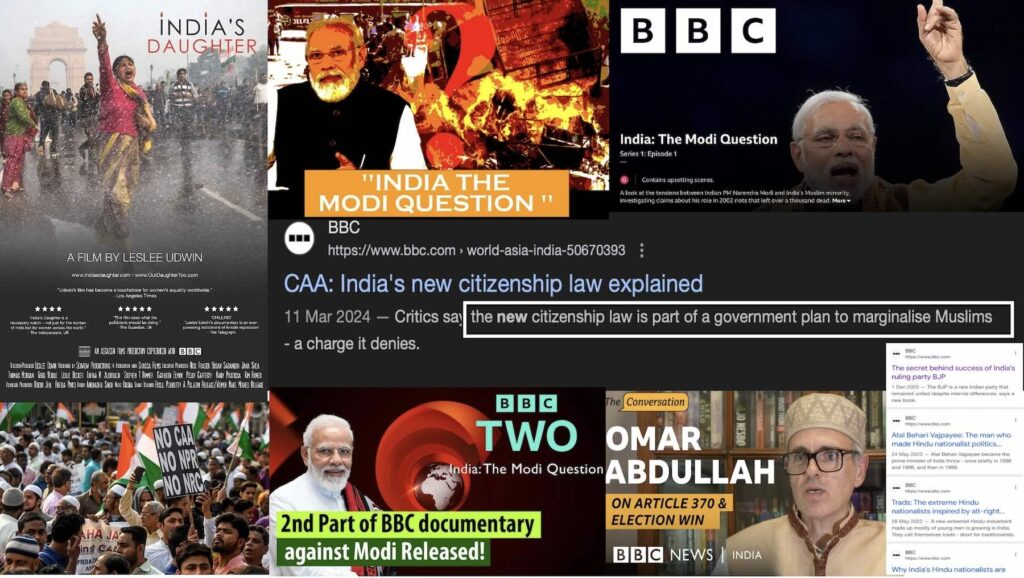
The most recent and high-profile example was the BBC’s two-part documentary India: The Modi Question, which revisited the 2002 Gujarat riots two decades after the incidents, and scrutinised Prime Minister Narendra Modi’s alleged role. The documentary, released in early 2023, was promptly blocked by the Indian government under the emergency provisions of the IT Rules, 2021, with the official statement labelling it a “propaganda piece with a colonial mindset” and the social media platforms were instructed to remove all links to the documentary.
Despite the ban, screenings were organised on a few university campuses and by political opposition groups, transforming the film from a piece of journalism into a symbol of defiance. While some argued this was a matter of transparency and public accountability, others criticised the timing, tone, selective approach and motive – questioning why a British broadcaster revisited a two-decade-old domestic issue at a politically sensitive time.
The documentary is a two-part series, with each episode running approximately 60 minutes, and was aired on BBC Two in January 2023 (Episode-1 on 17 January 2023 and Episode-2 on 24 January 2023).
Episode 1: Gujarat Riots, Godhra and Allegations Against Modi
While Episode 1 of the documentary focuses on Narendra Modi’s rise and the 2002 Gujarat riots, it also briefly references the incident that triggered the violence – the burning of the Sabarmati Express near Godhra on 27 February 2002, in which 59 Hindu pilgrims, including women and children returning from Ayodhya, were killed. In this part, the BBC does acknowledge the Godhra train burning. However, its choice to present the cause of the fire as “disputed” – despite multiple Indian judicial findings establishing that a Muslim mob had locked and set fire to the coach – contributes to a strong perception of editorial bias. BBC, rather than examining the full context of the incident or the severity of its violence, quickly shifts its focus to the state’s handling of the aftermath, especially Narendra Modi’s alleged inaction.
On this Indians felt that the BBC’s approach obscures the chain of events, beginning with the murder of Hindu pilgrims, minimises the culpability of the Muslim mob involved in a premeditated and brutal act, and elevates a politically charged narrative of systemic Hindu nationalism as the core takeaway.
This framing fits a broader pattern that has long been criticised in India that Western media institutions selectively apply moral outrage, often underplaying Islamist violence or complex socio-political contexts, while amplifying narratives that portray India as a majoritarian or intolerant democracy. The use of ambiguous terms like “disputed” to describe well-documented attacks, combined with a lack of equal emphasis on judicial and investigative outcomes, reinforces the view that Western reportage on India remains filtered through a postcolonial and ideologically oppositional lens – one that questions India’s democratic legitimacy when it doesn’t align with Western expectations.
A particularly controversial moment in Episode 1 is the presentation of a confidential UK diplomatic report that claims the 2002 Gujarat riots bore “all the hallmarks of ethnic cleansing.” This claim is followed by an interview with then–UK Foreign Secretary Jack Straw, who accuses Modi’s state government of having tacitly encouraged the violence. These statements were widely criticised in India as offensive, unsubstantiated, and diplomatically inappropriate raising the spectre of post-colonial judgementalism under the garb of investigative journalism.
For many in India, the reliance on a confidential, unilateral British report rather than findings of India’s Supreme Court-monitored Special Investigation Team (SIT), which found no prosecutable evidence against Modi, illustrated a troubling editorial bias. It suggested that the BBC, knowingly or otherwise, was privileging foreign perceptions over Indian legal outcomes, effectively reopening settled matters to retroactive global trial.
Episode 2: Article 370, CAA and the Politics of Post-2019 India
Episode 2 shifts focus to the post-2019 political landscape i.e., during Modi’s second term as Prime Minister and it covers three major developments: the abrogation of Article 370 and 35A, the Citizenship Amendment Act (CAA), and the 2020 Delhi riots.
The abrogation of Article 370 and 35A, which constitutionally ended the special status of Jammu & Kashmir, is portrayed in the documentary not as a legislative realignment or integration measure, but as a unilateral revocation of autonomy. The framing emphasises images of military deployment, communications blackouts, and house arrests of regional political leaders – conveying a sense of imposed political silencing rather than democratic restructuring. The term “revoked autonomy” is repeatedly used, instead of the more neutral and legally correct term “abrogation,” reinforcing a loss narrative.
No meaningful exploration is offered on the legal mechanics used to effect the change (i.e., Presidential Orders, Parliamentary endorsement), nor is any historical context provided about the temporary nature of Article 370, or the long-standing political debates within India regarding its repeal. The visual and editorial structure of this segment makes the viewer associate constitutional change with authoritarian suppression.
This editorial tone continues in the sections covering the Citizenship Amendment Act (CAA) and Delhi riots, where protest visuals dominate and government explanations are either minimised or cast in doubt. Protesters are positioned as principled defenders of democracy, while the state’s position – such as the legal logic behind CAA, or the communal trigger points in Delhi is either missing or insufficiently contextualised.
In the documentary India: The Modi Question (2023), BBC exemplifies a wider pattern of Western media’s selective outrage — where legislative acts passed through democratic institutions in India are framed as regressive, while the right of an elected government to pursue its policy mandate is treated as authoritarian overreach. This has led many observers to argue that the BBC, and by extension parts of the Western press, are less interested in reporting India’s political evolution than in narratively resisting the idea of an assertive, self-confident postcolonial nation charting its own course.
India’s Daughter (2015)
Another major controversy erupted with the BBC documentary India’s Daughter, directed by Leslee Udwin and produced for the BBC’s Storyville series. The film focused on the horrifying 2012 Delhi gang rape and murder of a 23 year-old paramedic student, an incident that shocked the nation and sparked nationwide protests. While the documentary claimed to highlight the entrenched patriarchy and violence against women in Indian society, it quickly drew fire for its editorial choices, most notably, for including an unfiltered and provocative interview with one of the convicted rapists, who showed no remorse and made deeply misogynistic remarks on camera.
The author criticises the government’s inability to enforce its own laws and protect its citizens from exploitation. The article also highlights the hypocrisy of the BBC’s portrayal of Indian society and its disregard for Indian cultural norms.
These chilling comments, broadcast globally, were seen by many not just as ethically irresponsible, but as dangerously platforming hate speech under the pretext of journalism. Critics argued that the interview sensationalised the crime, giving voice and visibility to a convicted rapist in a manner that bordered on the glorification of misogyny. Instead of focusing on the survivors’ stories, systemic reforms, or judicial progress made post-2012, the film’s emotional core was anchored in the rapist’s dehumanising narrative, allowing him to define the message and dominate the screen.
The Indian government pre-emptively banned the documentary, citing concerns over public disorder, ongoing legal appeals, and a potential violation of broadcasting norms. This triggered an international backlash, with Western media outlets and rights groups portraying the ban as an assault on press freedom and a repressive state’s discomfort with criticism.
But in India, the reaction was more nuanced. The debate was not merely about censorship, but about media ethics and narrative framing. Many questioned whether the BBC, under the guise of exposing social problems, was curating a spectacle for Western audiences—one that painted Indian men as inherently regressive and Indian society as uniquely broken. Critics pointed out that no comparable documentary had been made on systemic sexual violence in Western nations, where rape culture persists, albeit under different guises. Would the BBC have aired a similar documentary that gave extended screen time to a rapist in the UK or US, particularly one making inflammatory justifications?
By choosing to magnify a voice so grotesquely devoid of remorse and then releasing the documentary close to International Women’s Day, the BBC appeared to many Indians as performing outrage for Western moral satisfaction, rather than fostering meaningful change. The optics reinforced the very critique this series explores: that Western media applies selective moral outrage, highlighting India’s failures with dramatic urgency while ignoring similar or worse issues within its own borders.In this sense, India’s Daughter was not just a documentary, it became a cultural instrument that, intentionally or not, fit neatly into a long-standing pattern of Orientalist moral judgement, where India is framed as perpetually regressive and in need of Western validation, intervention, or rescue.
Broader Editorial Patterns: Kashmir, Protests, and Selective Amplification
Beyond documentaries, numerous BBC reports have drawn criticism for perceived editorial bias. Topics like Article 370 abrogation in Kashmir, the Citizenship Amendment Act (CAA) protests, the farmers’ agitation, and alleged human rights violations have often been presented with a tone of moral urgency, yet without sufficient legal, regional, or political context.
Critics argue that such coverage selectively amplifies dissent, often framing the Indian state as repressive while underplaying complexity or constitutionality. These portrayals risk reducing India’s democratic processes to simplistic binaries: protest equals moral virtue; enforcement equals authoritarianism.
Tax Raids and Compliance: A Legal Dispute or Political Message?
In February 2023, shortly after the broadcast of the India: The Modi Question documentary, India’s Income Tax Department conducted searches (referred to as “surveys”) at BBC offices in Delhi and Mumbai. The probe focused on alleged financial irregularities, including transfer pricing violations, unreported revenue, and other compliance issues.
The BBC acknowledged the scrutiny and admitted that “some financial compliance issues” were being addressed, while denying any deliberate wrongdoing. International media outlets and Western commentators quickly labelled the action “retaliatory,” framing it as an attack on press freedom. In contrast, the Indian government maintained that “no institution is above the law” and that the probe was a routine enforcement of tax regulations applicable to all entities operating in India.
This episode marked the beginning of a larger reckoning. The tax surveys were followed by further enforcement actions, including an Enforcement Directorate probe, eventually leading to a major restructuring of BBC’s operations in India. In 2024, to comply with India’s Foreign Direct Investment (FDI) rules in the news sector, the BBC split its Indian operations. While its English news-gathering remains directly controlled from London, all Indian-language services were transferred to an Indian-owned company called Collective Newsroom, in which BBC holds only a 26% minority stake.
What was once a fully foreign-controlled news operation is now operating under a hybrid model — largely managed through an Indian agency structure. For many Indians, this outcome symbolises a long-overdue assertion of national sovereignty: foreign media houses can no longer operate with the same unchecked influence they once enjoyed.
Shifting Perceptions: Revered Broadcaster or Ideological Holdout?
Traditionally, the BBC enjoyed high regard in India, particularly for its rural and development reporting, and its widely consumed Hindi services. Academics, diplomats, and international policy professionals often turned to BBC coverage for nuanced understanding of South Asia.
But that trust has eroded among large sections of India’s public, particularly those aligned with nationalistic, centre-right, or pro-development narratives. The BBC has been increasingly labelled as “anti-India” or “anti-Hindu” in public discourse, accused of showcasing Indian issues with disproportionate scrutiny while ignoring similar or worse conditions in the West.
Terms like colonial hangover, neo-imperial lens, and outsider framing have come to define the criticism—accusations the BBC strongly denies, asserting its editorial independence and journalistic integrity.
Two Sides of the Narrative War
Civil liberties groups and opposition figures, however, see the government’s pushback as part of a broader pattern of media suppression. They cite declining press freedom indices, increasing censorship, and institutional pressure on independent or foreign-funded media.
Thus, two sharply different narratives have emerged:
One sees BBC scrutiny as vital journalism and any government response as authoritarian.
The other sees such coverage as biased, agenda-driven, and disrespectful of Indian legal frameworks and sovereignty.
Finally, Sovereignty Meets Scrutiny
At the core of this tension lies a larger philosophical dilemma: can foreign media institutions claim the right to moralise about rising nations while retaining immunity from criticism themselves? As India asserts its global identity, it naturally demands narrative parity—not deference, but fairness.
The BBC’s relationship with India today is a microcosm of a changing world order. As post-colonial states reclaim narrative control, legacy institutions from the Global North are being asked—sometimes for the first time — to justify their gaze.
Open critique is essential to democracy. But critique without context, sensitivity, or mutual respect risks becoming ideological theatre. The way forward lies not in bans or boycotts, but in building a media ecosystem where truth, sovereignty, and journalistic integrity can coexist—without one consistently undermining the other.
It’s time to reclaim the lens.
Jai Hind.
Framing India: Western Gaze, Narrative Control, and the Politics of Portrayal Series Navigation:
Read Part 1 here → The BBC and the Origin of Exploitative Documentary Making
Continue to Part 2 here → Slumdog Millionaire Poverty Porn
Continue to Part 3 here → India’s Daughter Nirbhaya & Media Double Standards
You are reading Part 4 here on this page → BBC’s Fraught Relationship with India – Bans, Documentaries, and the Politics of Portrayal