Shifting Blame: How Mainstream Media’s Silence Dilutes Accountability for the U.S. Gulf of Oman Attack That Claimed Three Indian Lives
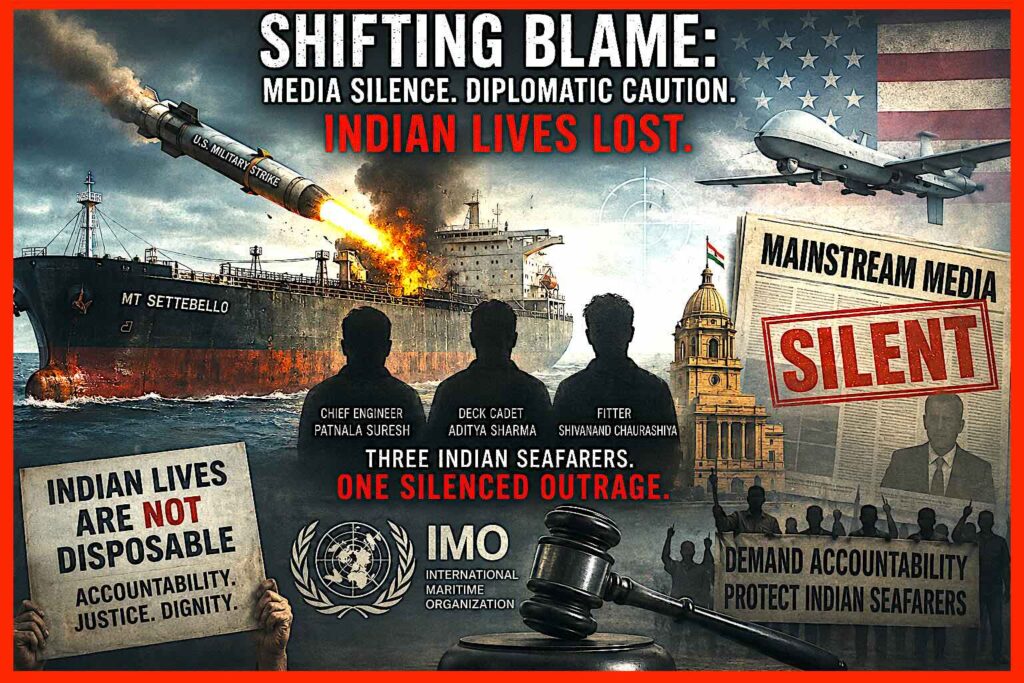
The strategic waters of the Gulf of Oman have just borne witness to a profound human tragedy. Following selected, targeted U.S. military strikes aimed at enforcing a naval blockade on commercial tankers, three Indian seafarers: Chief Engineer Patnala Suresh, Deck Cadet Aditya Sharma, and Fitter Shivanand Chaurashiya, have lost their lives aboard the MT Settebello.
In the wake of this disaster, deep failures have unfolded at home. We see a striking silence from mainstream Indian media, coupled with a highly calculated, risk-averse diplomatic response from New Delhi. Despite the gravity of the event, the response stops short of demanding true international accountability.
While the Ministry of External Affairs (MEA) unusually twice summoned U.S. Chargé d’Affaires Jason Meeks to lodge standard bureaucratic “strong protests”, this quiet diplomacy feels profoundly inadequate against the deployment of lethal missile fire on civilian maritime workers.
The government’s response has drawn sharp criticism.
External Affairs Minister S. Jaishankar’s phone call to U.S. Secretary of State Marco Rubio, where he merely stated that such lethal actions are “not justified,” has been viewed by critics as unacceptable and defensive. It treats the violent deaths of Indian citizens as a sensitive geopolitical balancing act rather than a grave loss of Indian civilian life.
Similarly, New Delhi’s muted stance at the United Nations, which avoided naming the U.S. directly while speaking broadly about safety in the Strait of Hormuz, has failed to match the gravity of the situation. By handling the crisis with excessive diplomatic caution, official policy has arguably fallen short.
This passivity has been actively enabled by our premier newsrooms. Rather than rigorously scrutinising the incident, mainstream networks have largely parroted Western blockade narratives to sanitise the incident. It appears as if the mainstream media is actively managing public perception to shield long-term diplomatic flexibility from short-term emotional escalations, effectively diffusing legitimate public anger.
The Hypocrisy of Selective Prime-Time Outrage
The restraint shown by Indian mainstream media in this instance is not objective journalism; it is an editorial choice to cushion a geopolitical reality. This is the very same media landscape that routinely transforms domestic legal cases into multi-week, high-decibel circus trials to capture ratings.
Consider the massive, breathless media frenzy surrounding the tragic Twisha Sharma death case in Bhopal. For weeks, television anchors have conducted hyper-aggressive, 24/7 parallel investigations, tracking every minute detail from CBI court custody orders to unsigned police seizure memos.
Why does a domestic tragedy spark a ferocious media crusade for justice, while the violent deaths of three Indian citizens on the high seas are relegated to the footnotes of the evening scroll?
Where are the prime-time debates questioning the legality of using Hellfire missiles against civilian maritime workers?
Why has no major news network aggressively demanded independent maritime logs, radio transcripts, or accountability from international actors?
By downplaying the raw grief of the victims’ families and over-emphasising the technicalities of the U.S. blockade, major news outlets are effectively diluting legitimate public outrage. They are shifting the focus to “why the ships were there in the high-risk zone” instead of asking “why Indian citizens are dying in foreign military crossfire”.
A Pattern of Executive Excess and Diplomatic Failure
The failure, however, does not end at the newsroom desk.
While independent voices and maritime unions are left alone to demand answers, prominent journalist Rahul Shivshankar, former Editor-in-Chief of TIMES NOW, sharply highlighted the systemic ineffectuality of the current policy. Writing for News18, Shivshankar pointed out that international maritime law strictly restricts the unilateral obstruction of strategic straits, making the deployment of lethal military force against civilian shipping highly illegal under global norms. The core of the problem, as he argues, is that while the U.S. actions are a flagrant violation, New Delhi has completely failed to effectively press this legal argument at the highest diplomatic levels. Rahul Shivshankar wrote on X:
“While the US under Trump may be in contempt of the spirit of international law, the point is that the law needs to be read persuasively to the United States at the highest diplomatic level. Unfortunately, this is where Delhi appears to have arguably fallen short.”
By allowing a Trump-led unilateral naval blockade to act as “judge, jury, and executioner” just off the coast of Oman, New Delhi has shown a dangerous deference. Firing precision munitions directly into the engine room of the Palau-flagged MT Settebello vaporised defenceless Indian crews. It is a terrifying sign of the times when Indian casualties in a foreign war zone approach the figures of nations actually fighting the war, yet our government responds with nothing more than mere formalities.
The Demands Ahead: Pragmatic Next Steps
A nation’s foreign policy cannot survive on caution alone.
If U.S. federal agencies can aggressively indict Indian business tycoons, arrest nationals on foreign soil for alleged assassination conspiracies, and strategically leak charges implicating high-profile Indian officials, all while seamlessly continuing high-level diplomacy, Quad summits, defence equipment deals, and bilateral trade talks, there is no logical reason for New Delhi to treat the relationship with such fragile, asymmetric deference. A truly self-reliant India must mirror this exact standard of cold realpolitik, proving that strategic partnerships do not require sacrificing the backbone to hold Washington fiercely and publicly accountable when innocent Indian citizens are killed by the U.S. military.
To protect the 300,000 Indian seafarers navigating global choke points, New Delhi must replace submissive diplomatic demarches with an active, unyielding defence of its citizens through a multi-layered counter-strategy:
Forced Multilateral Accountability: Demand a formal, independent investigation via the International Maritime Organisation (IMO) to review the legality and proportionality of using lethal military strikes against unarmed civilian merchant ships.
Active Security Interventions: Increase the Indian Naval presence in the Gulf of Oman for dedicated escort duties, ensuring Indian-crewed or Indian-interest vessels are not left vulnerable to foreign unilateral aggression.
Uncompromising Legal & Family Support: File a direct, formal state complaint at the IMO, forcing a global precedent that treats lethal strikes on civilian crews as war crimes and ensure immediate, comprehensive compensation for the victims’ families.
The Bottom Line
New Delhi’s diplomatic machinery cannot continue treating the violent deaths of its citizens as an inconvenient geopolitical balancing act. Standard bureaucratic complaints are entirely hollow if they are not backed by domestic resolve.
If renowned mainstream Indian media networks can cross oceans of ethical boundaries to run sensationalised domestic media trials, they have no excuse for looking away when Indian seafarers are returned home in body bags. The lives of our mariners are non-negotiable. It is time both our premier newsrooms and our foreign policymakers started acting like they believe it.
Also Read:
Twisha Sharma Case: Critical Questions the Media Has Not Asked
The Irony of “CBI Revelations”: When Crime Journalism Turns Questions into Conclusions