Updated on May 06, 2026
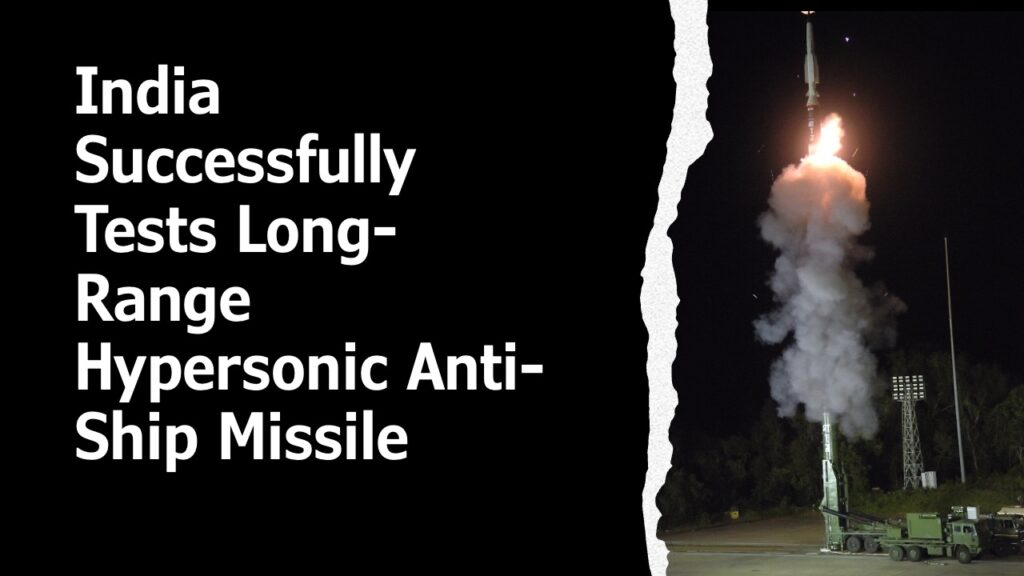
India Successfully Tests Long-Range Hypersonic Anti-Ship Missile Off Odisha Coast, Marking Major Leap in Naval Strike Capability
Chandipur/ New Delhi, May 3, 2026 — In a significant boost to India’s maritime defence and self-reliance in advanced weaponry, the Defence Research and Development Organisation (DRDO) has successfully conducted a Phase-II flight test of the indigenous Long-Range Hypersonic Anti-Ship Missile (LRAShM), a hypersonic boost-glide weapon designed primarily for the Indian Navy. The test took place on May 1, 2026 (Friday), from a defence facility off the Odisha coast in the Bay of Bengal, near the Integrated Test Range (ITR) at Dr. APJ Abdul Kalam Island/Chandipur.
The missile accurately struck a simulated sea-borne target at its maximum demonstrated range of 1,500 km, achieving a “perfect score” across all mission parameters, including mid-course manoeuvres, sustained hypersonic flight, terminal precision guidance, and evasion capabilities. A Notice to Airmen (NOTAM) had earlier declared a restricted zone extending up to 1,680 km in the Bay of Bengal for May 1–3, aligning precisely with the test window.
Technical Details of the LRAShM
The Long-Range Hypersonic Anti-Ship Missile is a two-stage, solid-propellant boost-glide hypersonic missile. It uses a solid rocket booster (derived from proven technologies such as the BO-5 submarine-launched ballistic missile) to accelerate the weapon to hypersonic velocities. After booster burnout, the unpowered hypersonic glide vehicle (HGV) separates and follows a quasi-ballistic trajectory with multiple low-altitude “skips” and high-speed manoeuvres, making it extremely difficult for enemy radars and air-defence systems to detect or intercept.
Key Performance Parameters of India’s LRAShM
Range: Over 1,500 km (tested to maximum range in this trial).
Speed: Peaks at Mach 10 during boost phase; sustains average Mach 5+ during glide with evasive manoeuvres.
Dimensions: Approximately 13 metres long, 1.4 metres in diameter, weighing around 12 tonnes.
Launch Platform: Road-mobile Transporter Erector Launcher (TEL) for coastal battery deployment.
Guidance: Inertial Navigation System (INS) + GNSS for mid-course; indigenous active radar homing (ARH) seeker with over 50 km range in the terminal phase (protected by a jettison-able carbon-silicon carbide heat shield).
Warhead: Conventional, multi-configurable payload for engaging both static and moving naval targets, including aircraft carriers and high-value surface combatants.
The missile was developed by DRDO’s Advanced Systems Laboratory (ASL) in Hyderabad under Project Director A. Prasad Goud. It leverages proven Indian technologies, including BrahMos guidance packages, to accelerate development.
This was the third known major test of the system, following earlier trials in 2023 and November 2024. The LRAShM made its public debut during the Republic Day Parade on January 26, 2026.
No formal press release has been issued by the DRDO or Press Information Bureau (PIB) on this specific test as of May 3. Details have emerged from credible defence sources quoted by major Indian media outlets.
How LRAShM Fits Into India’s Anti-Ship Missile Arsenal
India already fields one of Asia’s most potent anti-ship missile inventories, but the LRAShM introduces a new hypersonic layer:
BrahMos (Supersonic Cruise Missile): The operational workhorse. Joint Indo-Russian development. Speeds of Mach 3+, ranges from 290 km (standard) to 600 km (Extended Range variant). Deployed across ship, submarine, aircraft (Su-30MKI), and land platforms. Highly accurate, sea-skimming, and in active service with the Indian Navy, Army, and Air Force. Multiple upgraded blocks are in production and export.
BrahMos-II (Hypersonic Cruise Missile): Under joint development with Russia. Scramjet-powered (sustained powered hypersonic flight). Expected maiden flight tests in 2027–28. Lighter and more versatile than current BrahMos; targeted for multiple platforms. Still in advanced development phase with indigenous scramjet breakthroughs accelerating progress.
Other Systems: Short-range naval anti-ship missiles (e.g., NASM-SR, recently tested in salvo mode in April 2026) and quasi-ballistic options like Pralay provide layered defence. Separate DRDO hypersonic programmes such as Dhvani (glide vehicle) and ET-LDHCM (cruise) are progressing toward 2029–30 induction.
The LRAShM stands out as India’s first operational-ready indigenous hypersonic boost-glide anti-ship weapon, focused on long-range, high-speed strikes against moving naval targets while remaining virtually undetectable during most of its flight.
Expected Timeline for Induction
DRDO and the Indian Navy are on an accelerated path:
- Limited serial production has already begun or is entering the next phase following design reviews and flight validation.
- Full operationalisation and induction into Western and Eastern Naval Fleets targeted for 2028.
- Initial operational capability for the Indian Navy expected by 2029.
Further user trials and integration with coastal defence batteries are expected in the coming months, with potential future adaptations for air and submarine launch platforms.
Strategic Significance
This Long-Range Hypersonic Anti-Ship Missile test dramatically enhances India’s anti-access/area-denial (A2/AD) capabilities in the Indian Ocean Region. The LRAShM can neutralise high-value enemy naval assets — including aircraft carriers — at extended ranges with near-impossible-to-intercept speed and manoeuvrability. It aligns with Prime Minister Narendra Modi’s vision of Atmanirbhar Bharat in defence and strengthens deterrence amid evolving maritime challenges.
Defence analysts describe the development as India entering the “elite hypersonic club” with a pragmatic, cost-effective system built on proven domestic technologies. More tests and production scaling are anticipated as the system moves toward frontline deployment.
Tattvam News Today will continue to monitor official updates from DRDO and the Ministry of Defence. This successful trial underscores India’s growing prowess in next-generation hypersonic weaponry and its resolve to safeguard maritime interests.
Also Read:
India Unveils Indigenous Hypersonic Anti-Ship Missile at Republic Day Parade
Why India Chose BrahMos Over ASBMs: The Doctrine Behind New Delhi’s Missile Logic