Updated on May 06, 2026
The Dowry Dilemma: When Protection Becomes Legal Terrorism
Dowry occupies a deeply complicated place in Indian society. For many families (new couples), it began as a form of voluntary support — gifts, financial help, or assets intended to help a young couple establish a stable life, share wedding expenses, or ease the groom’s burdens. In the world of arranged marriages, where families negotiate matches based on horoscopes, status, and compatibility, a fixed, transparent, one-time contribution can appear as practical goodwill rather than exploitation, particularly when both sides agree and the bride’s family can afford it without hardship.
Yet this practice has long since mutated into something far darker. Coercive demands, relentless harassment, and “dowry deaths” continue to scar the nation. NCRB data for 2023 (still widely referenced in early 2026) recorded a 14 per cent rise in cases with over 6,100 deaths, underscoring that the evil persists despite decades of legislation.
The One-Sided Trap and Dowry Laws Terrorism
The good intentions behind the Dowry Laws: Prohibition Act of 1961 and Section 498A (now Section 85 of the Bharatiya Nyaya Sanhita) have produced devastating unintended consequences. The provisions are heavily one-sided by design, reflecting the historical pattern of violence against brides. In practice, they have become dangerously easy to weaponise in matrimonial disputes. False or exaggerated complaints trigger immediate police action, arrests that frequently sweep in the entire husband’s family, and trials that stretch across years. Conviction rates remain abysmally low — often in the 11-17 per cent range nationally, with local studies revealing even starker figures and nearly half the cases quashed by higher courts. The Supreme Court has repeatedly condemned this misuse, describing how Section 498A is deployed as a tool for “personal vendetta,” extortion, or retaliation after marital discord.
This is legal terrorism in all but name. In arranged marriage realities, the asymmetry is particularly cruel. The bride’s side sometimes resorts to outright deception — faking ages or birth charts to match the groom’s kundali, concealing health conditions, or misrepresenting facts that the groom’s family would never have accepted. Once the marriage is solemnised and the truth emerges, any attempt by the groom’s side to seek annulment or divorce on grounds of fraud (a valid remedy under Section 12(1)(c) of the Hindu Marriage Act) risks immediate retaliation through a dowry harassment complaint. The dowry laws’ procedural power — cognizable and non-bailable — gives one side overwhelming leverage, while the other is forced into slow, expensive civil remedies.
The Human Cost: Ruined Lives and Irreversible Damage
The human toll is heartbreaking precisely because justice moves at a glacial pace. A single case can drag from District Court to Sessions, High Court, and Supreme Court over 10 to 15 years. Even when the complaint is eventually quashed or ends in acquittal, the damage is irreversible. Families endure months or years of legal battles, lost livelihoods, financial ruin, destroyed reputations, fractured relationships, and profound mental trauma. Social ostracism begins the moment an FIR is filed. Friends vanish, marriage prospects for siblings are ruined, and pride is shattered. For many innocent men and their families, “winning” years later feels hollow — the best years of their lives have already been drained.
Is There Any Relief?
Recent Supreme Court interventions between 2024 and 2026 have offered some limited hope. Judgments such as Shivangi Bansal v. Sahib Bansal (July 2025) and others have seen the Court quash clearly false cases more readily when fraud or misuse is evident, stress the need for specific rather than vague or omnibus allegations, and in extreme situations invoke Article 142 to dissolve marriages and end the nightmare. Yet such relief still requires reaching the higher courts, a process that demands years and significant financial resources. Most affected families never make it that far.
Urgent Reforms Needed
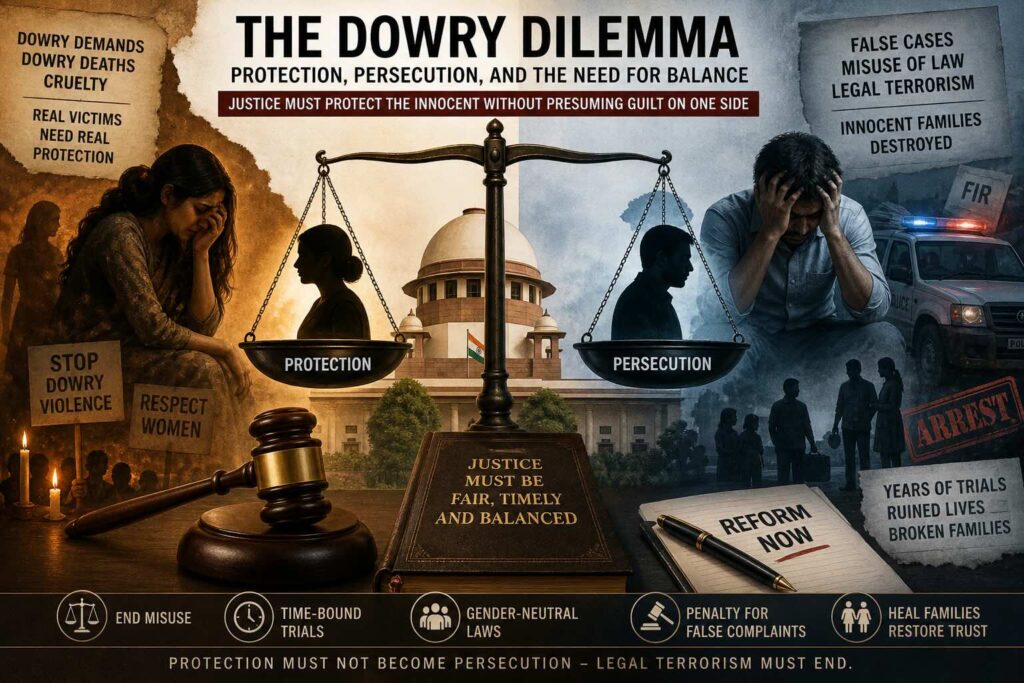
The current framework is failing both genuine victims and the innocent. Men’s rights groups, affected families, and even some judges have long demanded concrete changes. Section 498A should be made compoundable, allowing genuine disputes to be resolved amicably with proper safeguards. Heavy penalties must be imposed for proven false complaints, including costs and action for perjury, to deter misuse. Time-bound trials in fast-track family courts are essential so cases do not linger for a decade. Above all, India must move toward gender-neutral cruelty laws that protect victims regardless of gender and address deceit or harassment from any side.
States are beginning to experiment. In early 2026, Kerala’s Law Reforms Commission proposed amendments to the Dowry Prohibition Act that would decriminalise the act of giving dowry while strengthening action against those who demand it — a move aimed at encouraging victims to report without fear.
Until these systemic reforms are implemented nationwide, the one-sided design will continue to feel profoundly unfair. Dowry as a social evil deserves to be tackled, but not at the cost of turning the justice system into a weapon that destroys innocent families in arranged marriages. Parliament and the judiciary must act decisively. Protection must not become persecution – and legal terrorism must end. The lives already ruined by delay and misuse demand nothing less.
References
Supreme Court Judgments & Observations on Misuse
- Supreme Court Judgment – Shivangi Bansal v. Sahib Bansal (2025) – Landmark case on curbing misuse, quashing false cases and dissolving marriage under Article 142. (Search on SCI website for full text)
- Rajesh Chaddha v. State of Uttar Pradesh (2025) – SC criticises vague allegations and misuse of 498A.
- Supreme Court Guidelines on 498A Misuse (various 2024–2026) – Collection of recent orders emphasising specific evidence and protecting innocent family members.
NCRB Official Data (Dowry Deaths & Cases)
- NCRB Crime in India 2023 Report – Official statistics showing 14% rise in dowry cases and over 6,100 deaths.
- NCRB Home Page – Latest Reports – Direct source for annual Crime in India reports.
Law Reforms & Government
- Kerala Law Reforms Commission – Dowry Prohibition (Kerala Amendment) Bill 2025 – Proposal to decriminalise giving dowry while strengthening action against demands.
- Dowry Prohibition Act, 1961 (Original) — Official bare act on India Code portal.
Hindu Marriage Act (Fraud/Annulment)
- Section 12 – Hindu Marriage Act, 1955 (Voidable Marriages due to Fraud) – Legal basis for annulment on concealment of material facts.