Sheikh Mohamed bin Zayed’s Brief India Visit Signals Accelerated India–UAE Convergence
A High-Impact Visit Amid Regional Flux
UAE President His Highness Sheikh Mohamed bin Zayed Al Nahyan arrived in New Delhi on 19 January 2026 for a tightly scheduled but strategically significant visit that reinforced the growing depth of India–UAE relations. Although initially mentioned as a full-day working engagement, the visit was compressed into a brief two-to-three-hour window. Despite its brevity, the engagement delivered substantive outcomes across trade, energy, technology, and security cooperation.
The visit marked Sheikh Mohamed’s third official trip to India since assuming the presidency and his fifth in the past decade. It followed a steady rhythm of high-level exchanges, including visits by Abu Dhabi Crown Prince Sheikh Khaled bin Mohamed bin Zayed Al Nahyan in September 2024 and Dubai Crown Prince Sheikh Hamdan bin Mohammed bin Rashid Al Maktoum in April 2025. Together, these engagements underline the maturation of the India–UAE Comprehensive Strategic Partnership.
Sudden Announcement and Discreet Diplomatic Planning
The confirmation of the visit emerged only a day prior, following an official announcement by India’s Ministry of External Affairs. The absence of advance signalling set the visit apart from conventional state engagements. Diplomatic sources indicated that preparations had been conducted quietly over preceding weeks, allowing both sides flexibility amid heightened volatility in West Asia.
The Indian officials described the engagement as concise but highly prepared, with both sides arriving with clear priorities and ready agreements. The compressed schedule reinforced the impression of urgency rather than improvisation.
A Symbolic Welcome Reflecting Personal Diplomacy
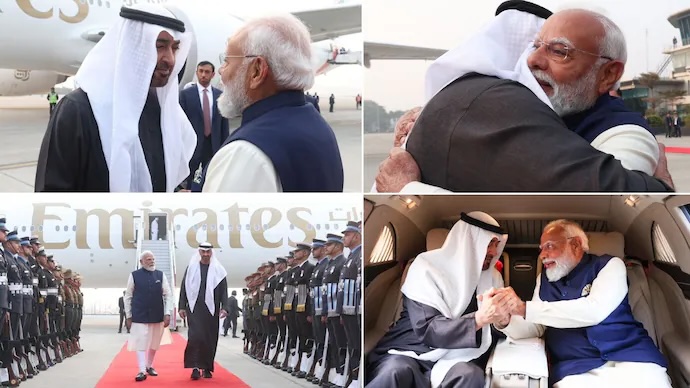
Prime Minister Narendra Modi personally received Sheikh Mohamed at Indira Gandhi International Airport, a gesture rarely extended outside formal state visits. The reception included ceremonial honours and cultural elements, reflecting the personal warmth that has come to characterise the relationship between the two leaders.
Images of the leaders greeting each other underscored the importance both sides attach to personal diplomacy. The Prime Minister later noted that discussions would further strengthen the bilateral partnership, signalling continuity in high-level political alignment.
A Powerful Delegation and Focused Engagements
Despite the shortened timeline, the UAE President was accompanied by a large and senior delegation. This included Dubai Crown Prince and Defence Minister Sheikh Hamdan bin Mohammed bin Rashid Al Maktoum, Foreign Minister Sheikh Abdullah bin Zayed Al Nahyan, and several senior members of the Presidential Court and advisory council.
Talks were held at Hyderabad House and covered the full spectrum of bilateral cooperation. Areas discussed included trade expansion, energy security, defence collaboration, advanced technology, artificial intelligence, counter-terrorism, and regional stability. Officials described the discussions as outcome-oriented, reflecting months of preparatory work behind the scenes.
Agreements and Announcements Delivered at Speed
Following the meetings, officials confirmed a broad set of outcomes that reflected both strategic intent and operational readiness. These included commitments by UAE entities to invest in infrastructure development at Gujarat’s Dholera Special Investment Region, expanded cooperation in defence technology and training, and a long-term liquefied natural gas (LNG) supply agreement between Indian and Emirati energy companies.
Both sides also agreed to pursue an ambitious goal of doubling bilateral trade to USD 200 billion by 2032, building on the momentum generated by the Comprehensive Economic Partnership Agreement signed in 2022. Cooperation in artificial intelligence, supercomputing, digital finance, healthcare, sustainability, and civil nuclear energy was also advanced, alongside enhanced counter-terrorism coordination.
Officials emphasised that the pace of announcements reflected prior alignment rather than hurried negotiation, demonstrating a high degree of institutional trust.
Defence Expectations and Strategic Silence
In the days preceding the visit, expectations had grown around possible defence-related announcements, particularly regarding Akash SAM air defence cooperation. While defence featured prominently in discussions, official readouts remained deliberately restrained on specific platforms or systems.
This calibrated disclosure approach suggested that sensitive matters were addressed privately, leaving scope for future announcements once negotiations mature. Analysts noted that the absence of public detail did not indicate absence of progress, but rather reflected the strategic caution typical of defence diplomacy.
A Visit That Reinforced Strategic Momentum
Although brief, the visit carried disproportionate strategic weight. Diplomatic sources indicated that preparatory discussions may have intensified during late-2025 bilateral engagements, allowing leaders to use this meeting to fast-track decisions rather than explore options.
For India, the visit reaffirmed the UAE’s role as a cornerstone partner in energy security, investment, technology, and diaspora engagement. For the UAE, it reinforced India’s position as a stable and reliable Asian partner amid shifting regional alignments.
As Sheikh Mohamed departed New Delhi later the same day, the visit demonstrated that in contemporary diplomacy, duration matters less than clarity of intent and readiness to act.
Also Read
Mediterranean Realignment: India’s Strategic Invitation into a Greece–Cyprus–Israel Defence Axis