A Mediterranean Quad in the Making and India’s Expanding Strategic Horizon
Strategic Context of the Mediterranean Realignment
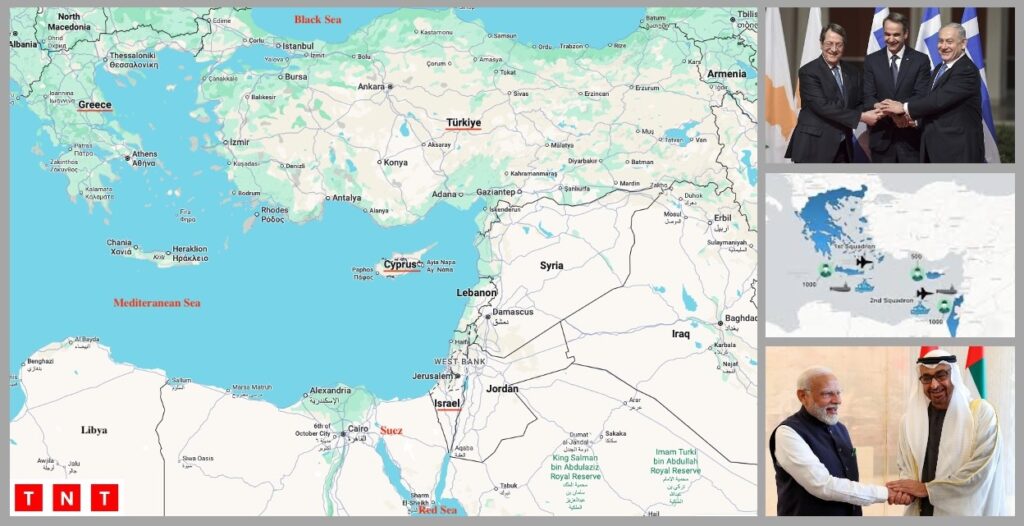
A new security architecture is gradually taking shape in the Eastern Mediterranean, driven by converging security concerns, maritime disputes, and shifting power balances. Greece, Cyprus, and Israel have moved decisively toward institutionalised military cooperation following a trilateral defence agreement concluded in late December 2025. The agreement focuses on joint military exercises, intelligence sharing, training in unmanned systems and electronic warfare, and the development of coordinated rapid-response capabilities.
Within this evolving framework, India has emerged as a natural external partner. The invitation extended to New Delhi reflects not symbolic diplomacy but a strategic assessment of India’s growing naval reach, defence-industrial capability, and converging interests with the trilateral bloc. The emerging format is often described as a “3+1” arrangement, with India positioned as the fourth pillar of a potential Mediterranean Quad.
Drivers Behind the Greece–Cyprus–Israel Defence Convergence
Turkey as the Central Strategic Variable
The core catalyst behind this trilateral consolidation is Turkey’s increasingly assertive regional posture. Ankara’s “Blue Homeland” doctrine lays claim to expansive maritime zones across the Eastern Mediterranean, directly contesting Greek and Cypriot claims and disrupting energy exploration activities. These assertions are backed by sustained naval deployments and political pressure.
Read Also
Bangladesh’s Political Crisis: Unpacking the Conspiracy Theories and Seeking Reality
Turkey’s continued military presence in northern Cyprus since the 1974 intervention remains a structural fault line. The lack of progress on reunification, combined with Ankara’s rejection of international mediation frameworks, has reinforced Greek and Cypriot threat perceptions. For Israel, relations with Turkey have steadily deteriorated following repeated political confrontations, regional conflicts, and ideological divergence, particularly after the breakdown of earlier strategic cooperation frameworks.
India’s Strategic Compatibility with the Trilateral Bloc
Defence, Maritime, and Technological Convergence
India’s alignment with Greece, Cyprus, and Israel is grounded in substantive cooperation rather than abstract convergence. New Delhi maintains active naval engagement with Greece through regular maritime exercises and air force deployments. With Cyprus, India has expanded maritime security cooperation and intelligence coordination in the Eastern Mediterranean.
Read Also
India–Turkey Tensions: INS Trikand’s Mediterranean Gambit Rattles Ankara’s Blue-Homeland Dream
Israel remains one of India’s most critical defence partners. Cooperation spans advanced missile systems, unmanned platforms, artificial intelligence, cyber security, and joint research and development programmes. Regular air exercises and operational-level coordination have deepened mutual trust. These relationships collectively position India as a credible security contributor rather than a distant observer.
A Broader West Asian Power Rebalancing
Competing Axes and Strategic Hedging
The Mediterranean realignment does not exist in isolation. It is unfolding alongside the emergence of competing security groupings across West Asia. Turkey has explored structured defence cooperation with Saudi Arabia and Pakistan under a mutual assistance framework inspired by collective defence models. This prospective axis combines financial capacity, military manpower, and strategic depth.
For India, this evolving landscape presents both risk and opportunity. Turkey’s overt support for Pakistan on Kashmir and its opposition to Indian security operations have already strained bilateral ties. At the same time, India maintains a comprehensive strategic partnership with Saudi Arabia, built on energy security, investment flows, and the welfare of a large Indian diaspora.
Balancing these relationships while countering emerging hostile alignments has become a central challenge for Indian diplomacy.
The Role of Energy Corridors and Economic Geography
IMEC and the Eastern Mediterranean
Energy and connectivity projects form the economic backbone of the emerging alignment. The India–Middle East–Europe Economic Corridor is designed to link Indian ports with Europe via Israel and Greece, integrating maritime, rail, and digital infrastructure. This corridor deliberately bypasses Turkey, altering long-standing transit geographies.
India’s commercial stake in Israel’s Haifa Port reinforces its material presence in the Eastern Mediterranean. These investments transform strategic partnerships into tangible economic interdependence, raising the cost of disruption and strengthening incentives for coordinated security frameworks.
Post-2023 Acceleration of Regional Polarisation
The conflict dynamics following October 2023 accelerated regional polarisation. Israel’s security posture hardened, while Turkey’s diplomatic and economic relations with Israel further deteriorated. Ankara’s broader regional ambitions increasingly clashed with NATO expectations, even as it continued to host strategic Western military assets.
Simultaneously, unresolved conflicts in Syria, Libya, and the Red Sea region added complexity to alliance calculations. Greece and Cyprus responded by strengthening deterrence through advanced air defence acquisitions and deeper integration with Israeli systems.
Future Trajectories of the Mediterranean Quad
India’s Potential Modes of Engagement
India’s participation could take multiple forms. A full-fledged Mediterranean Quad would institutionalise joint exercises, maritime surveillance coordination, and rapid-response planning without requiring a formal treaty commitment. This model would allow India to project influence while retaining strategic autonomy.
Alternatively, New Delhi could deepen bilateral and trilateral engagements even without formally joining a quad framework, thereby preserving diplomatic flexibility with Saudi Arabia and other Gulf partners. This calibrated approach would still enhance India’s presence while limiting political exposure.
Possible Expansion of Competing Blocs
Turkey’s efforts to consolidate alternative defence arrangements may draw additional partners, but internal divergences and competing regional priorities could constrain cohesion. While Pakistan’s nuclear deterrence adds a layer of complexity, sustained alignment among ideologically diverse partners remains uncertain.
Conversely, the Greece–Cyprus–Israel–India configuration benefits from operational compatibility, shared maritime interests, and converging economic incentives.
Strategic Consequences and Risk Assessment
Opportunities for India and Regional Stability
For India, deeper engagement in the Eastern Mediterranean strengthens deterrence against hostile alignments, secures critical trade corridors, and reinforces its image as a net security provider beyond the Indo-Pacific. It also supports India’s broader aspirations in global governance and institutional reform.
Risks of Escalation and Strategic Overstretch
However, the risks are non-trivial. Turkey may perceive expanded coordination as containment, leading to heightened military posturing or proxy escalation in contested theatres. India’s balancing act with Saudi Arabia could become more complex if regional blocs harden into opposing camps.
Short-term volatility is likely, particularly across energy markets and maritime security environments. Long-term outcomes will depend on whether emerging groupings stabilise deterrence or entrench confrontation.
A Pivotal Decision Point for India
The emerging Mediterranean Quad represents more than a regional security arrangement. It is a test case for India’s evolving role as a cross-regional strategic actor. Whether New Delhi chooses formal participation or calibrated engagement, its decisions will significantly shape the balance of power across West Asia and the Eastern Mediterranean.
In a region increasingly defined by competing axes rather than fixed alliances, India’s strategic maturity, restraint, and clarity of purpose will determine whether this realignment leads to stabilisation or prolonged rivalry.