India’s Top Court Puts UNHCR Under Scrutiny
New Delhi | The Supreme Court on United Nations High Commissioner for Refugees (UNHCR) has set off a significant debate over the role and authority of the UNHCR in India. During a recent hearing involving a Sudanese asylum seeker, Justice Surya Kant’s sharp observation — “They have opened a showroom here to issue refugee certificates to everyone” — sent ripples across legal and humanitarian circles including United Nations Human Rights Council.
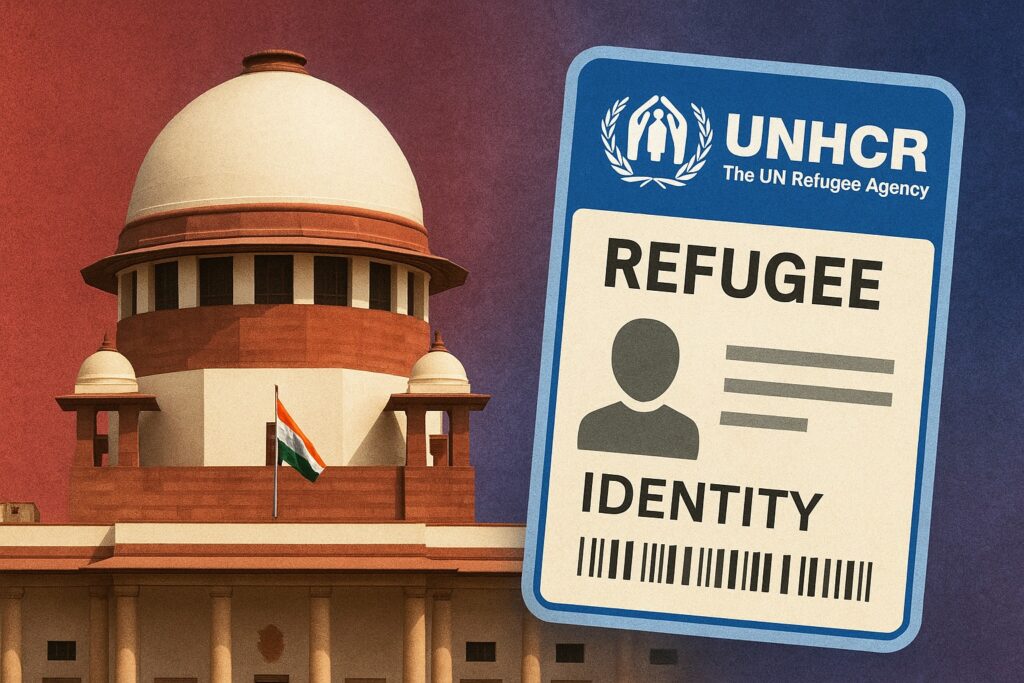
The Court questioned the legitimacy of UNHCR-issued refugee cards, making it clear that these documents hold no legal standing within Indian jurisdiction since the nation is not a signatory to the 1951 Refugee Convention.
Supreme Court’s Stern Message: UNHCR Cards Hold No Legal Weight
The bench’s comments came while refusing interim relief to a Sudanese national facing deportation despite possessing a UNHCR refugee card. The Court stressed that such cards grant no enforceable rights in India. It suggested the petitioner approach the National Human Rights Commission (NHRC) instead — a move underscoring that only Indian institutions can safeguard rights within national borders.
In effect, the Supreme Court reaffirmed that India’s domestic law supersedes international humanitarian documentation. The ruling reflects a pragmatic, sovereignty-centred stance: humanitarian empathy cannot override immigration law.
How UNHCR Operates in India: A Quiet Humanitarian Presence
The UNHCR has been active in India since 1981, operating from New Delhi with tacit governmental permission rather than formal authorisation. It primarily assists refugees and asylum seekers with humanitarian aid, legal counselling, and protection support.
However, India has never officially recognised UNHCR refugee cards, citing its non-signatory status to the Refugee Convention. While the agency’s actions are tolerated for humanitarian reasons, its authority remains limited. The government maintains control over refugee policy, often balancing humanitarian commitments with national security and immigration priorities.
Immediate expulsion of UNHCR from India is unlikely due to diplomatic sensitivities and humanitarian optics, but its operational space may shrink under heightened judicial scrutiny.
The Numbers Behind the Controversy
UNHCR’s India office has reportedly issued 45,000 to 50,000 refugee cards to asylum seekers from Afghanistan, Myanmar (Rohingyas), Sudan, Somalia, and other nations. These cards follow a detailed Refugee Status Determination (RSD) process — a cornerstone of UNHCR’s global practice.
Yet, despite the UN agency’s credibility abroad, Indian authorities treat these cards as advisory, not authoritative. Holders remain vulnerable to detention or deportation, particularly amid the government’s strong stance against illegal immigration.
The Supreme Court’s observation will likely embolden the government’s approach: refugee cards do not override India’s sovereign right to decide who can stay or leave.
Implications: Redefining Refugee Protection in India
The Supreme Court on UNHCR has effectively redrawn the contours of refugee management in India.
Its remarks are more than judicial criticism — they are a policy signal.
- Legal Impact: Refugee cards lack any legal shield against deportation.
- Administrative Impact: Government agencies may intensify verification and deportation drives.
- Diplomatic Impact: UNHCR’s diplomatic legitimacy remains intact but operational authority weakens.
- Legislative Vacuum: The case exposes India’s urgent need for a formal refugee law to define the rights and limits of asylum seekers.
Without such a law, India will continue navigating refugee issues through ad-hoc executive decisions, leaving thousands in a grey zone between compassion and control.
Balancing Sovereignty and Humanitarianism
India’s stance reflects a delicate balance between national security and global responsibility. On one hand, the government asserts its sovereign right to regulate borders; on the other, it acknowledges international humanitarian principles.
The Supreme Court’s remarks, though stern, highlight the institutional confusion caused by the absence of a statutory refugee framework. It is a call for legal clarity — not merely a rebuke to the UNHCR.
As deportations continue and refugee camps swell, the need for a clear national refugee policy becomes urgent. Until then, UNHCR’s cards may offer humanitarian comfort but no legal cover.
Conclusion: A Turning Point in India’s Refugee Policy Debate
The latest ruling marks a turning point in India-UNHCR relations. It reinforces India’s position as a country that will chart its own refugee course — guided by domestic law rather than international pressure.
The Supreme Court on UNHCR has exposed the fragile foundation of refugee protection mechanisms in India and triggered a renewed debate: should India continue operating in legal ambiguity, or finally legislate a comprehensive refugee protection law?
For now, UNHCR’s “showroom” in India may remain open, but its certificates will continue to carry humanitarian, not legal, value.