From Ukraine War to India’s Northeast: NIA Probe Tracks American–Ukrainian Drone Network
A Routine Arrest — Or Something Far More Serious?
What initially appeared to be a routine detention of foreign nationals for immigration violations is rapidly unfolding into one of the most consequential national security investigations in recent years.
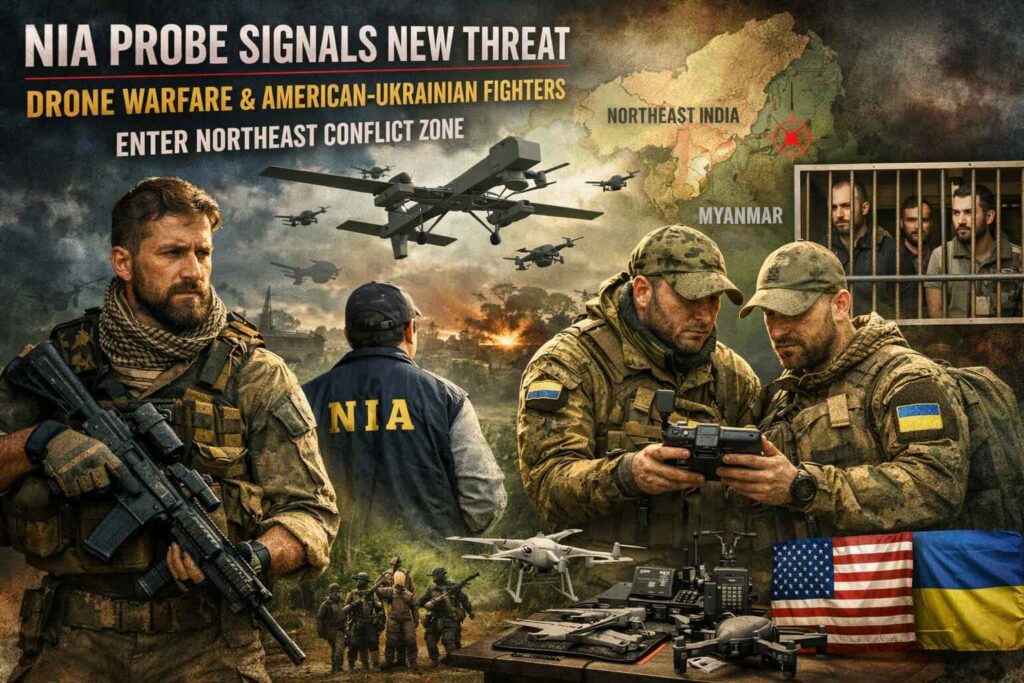
The probe led by the National Investigation Agency has brought into focus a troubling possibility — that India’s Northeast may have been quietly exposed to a new form of warfare, driven not by traditional insurgents but by battle-hardened foreign fighters with expertise in modern drone combat.
At the centre of this investigation are six Ukrainian nationals and one American, individuals whose backgrounds, movements, and alleged activities suggest a pattern that goes well beyond tourism gone wrong.
The Man in the Middle: A Familiar Face from Global Conflict Zones
The most prominent among those arrested is Matthew Aaron Van Dyke, a 46-year-old American whose presence alone shifts the gravity of the case.
Van Dyke is no stranger to conflict. His trajectory spans Libya during the fall of Muammar Gaddafi, where he was captured and held as a prisoner of war, to Syria, Iraq, and later Ukraine. Over the years, he has cultivated a reputation as a self-styled “freedom fighter,” though his roles have often blurred the lines between activist, combatant, and trainer.
He is also the founder of Sons of Liberty International, an outfit known for providing military training to non-state actors. According to Indian investigators, it is this experience — particularly in training irregular forces — that placed him at the centre of the alleged Myanmar operations.
Security agencies had reportedly been tracking his movements for months before his arrest at Kolkata airport on March 13.
The Ukrainian Link: Veterans of a Modern War
The six Ukrainian nationals present a different but equally significant dimension. Unlike typical foreign detainees, these individuals are believed to be veterans of the Russia–Ukraine war — a conflict that has redefined the use of drones, electronic warfare, and decentralised combat tactics.
Among them, Marian Stefankiv stands out. Open-source material and prior video records show his familiarity with drone reconnaissance and battlefield deployment. His association with nationalist formations in Ukraine has also been noted in multiple reports, adding another layer of complexity.
The others — Petro Hurba, Taras Slyviak, Ivan Sukmanovskyi, Maksim Honcharuk, and Viktor Kaminskyi — maintain relatively low public profiles. However, investigators describe them collectively as “experienced operators,” a term that in intelligence vocabulary typically implies prior combat exposure.
What links them is not just nationality, but a shared skillset shaped by one of the most drone-intensive wars in recent history.
The Route: How They Entered and Moved
The pattern of entry into India is one of the more revealing aspects of the case. At least three of the accused — Hurba, Slyviak, and Sukmanovskyi — arrived on December 18, 2025, via the UAE. Others entered separately on tourist visas over subsequent weeks.
From there, the route was consistent. They travelled to Guwahati and then moved into Mizoram, a protected region requiring special permits for foreign nationals. According to the NIA, these permits were never obtained.
From Mizoram, the group allegedly crossed into Myanmar’s Chin State — a region that has seen active insurgent movements and armed ethnic groups.
It is this cross-border movement, combined with the nature of their alleged activities, that transformed what could have been a visa violation into a national security investigation.
The Modus Operandi: Drones, Training and a Shadow Network
The NIA’s case, as presented in court, is built on multiple converging strands.
Investigators allege that the group was involved in importing drone equipment from Europe into India, which was then transported to Mizoram. These drones, along with technical know-how, were allegedly provided to ethnic armed groups operating across the border.
Training sessions reportedly included drone assembly, operational deployment, and countermeasures such as jamming techniques, along with conventional weapons handling.
Crucially, the agency has stated that these Myanmar-based groups maintain operational linkages with banned insurgent outfits in India’s Northeast, including factions of ULFA (I), NSCN, and the Kuki National Army.
This indirect linkage — training one group that supports another — forms the legal basis for invoking conspiracy provisions under the Unlawful Activities (Prevention) Act – UAPA.
What the Evidence Suggests So Far
Unlike speculative cases, this probe is anchored in multiple forms of evidence. Immigration records establish unauthorised entry into restricted areas. Travel patterns confirm movement to border regions. Physical consignments of drones are under scrutiny.
More significantly, initial questioning has reportedly yielded admissions regarding contact with armed individuals in Myanmar. However, the most critical evidence may yet emerge from digital forensics.
All seized devices have been sent to CERT-In for analysis, which is expected to reconstruct communication networks, financial trails, and possible handlers behind the operation.
The investigation is also expanding to track at least eight more Ukrainian nationals believed to be part of the larger network.
Ukraine’s Aggressive Response: Diplomacy or Damage Control?
Perhaps the most intriguing dimension of the case lies not in the arrests, but in the speed and tone of Ukraine’s response.
Within days, Ambassador Oleksandr Polishchuk lodged a formal protest with India’s Ministry of External Affairs, demanding immediate release and full consular access.
Ukraine’s official position rests on three pillars: lack of prior notification, absence of “established facts,” and the suggestion that any violations may have been unintentional.
Notably, Ukrainian statements have avoided engaging with the core allegations of drone training and insurgent linkages, focusing instead on procedural aspects.
While such responses are not unusual in diplomatic practice, the urgency and assertiveness have raised questions within strategic circles — particularly given that the investigation is still in its early stages.
A Larger Question: Is This a New Security Paradigm?
The deeper concern emerging from the NIA drone warfare probe is not limited to this group alone. It is about what their presence represents.
For decades, insurgency in India’s Northeast has been shaped by local dynamics and cross-border sanctuaries. What this case suggests is a possible evolution — where global conflict expertise, especially in drone warfare, begins to intersect with regional insurgencies.
If substantiated, this would mark a significant shift in the threat landscape. It would mean that future conflicts in the region may no longer be limited to small arms and guerrilla tactics, but could involve technologically enhanced warfare capabilities.
The Road Ahead
The accused remain in NIA custody as the investigation deepens. The next court hearing on March 27 is expected to provide further clarity on the direction of the case.
For now, the facts are still being assembled. But even at this stage, one conclusion is difficult to ignore.
This is no longer just a case about foreign nationals overstaying visas or crossing borders. It is a window into a changing nature of conflict — one where geography matters less, networks matter more, and expertise travels faster than ever before.