Persian Energy Crisis: Irreplaceable Oil & Gas Reserves at Risk
Energy Infrastructure Under Fire: A Silent Global Loss
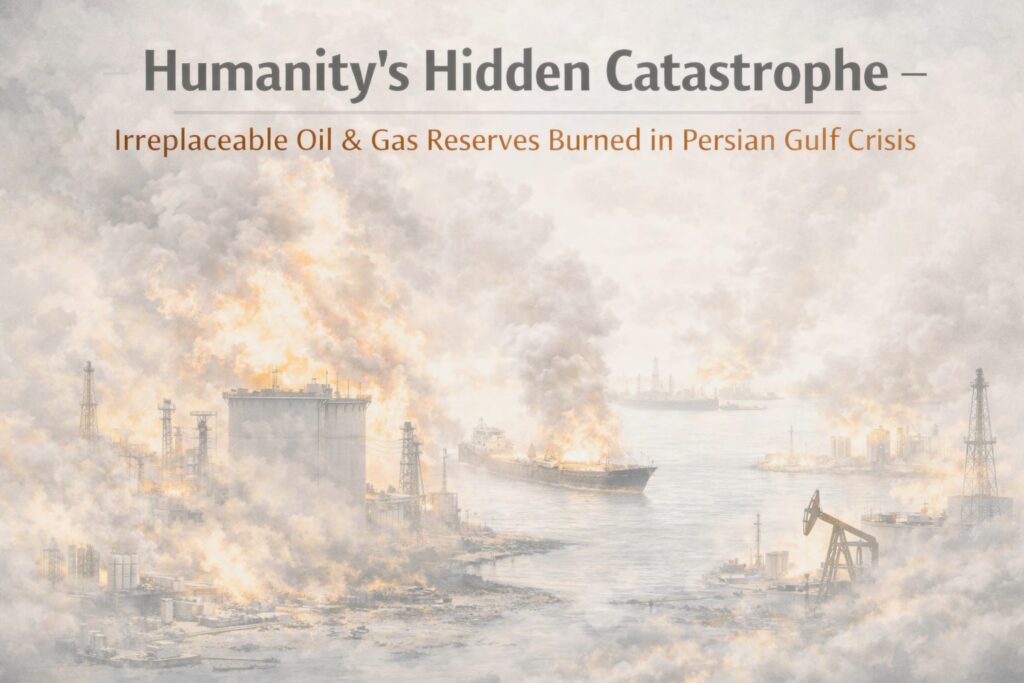
The Persian energy crisis has emerged as the most consequential yet underreported dimension of the ongoing conflict. While public discourse remains centred on missile exchanges and casualty counts, the systematic targeting of hydrocarbon infrastructure across Iran and the Gulf is inflicting damage that extends far beyond the battlefield. Unlike conventional military losses, the destruction of oil and gas assets represents a depletion of finite geological reserves formed over millions of years.
This crisis has been amplified by the destabilisation of the Strait of Hormuz, transforming a regional conflict into a global energy emergency. The scale of disruption now threatens not only current supply chains but also the long-term availability of hydrocarbons.
Direct Infrastructure Damage Across the Region
Iranian Energy Assets Under Sustained Attack
On the Iranian side, the most strategically significant damage has occurred within the South Pars gas field, which forms part of the larger South Pars/North Dome reservoir shared with Qatar. This field alone accounts for a substantial portion of global natural gas reserves. Strikes have been reported in the onshore processing zones around Asaluyeh and Kangan in Bushehr province, where gas treatment plants, condensate stabilisation units, and export pipeline manifolds are located.
Satellite assessments and regional energy trackers indicate that sections of Phase 12 and Phase 14 processing facilities have suffered functional disruption. Condensate storage tanks near Tombak and pipeline corridors feeding export terminals have also been affected. Iranian sources have acknowledged a measurable drop in output, although precise figures remain undisclosed. However, even partial damage in such a high-capacity field introduces prolonged recovery timelines due to the technical complexity of gas processing infrastructure.
In addition, infrastructure linked to the South Pars condensate stream, including loading facilities at the Persian Gulf Star refinery near Bandar Abbas, has faced intermittent operational disruptions. These installations play a critical role in converting condensate into refined products, and their impairment further compounds downstream supply constraints.
Gulf Energy Infrastructure Under Repeated Strikes
Across the Gulf, the pattern of targeting has focused on high-value nodes within the hydrocarbon supply chain. In Qatar, repeated strikes on Ras Laffan Industrial City have disrupted operations at one of the world’s most critical LNG export hubs. Ras Laffan handles roughly one-fifth of global LNG trade, and damage to liquefaction trains, storage tanks, and associated port infrastructure has led to partial shutdowns. Reports also indicate fires in proximity to the Pearl GTL facility, operated by QatarEnergy in partnership with Shell, which converts gas into liquid fuels.
In Saudi Arabia, the strikes have concentrated on refining and petrochemical clusters along the eastern seaboard. The SAMREF refinery in Yanbu, although located on the Red Sea coast, has faced reported operational interruptions linked to supply chain disruptions originating in the Gulf. More critically, facilities in Jubail Industrial City, one of the largest petrochemical complexes in the world, have been hit, affecting downstream processing capacity. The Ras Tanura export terminal, Saudi Arabia’s primary oil export hub, has experienced nearby impacts, raising concerns over loading operations. Installations around Dhahran and Abqaiq, which are central to crude stabilisation and processing, have also been placed on high alert, with intermittent disruptions reported.
The United Arab Emirates has not remained insulated. The Al Hosn gas field in Abu Dhabi, a key sour gas development project, has sustained damage that has forced partial shutdowns. Furthermore, the Fujairah oil storage and bunkering hub, strategically located outside the Strait of Hormuz, has suffered significant damage to storage tanks and transfer infrastructure. Fujairah serves as a critical alternative export route for Gulf crude, and its impairment reduces the region’s ability to bypass Hormuz constraints.
Compounding Systemic Disruption
The cumulative effect of these strikes is not confined to isolated facilities. The hydrocarbon supply chain operates as an integrated network, where upstream extraction, midstream transport, and downstream processing are interdependent. Damage at any stage creates cascading disruptions. In the present Persian energy crisis, multiple nodes across this network have been simultaneously targeted, magnifying the overall impact.
The Strait of Hormuz Blockade – Core of the Persian Energy Crisis
The Strait of Hormuz remains the central artery of global energy flows, and its disruption has elevated the Persian energy crisis into a systemic shock. Prior to the conflict, the strait facilitated the transit of more than 150 oil tankers and LNG carriers each day. Current conditions, however, reflect a near-collapse of routine maritime movement, with several days witnessing negligible transit activity.
A significant volume of global energy supply is now effectively immobilised. Estimates suggest that close to 700 commercial vessels are either stranded within the Gulf or waiting at anchorage points outside the Strait. Among these are approximately 400 oil tankers carrying an estimated 200 million barrels of crude and refined products. This concentration of idle cargo represents one of the largest supply bottlenecks in modern energy history.
The strategic importance of Hormuz lies in its throughput. It accounts for nearly 20 percent of global seaborne oil trade and around 30 percent of liquefied natural gas shipments. Even partial disruption creates immediate supply imbalances. Unlike other maritime chokepoints, Hormuz lacks scalable alternatives. Pipeline routes across Saudi Arabia and the UAE provide limited relief, but their capacities fall significantly short of compensating for the loss of maritime transit.
The duration of disruption further compounds the crisis. Each week of constrained passage removes millions of barrels from global circulation. These volumes cannot be rapidly replaced or rerouted, leading to tightening supply conditions and heightened market volatility.
Global Consequences and Irrecoverable Resource Loss
The Persian energy crisis has already triggered a pronounced escalation in global energy prices. Brent crude has risen sharply from pre-conflict levels of around US$67 per barrel to a sustained range between $100 and $120. Market projections now indicate the possibility of prices reaching $130 to $150 if disruptions persist.
Beyond price dynamics, the more profound consequence lies in the irreversible loss of hydrocarbon resources. Fires in reservoirs, uncontrolled flaring of natural gas, and contamination of subsurface formations can permanently reduce recoverable reserves. In gas fields such as South Pars, damage to pressure management systems and processing units can impair long-term extraction efficiency. These are losses that cannot be reversed through reconstruction alone.
The downstream effects are equally significant. Rising fuel costs are feeding into broader inflationary pressures across global economies. Developing nations, which rely heavily on imported energy, face heightened vulnerability to supply disruptions and price volatility. Industrial sectors dependent on stable energy inputs are also encountering escalating operational costs.
At the same time, the crisis is reshaping investment priorities. Capital that might have been directed towards renewable energy development is being diverted to stabilise and repair existing fossil fuel infrastructure. This shift risks delaying the global transition towards cleaner energy systems.
A Civilisational Cost Beyond Immediate Conflict
The Persian energy crisis represents a form of loss that extends beyond immediate human and material damage. Hydrocarbon reserves constitute a finite inheritance accumulated over geological timescales. Their destruction in the course of conflict diminishes the resource base available to future generations.
As the crisis deepens, the implications become increasingly global. What began as a regional confrontation has evolved into a systemic disruption of energy supply, market stability, and long-term resource sustainability. The scale of this loss underscores a fundamental reality: in targeting energy infrastructure, the conflict is not merely consuming present assets but eroding the foundations of future energy security.