India’s Strategic Autonomy Amid Iran–Israel Escalation
India strategic autonomy is being tested in real time as the West Asian crisis deepens following the reported killing of Ali Khamenei during U.S.–Israeli strikes in late February 2026.
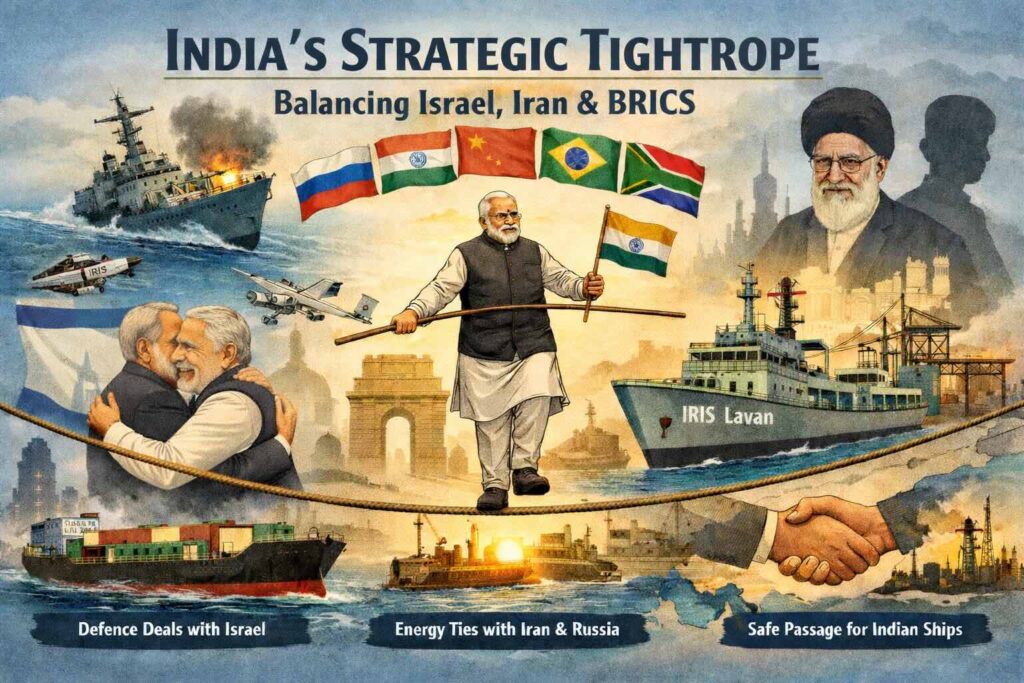
New Delhi’s actions since then may appear contradictory at first glance. Prime Minister Narendra Modi visited Israel at a time when tensions across West Asia were already escalating. Within days, Israel launched strikes against Iran. India refrained from publicly condemning the assassination of Iran’s supreme leader and the reported killing of nearly 180 children on the first day of the attack.
At the same time, New Delhi quietly maintained diplomatic engagement with Tehran to safeguard Indian shipping lanes and critical energy routes. In a parallel move, India permitted the Iranian naval vessel IRIS Lavan to dock at Kochi on humanitarian grounds after the ship reported technical problems, allowing its crew to access Indian naval facilities.
However, diplomats say these moves follow a long-standing doctrine. India refuses to align fully with any single bloc. Instead, it seeks to maintain parallel relationships with competing powers while protecting its core interests.
The recent sequence of events illustrates how this multi-alignment strategy works under pressure.
A Week of Conflicting Signals
The diplomatic balancing act began in late February.
Prime Minister Narendra Modi travelled to Israel on February 25–26 to upgrade bilateral ties with Benjamin Netanyahu. Defence cooperation dominated the visit, with discussions on drones, missile defence systems, and advanced surveillance technology.
Israel remains one of India’s most important military partners. It supplies critical equipment used along India’s northern border and provides intelligence cooperation on regional security threats.
Two days later, the regional crisis escalated when U.S. and Israeli forces reportedly targeted Iranian military infrastructure. Reports soon emerged that Iran’s supreme leader Ali Khamenei had been killed during the strikes.
New Delhi did not immediately comment. Instead, it maintained silence for nearly a week before quietly sending a diplomatic representative to sign the condolence register at the Iranian embassy.
Officials described the response as deliberate. A strong condemnation would have strained relations with Israel and the United States. Yet endorsing the killing risked angering Iran and the wider Shia world.
Maritime Tensions and India’s Energy Lifeline
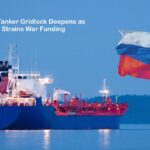
The conflict quickly spread to the sea lanes of the Persian Gulf. Several tankers were attacked near the Strait of Hormuz, the narrow waterway through which roughly one-fifth of the world’s oil supply passes.
India’s concern was immediate. A large portion of its crude imports travels through this corridor.
External Affairs Minister S Jaishankar held multiple phone conversations with Iran’s foreign minister Abbas Araghchi to ensure the safety of merchant shipping.
Soon after the talks, reports indicated that Indian-flagged tankers had been allowed to pass through the Strait of Hormuz without obstruction. Two vessels, Pushpak and Parimal, were among those that crossed the route safely.
Iran later reiterated that the strait would remain open to most countries despite the conflict.
For India, the stakes are enormous. Nearly 40% of its crude imports pass through this corridor. Any disruption would trigger fuel price spikes and wider economic stress.
Naval Diplomacy: Shelter and Signalling
Another episode underscored India’s attempt to maintain neutrality amid the escalating U.S.–Israel conflict with Iran.
At the onset of the war on February 28, 2026, Iran sought permission for three naval vessels — IRIS Dena, IRIS Lavan, and IRIS Bushehr — to seek refuge at regional ports as tensions made their return voyages risky. New Delhi approved an emergency docking request for IRIS Lavan on March 1 after Tehran reported technical problems aboard the vessel.
Days later, on March 4, a U.S. submarine torpedoed and sank IRIS Dena, a Moudge-class frigate that had participated in the MILAN 2026 in Visakhapatnam. The attack occurred in international waters off Sri Lanka, killing at least 87 sailors.
The same day, IRIS Lavan, a Hengam-class landing ship, docked at Kochi for urgent technical assistance, while IRIS Bushehr sought refuge at Trincomalee.
India did not publicly criticise the U.S. strike. However, by granting harbour to the Iranian vessel, New Delhi signalled that it was not aligning itself with an anti-Iran coalition. Such gestures are common in naval diplomacy, where port access often carries symbolic meaning beyond logistics.
India’s Public Criticism of Regional Attacks
Despite maintaining dialogue with Tehran, India has not remained silent on Iranian actions in the region. New Delhi criticised Iran after missile and drone attacks struck infrastructure in Gulf states, including the United Arab Emirates.
Officials warned that escalating attacks threatened global shipping routes and could destabilise energy markets.
The Indian Navy has increased patrols in the region under Operation Sankalp to protect merchant vessels and energy shipments.
The mission reflects India’s growing role as a maritime security provider in the Indian Ocean and Persian Gulf.
Strategic Friction Beneath the Partnership
The recent crisis also revived older debates about Iran’s reliability as a partner.
Critics point to past Iranian statements on Indian domestic issues, particularly remarks by Ali Khamenei about Kashmir and communal tensions in India.
Indian diplomats have repeatedly rejected such comments as interference in internal affairs.
Security concerns have also emerged. Indian investigators linked a 2021 blast near the Israeli Embassy in New Delhi to operatives associated with Iran’s external security network, though Tehran has denied involvement.
These episodes illustrate the complicated nature of the relationship. Cooperation continues, yet mistrust persists.
Chabahar, China, and the Strategic Competition
Another major issue shaping India’s Iran policy is the future of Chabahar Port.
India invested heavily in the port to secure trade routes to Afghanistan and Central Asia without passing through Pakistan. The project also connects to the International North-South Transport Corridor linking India with Eurasian markets.
However, sanctions and geopolitical tensions have slowed progress.
Iran’s growing economic partnership with China has intensified concerns in New Delhi. Beijing already maintains a strong presence at Pakistan’s Gwadar port, barely 100 kilometres away.
Analysts warn that if India reduces its involvement in Chabahar, China could eventually expand its influence there as well.
For India, that scenario would weaken a key strategic investment designed to bypass Pakistan and counter China’s Belt and Road Initiative.
BRICS Pressure and Diplomatic Tightrope
The crisis has also created tensions within BRICS.
Russia and China strongly condemned the U.S.–Israeli strikes on Iran and pushed for a joint statement of solidarity with Tehran.
Yet under India’s current BRICS chairmanship, the bloc has issued no unified declaration.
New Delhi’s cautious stance reflects its competing interests. India seeks to maintain cooperation within BRICS while preserving partnerships with the United States and Israel.
The silence has exposed deeper divisions within the group about how far it should challenge Western powers.
A Strategy Built on Strategic Autonomy
Taken together, the events of the past weeks illustrate India’s long-standing diplomatic philosophy.
The country continues to buy oil from Russia and Iran. It strengthens defence ties with Israel and the United States. It participates in BRICS while maintaining partnerships in the Quad.
Rather than choosing sides, India attempts to maintain relations with all major players.
This strategy can appear confusing from the outside. Yet for policymakers in New Delhi, it remains a deliberate approach to navigating an increasingly fragmented world order.
As the West Asian crisis evolves, India’s ability to maintain this delicate balance may become one of the most important tests of its foreign policy.