US Kharg Island Strike Puts Iran’s Oil Lifeline Under Threat
Tattvam News Today | March 14, 2026 | Delhi
In a dramatic escalation of the ongoing U.S.–Israel–Iran conflict, President Donald Trump announced late on March 13 that American forces had carried out one of the most powerful bombing raids in the history of the Middle East. Over several hours, U.S. aircraft struck more than fifteen Iranian military targets on Kharg Island, destroying air defences, naval installations, helicopter pads, and airport infrastructure.
However, the oil export infrastructure was deliberately spared during the Kharg Island strike. Trump described the operation as a warning and warned Tehran that any attempt to block shipping through the Strait of Hormuz would lead to immediate destruction of the island’s oil facilities.
Iranian state media and the Islamic Revolutionary Guard Corps (IRGC) claimed their air defences resumed operations within an hour and insisted that no oil installations suffered damage. Independent satellite assessments had not yet been released by early March 14. Nevertheless, Washington’s message is clear: Kharg Island now sits firmly in America’s strategic crosshairs.
What Exactly Is Kharg Island?
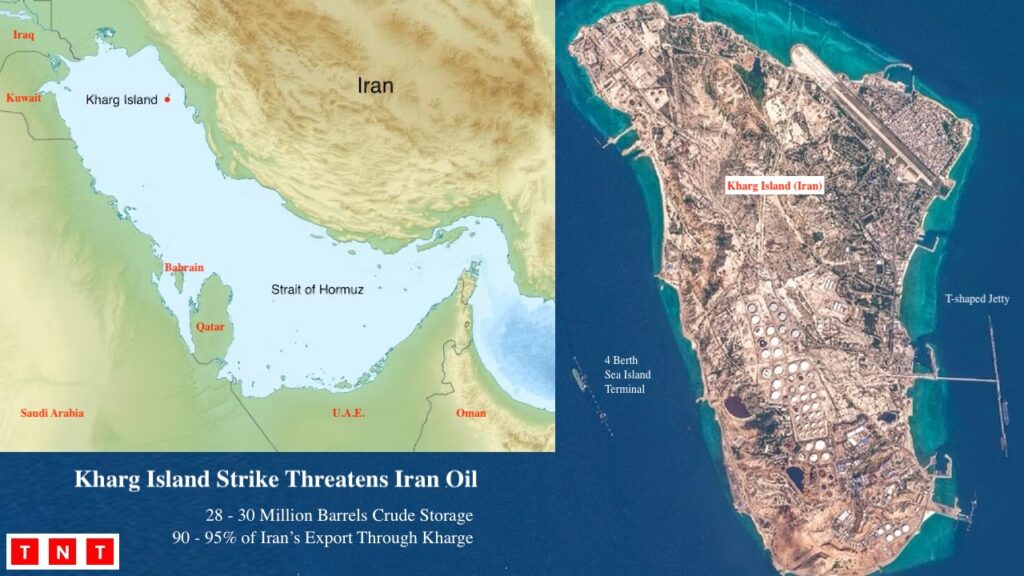
Kharg Island is a small rocky coral outcrop covering roughly 22 square kilometres. It lies about 24–40 kilometres off Iran’s southwestern coast in the northern Persian Gulf.
The island developed during the 1950s and 1960s as Iran’s principal oil export hub. Crucially, Kharg does not produce crude oil. It contains no oil wells, no drilling operations, and no refinery facilities. Instead, it functions solely as a collection, storage, and loading terminal for Iranian crude exports.
For this reason, energy analysts often describe Kharg as the “crown jewel” of Iran’s oil economy.
How Iran’s Kharg Export System Works
The Kharg Island strike has drawn attention to the complex infrastructure that feeds the terminal.
Collection Network
Iran’s crude oil originates primarily from major Khuzestan fields including:
- Ahvaz
- Marun
- Gachsaran
- West Karun
Additional crude also comes from offshore platforms such as:
- Abouzar
- Forouzan
- Dorood
After initial processing at field facilities, crude travels through onshore trunk pipelines toward coastal pumping stations at Ganaveh and Goreh. From there, multiple subsea pipelines transport the oil directly to Kharg Island.
These pipelines range from 30 to 56 inches in diameter and extend 30 to 76 kilometres across the Gulf.
Storage Capacity
Kharg Island houses a vast tank farm capable of storing approximately 28–30 million barrels of crude oil. Ironically, Iran recently expanded the facility with two additional 1-million-barrel tanks for storage.
The storage tanks use floating roof technology and typically hold several grades of crude including:
- Iran Light
- Iran Heavy
- Foroozan Blend
Loading Infrastructure
The island’s loading facilities remain among the largest in the Middle East.
A T-shaped jetty connected by a 1,100-metre trestle links the terminal to offshore berths. In addition, a four-berth Sea Island terminal enables the simultaneous loading of large tankers.
Water depths ranging between 17 and 21 metres allow Very Large Crude Carriers (VLCCs) to dock safely. At full capacity, the terminal can service up to ten VLCC supertankers simultaneously.
Why the Kharg Island Strike Matters
Energy analysts consistently estimate that 90–95% of Iran’s crude exports pass through Kharg Island.
Historically, the terminal has handled 1.3 to 3 million barrels per day, while theoretical capacity could reach around 7 million barrels per day under optimal conditions.
Without Kharg, Iran’s remaining export infrastructure — including terminals at Jask, Lavan, and Sirri — cannot collectively handle more than 400,000 to 500,000 barrels per day on a sustained basis.
Therefore, the Kharg Island strike threatens the single most critical chokepoint in Iran’s oil export system.
Iran’s Limited Alternative Export Routes
Despite occasional claims of diversification, Iran’s other terminals remain relatively small.
Jask Terminal
Located on the Gulf of Oman, Jask was designed as a Hormuz bypass connected through the Goreh–Jask pipeline, inaugurated in 2021.
However, the project has faced delays and sanctions-related constraints.
Key limitations include:
- Designed capacity: 1 million bpd
- Effective throughput: about 300,000 bpd maximum
- Storage capacity: roughly 2 million barrels
- Only sporadic tanker loadings reported
Energy analytics firms such as Vortexa and Kpler frequently describe Jask as not yet capable of functioning as a large-scale alternative to Kharg.
Lavan Island
Lavan supports exports from nearby offshore fields.
- Capacity: 200,000–300,000 bpd
- Storage: roughly 5.5 million barrels
However, the facility remains far smaller than Kharg.
Sirri Island
Sirri’s infrastructure is even more limited.
- Capacity: 100,000–200,000 bpd
- Storage: around 4.5 million barrels
Mainland Terminals
Ports such as Bandar Mahshahr, Imam Khomeini Port, and Assaluyeh mainly handle petroleum products, condensates, or gas exports.
Most mainland locations lack the deep-water berths required for VLCC tankers, which explains why Iran historically relied on the offshore location of Kharg Island.
Strategic Choices Facing Tehran
The Kharg Island strike leaves Iran with a narrowing range of strategic options.
Immediate Denial Measures
Iran could shut mainland valves at Goreh and Ganaveh, preventing crude from reaching the island. Authorities could also sabotage the subsea pipelines.
The crude already stored on the island, estimated at 28–30 million barrels, could theoretically be destroyed or drained.
Scorched-Earth Sabotage
Iran might destroy its own storage tanks and loading facilities. Such a move would deny the asset to an adversary but would simultaneously eliminate nearly all oil export revenue.
The environmental damage to the Persian Gulf could also be catastrophic.
Asymmetric Retaliation
Iran has repeatedly threatened retaliation across the region.
Potential measures include:
- Mining or closing the Strait of Hormuz
- Targeting oil infrastructure in Saudi Arabia or the UAE
- Activating regional proxy militias
Iranian commanders have already warned that regional energy facilities linked to American companies could become targets.
Negotiated Pause
Finally, Tehran could use the threat of disruption as leverage in diplomatic negotiations.
Even if Kharg Island were seized militarily, the upstream fields, pipelines, and pumping stations remain on the Iranian mainland. Without control of those assets, any occupying force would struggle to restore exports.
The Strategic Endgame
From a conventional military perspective, disabling Kharg could deprive Iran of up to 90% of its foreign currency revenue within days. Upstream oil fields across Khuzestan would likely shut down as storage capacity filled.
However, the broader strategic picture remains complex.
Capturing Kharg Island would represent only a temporary economic blow unless external forces also gained control over Iran’s mainland oil network. Tehran could simply halt flows or destroy stored crude, leaving the island operationally useless.
As a result, the outcome of the Kharg Island strike may hinge on two critical questions in the coming days.
Will Iran escalate through retaliation or self-sabotage?
Or will Washington limit its strategy to military pressure and sanctions?
For now, both sides remain just short of crossing the decisive red line. Yet Kharg Island — once a quiet export hub — has suddenly become the most important pressure point in the 2026 Middle East conflict.
ALSO READ:
Hormuz Crisis Could Trigger $200 Prices and Global Recession