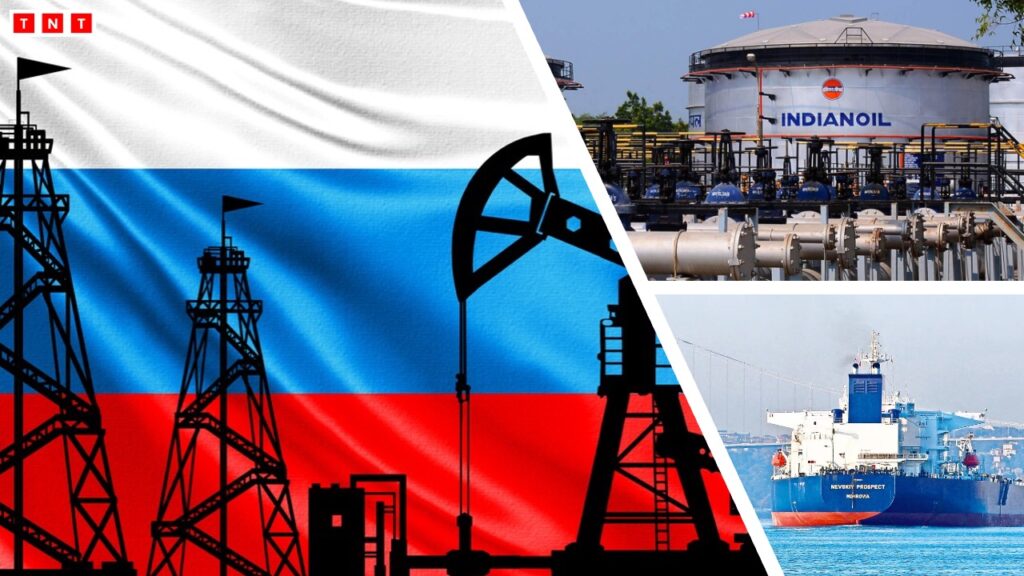
Hormuz Crisis Drives India Toward Russian Crude Imports
New Delhi | 13 March 2026
The escalating conflict in the Middle East and the disruption of shipping through the Strait of Hormuz have triggered major shifts in global oil trade. One immediate outcome is the sharp rise in India Russian crude imports, as Indian refiners secure alternative supplies to replace uncertain Gulf shipments.
India currently consumes about 5.5–5.8 million barrels of crude oil per day, making it the third-largest oil consumer in the world after the United States and China. Nearly 88% of that demand is met through imports, leaving the country highly exposed to global supply disruptions.
The crisis has already pushed global oil markets into volatility. Brent crude briefly surged above $115 per barrel after tanker attacks and naval tensions around the Hormuz corridor.
However, India’s diversified sourcing strategy and large refining capacity allow the country to adapt faster than many other major importers.
Industry analysts say that while high oil prices create long-term risks for the Indian economy, the current environment also offers short-term advantages for India’s refining and energy trading sectors.
Hormuz Disruption Forces Rapid Supply Shift
The Strait of Hormuz handles around 20 million barrels of oil per day, which represents about one-fifth of global petroleum trade.
For India, the corridor is even more critical. Roughly 45–50% of India’s crude imports normally pass through the strait, originating mainly from Iraq, Saudi Arabia, the United Arab Emirates, and Kuwait.
Before the current crisis, Gulf producers together accounted for over 55% of India’s oil imports.
When tensions escalated and tanker routes became uncertain, Indian refiners began looking for immediate alternatives.
According to ship-tracking data from Kpler, Indian purchases of Russian crude increased sharply during the first half of March.
Imports rose from roughly 0.8–1.0 million barrels per day to nearly 1.5–1.6 million barrels per day within days of the crisis intensifying.
Traders also reported that Indian companies secured around 30 million barrels of Russian crude from spot markets in early March.
That volume represents nearly five days of India’s total crude consumption.
Russian Supply Provides Immediate Energy Security
The surge in India Russian crude imports reflects New Delhi’s effort to maintain supply continuity during a volatile period.
Russian oil shipments typically originate from Baltic ports such as Primorsk and Ust-Luga, as well as the Black Sea terminal at Novorossiysk. These cargoes travel longer routes to Asia but bypass the immediate risks surrounding the Strait of Hormuz.
As a result, Russian supplies provide an important safety valve for Indian refiners.
India’s oil import structure has already shifted dramatically over the past three years. Russia supplied less than 2 percent of India’s crude imports in 2021, but its share surged to around 35% in 2024–2025 after Western sanctions redirected Russian barrels toward Asia.
Although that share had fallen to about 19–21% in early 2026, the Hormuz disruption has again accelerated Russian shipments to Indian ports.
India’s Refining Sector Gains Strategic Advantage
India’s refining industry plays a crucial role in the country’s energy strategy.
The country operates the fourth-largest refining system in the world, with a combined capacity of around 255 million tonnes per year (roughly 5.1 million barrels per day).
One of the most prominent complexes is the Jamnagar Refinery operated by Reliance Industries. The facility alone can process 1.24 million barrels per day, making it the largest refining complex globally.
These refineries are designed to process heavier crude grades such as Russia’s Urals blend.
During periods of high oil prices, refining margins—known as crack spreads—often widen significantly.
India exports between 1.2 and 1.5 million barrels per day of refined petroleum products, including diesel, aviation turbine fuel, and petrol.
Major export destinations include Europe, Africa, and Southeast Asia.
Higher global energy prices therefore increase the value of these exports, boosting foreign exchange earnings for Indian refiners.
Price Dynamics Still Favour Russian Crude
Historically, Russian crude traded at deep discounts compared with Brent benchmark prices.
Before the latest Middle East crisis, Urals crude typically sold at discounts of $10–13 per barrel relative to Brent.
However, the Hormuz disruption has narrowed those discounts dramatically.
Some traders report that Russian cargoes are now selling at premiums of $2–8 per barrel above Brent, reflecting intense competition among Asian buyers.
Even so, Russian supplies often remain more accessible than alternative spot cargoes from West Africa or Latin America.
Those alternatives require longer shipping routes and higher war-risk insurance premiums during periods of geopolitical instability.
India also benefits from flexible payment arrangements in certain transactions, including rupee-based settlement mechanisms, which reduce pressure on foreign exchange reserves.
Multi-Alignment Strategy Supports Energy Security
India’s energy diplomacy increasingly relies on diversified sourcing.
The country imports crude from the Middle East, Russia, the United States, and Latin America. This strategy reduces dependence on any single supplier or shipping route.
The current surge in India Russian crude imports reflects this pragmatic approach.
Even Western policymakers recognise that large consuming economies must maintain supply stability during major disruptions.
Ensuring that markets such as India continue importing oil helps prevent further price spikes and global shortages.
Benefits May Be Temporary
Despite the advantages for refiners and energy traders, the broader economic picture remains complex.
India’s annual crude import bill already exceeds $160–170 billion at prices near $90–100 per barrel.
If oil prices move toward the $150–200 range, the import bill could rise sharply, widening India’s current account deficit.
Higher crude prices also push up transportation costs and fuel inflation across the economy.
Economists therefore describe the current situation as a short-term buffer rather than a structural advantage.
Energy Markets Remain on Edge
For now, Indian refiners continue securing alternative cargoes while maintaining high utilisation rates.
Energy traders and policymakers are closely watching developments around the Strait of Hormuz. Any further escalation could tighten global supply even more.
The surge in India Russian crude imports illustrates how rapidly global energy flows can shift during geopolitical crises.
As the conflict unfolds, India’s ability to balance supply security, refining exports, and macroeconomic stability will remain central to navigating the volatile oil market.