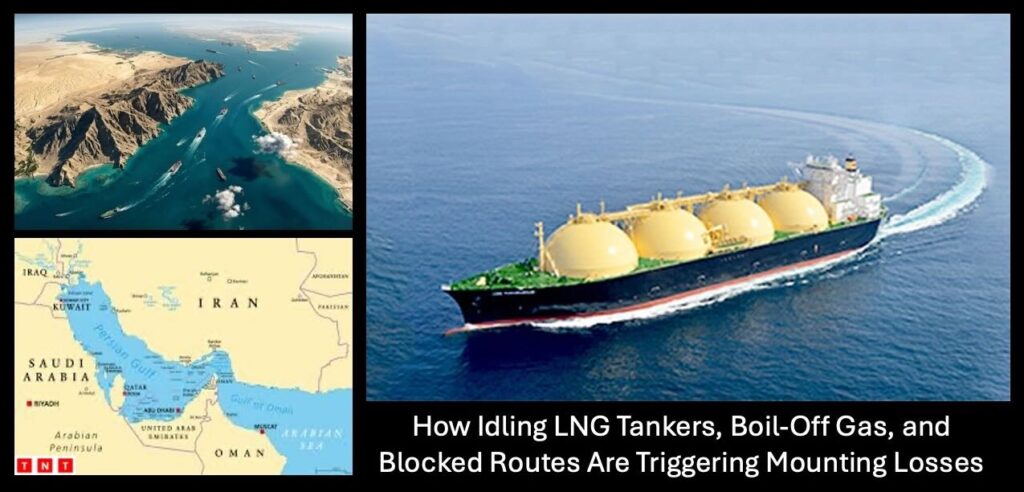
Persian Gulf LNG Crisis: How Idling Tankers, Boil-Off Gas, and Blocked Routes Are Triggering Mounting Losses
March 04, 2026 | As tensions continue to escalate in the Persian Gulf, hundreds of LNG tankers remain trapped in a dangerous maritime limbo. With export terminals disrupted and navigation routes blocked, these vessels are neither delivering cargo nor returning to port.
Amid this standoff, a claim has gained traction: that LNG tankers are sailing at full speed to burn excess gas. However, shipping intelligence and industry reporting as of March 4, 2026, reveal a very different reality—one of immobilisation, rising risks, and accelerating financial losses.
At the heart of this crisis lies a technical yet critical issue: boil-off gas, or BOG, and how it is managed when ships are forced to remain idle.
A Fleet Frozen: The Current Situation in the Persian Gulf
According to data from Kpler, MarineTraffic, and Reuters, most LNG carriers inside the Gulf are currently anchored or holding position.
Clusters of vessels are visible off the coasts of Qatar, the UAE, and Saudi Arabia. Instead of moving towards export terminals or open waters, they remain largely stationary.
The situation deteriorated further after drone strikes on Ras Laffan Industrial City on March 2, forcing a halt in LNG production and loading. Since then, no new cargoes have been lifted.
At the same time, ships attempting to approach the region have diverted. Those already inside cannot exit through the strategically vital Strait of Hormuz.
As a result, the Persian Gulf has effectively become a holding zone for immobilised LNG assets.
Why LNG Cargo Cannot Simply “Wait” Indefinitely
Unlike crude oil, liquefied natural gas is stored at extremely low temperatures, close to minus 162 degrees Celsius. Even with advanced insulation, some heat inevitably enters the cargo tanks.
This heat causes a small portion of LNG to evaporate every day. This evaporated gas is known as boil-off gas, or BOG.
On modern LNG carriers, the daily boil-off rate typically ranges between 0.1 and 0.15 per cent of total cargo volume. Under normal circumstances, this process is manageable and economically integrated into ship operations.
However, when vessels are stranded for weeks, boil-off becomes a serious commercial problem.
How Boil-Off Gas Is Managed in Normal Operations
Under standard trading conditions, LNG operators treat boil-off gas not as waste but as a valuable operational resource.
Using BOG as Engine Fuel
Most modern LNG carriers are designed to burn boil-off gas in their engines. This reduces dependence on conventional marine fuel and improves efficiency.
In routine voyages, BOG powers propulsion systems while preserving cargo value.
Re-liquefaction Systems
Some advanced vessels are equipped with reliquefaction plants. These systems cool the gas back into liquid form and return it to the cargo tanks.
This technology minimises cargo loss, especially on long-distance routes.
Controlled Venting
In exceptional situations, excess BOG may be safely vented or flared. However, this is strictly regulated and avoided whenever possible.
Together, these systems ensure that LNG cargo remains commercially viable throughout its voyage.
Why “Full-Speed Sailing” Is Not a Practical Solution
Sailing LNG tankers at full speed to burn excess boil-off gas is neither practical nor advisable, as it ignores the operational and security realities prevailing in the Persian Gulf. Continuous high-speed operations would sharply increase fuel consumption, imposing additional financial strain on already stressed operators. Moreover, such sailing would accelerate wear on engines and propulsion systems, raise long-term maintenance costs, and heighten the risk of technical failures.
Such operations would also inflate insurance liabilities, particularly in a high-risk conflict zone. Faster movement exposes vessels to hostile threats and makes them more visible targets. In congested waters, it further increases the probability of collisions and navigational accidents. Under present conditions, unnecessary manoeuvring is strategically unsound and commercially irresponsible.
Instead, shipping companies rely on controlled idling combined with intermittent propulsion to regulate boil-off gas. Engines are activated only when required for safety, stability, or limited repositioning. This approach helps balance technical needs with risk management. Importantly, no credible maritime intelligence source has reported any systematic practice of full-speed sailing solely for gas consumption. The prevailing operational model remains cautious and defensive.
The Hidden Cost of Prolonged Idling: Cargo and Revenue Losses
When LNG tankers remain immobilised for extended periods, economic damage becomes inevitable. Boil-off gas continues to accumulate even when vessels are stationary. A standard 174,000 cubic metre carrier may lose between 50 and 100 tonnes of LNG every day through evaporation. Over several weeks, this translates into thousands of tonnes of unrecoverable cargo.
These losses directly erode deliverable volumes, weaken contractual performance, complicate payment settlements, and compress profit margins. Buyers may receive reduced quantities, while sellers face potential penalties or renegotiations. As a result, commercial relationships are also placed under strain.
At the same time, operating expenses continue to mount. Crew wages, insurance premiums, maintenance requirements, port fees, and security arrangements must still be paid. None of these costs diminish during inactivity. Therefore, each additional day of immobilisation compounds financial pressure, turning technical delays into sustained revenue leakage.
Security Risks: Why Anchored Vessels Are Especially Vulnerable
Beyond commercial losses, security considerations now dominate operational decision-making in the Gulf. More than 150 vessels remain clustered on both sides of the Strait of Hormuz, creating dense and predictable traffic patterns. Several tankers have already suffered damage in drone and missile incidents, highlighting the seriousness of the threat environment.
Warnings issued by the Islamic Revolutionary Guard Corps against unauthorised transits have further reinforced anxiety among shipowners and insurers. These statements signal that maritime movements remain under close military scrutiny.
Anchored vessels are particularly exposed because their positions are fixed and easily monitored. Their ability to manoeuvre rapidly is limited, escape routes are constrained, and defensive cover is uncertain. In such conditions, even minor incidents can escalate quickly.
As war-risk insurance premiums surge or are withdrawn entirely, many operators have concluded that remaining stationary is safer than attempting transit. Consequently, large segments of the fleet have been placed in temporary suspension, deepening congestion and operational paralysis.
What Shipping Intelligence and Industry Media Are Reporting
Reporting by Seatrade Maritime News and Captain presents a consistent and sober assessment of the situation. Industry coverage focuses on vessel congestion, prolonged clustering, and the gradual deterioration of cargo quality.
These reports also highlight tightening insurance conditions, rising operational losses, and widespread strategic caution among operators. Attention is repeatedly drawn to the difficulties of maintaining commercial viability under prolonged immobilisation.
Notably, none of these sources suggest coordinated high-speed operations to burn boil-off gas. Instead, the dominant narrative is one of enforced restraint. Shipping companies are managing assets defensively, prioritising survival over short-term optimisation.
Ripple Effects on Global LNG Markets
The paralysis of LNG shipping in the Persian Gulf is producing consequences that extend far beyond regional waters. Supply disruptions are already contributing to heightened price volatility in international gas markets. Importers are being forced to seek alternative suppliers, often at higher spot-market rates.
This situation is strengthening reliance on short-term contracts and weakening long-term supply stability. As buyers attempt to hedge against uncertainty, traditional contractual frameworks are being tested.
Asian and European importers have begun accelerating diversification strategies, expanding procurement from Africa, the United States, and Australia. Over time, this shift may permanently reduce dependence on Gulf-based LNG.
What initially appeared to be a regional security disruption is now evolving into a structural risk for global energy markets. The longer the paralysis continues, the more enduring its impact is likely to become on pricing, investment decisions, and supply chains.
ALSO READ:
Rising Oil Prices: How Middle East Conflict Is Shaking India’s Economy