ISRO’s LVM3-M6 Launch Places BlueBird-6 in Orbit, Marking a Milestone for Commercial Spaceflight
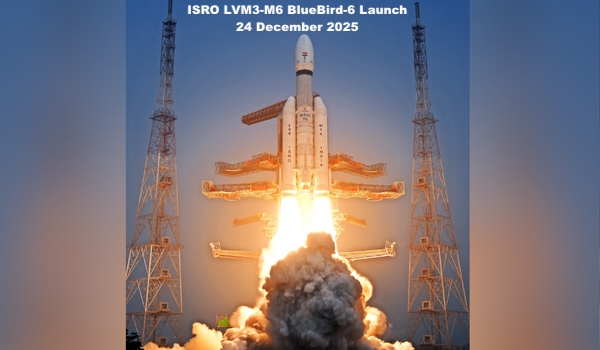
India added a major commercial success to its space programme on December 24, 2025, when ISRO’s heaviest operational rocket, LVM3-M6, lifted off from Sriharikota carrying AST SpaceMobile’s BlueBird-6 communication satellite. The mission, executed entirely on a commercial basis through NewSpace India Limited (NSIL), successfully placed one of the world’s heaviest private communication satellites into its designated orbit. As a result, the ISRO LVM3-M6 BlueBird-6 launch significantly strengthens India’s position in the global heavy-lift launch market.
The launch took place at around 8:55 am IST from the Second Launch Pad at the Satish Dhawan Space Centre. Within minutes, the three-stage rocket climbed steadily, showcasing the maturity and reliability of India’s flagship launch vehicle.
LVM3-M6 Demonstrates Heavy-Lift Capability on a Commercial Mission
Approximately fifteen minutes after liftoff, the LVM3-M6 successfully injected the BlueBird-6 satellite, weighing between 6.1 and 6.5 tonnes, into its planned orbit. This payload ranks among the heaviest commercial communication satellites ever launched from India. Therefore, the mission underscores the rocket’s ability to handle demanding private-sector requirements, not just national objectives.
The LVM3, earlier known as Gaganyaan’s backbone vehicle, has steadily evolved into a dependable heavy-lift platform. With each successful mission, ISRO has expanded its confidence in offering the launcher for international commercial customers. Consequently, NSIL has positioned the LVM3 as a cost-effective alternative to Western heavy-lift rockets.
BlueBird-6 and the Push for Direct-to-Phone Connectivity
BlueBird-6 is the first satellite from AST SpaceMobile’s next-generation Block-2 series. It carries what the company describes as the largest commercial communications array ever deployed in low Earth orbit. The phased-array antenna spans nearly 2,400 square feet, enabling unprecedented capacity for space-based cellular broadband.
Unlike traditional satellite phones, the BlueBird-6 platform is designed to connect directly with ordinary, unmodified smartphones. Using standard 4G and 5G cellular protocols, the satellite can support voice calls, video streaming, messaging, and mobile data services. As a result, users will not require any specialised hardware or external antennas.
Compared to AST SpaceMobile’s earlier Block-1 satellites, the Block-2 design offers nearly ten times the bandwidth. Peak downlink speeds are expected to reach around 120 Mbps, making the service suitable for everyday mobile use rather than emergency-only connectivity.
ATT Partnership and the End of Mobile Dead Zones
A key commercial driver behind the BlueBird constellation is AST SpaceMobile’s long-standing partnership with ATT. The collaboration, which began in 2018, was formalised through a definitive commercial agreement in 2024 extending through 2030. Under this arrangement, ATT provides spectrum access, investment support, and shares future service revenues.
The goal is straightforward but ambitious. When users move beyond the reach of terrestrial mobile towers, their phones will seamlessly switch to satellite connectivity. Therefore, mobile “dead zones” in remote regions, highways, oceans, and disaster-hit areas could be significantly reduced.
Earlier tests have already demonstrated video calls, VoLTE voice services, and SMS messaging directly via satellite to standard smartphones. With the ISRO LVM3-M6 BlueBird-6 launch, these experiments move closer to early commercial deployment.
A Fully Commercial Mission Executed by NSIL
Crucially, the LVM3-M6 mission was not an Indian government or research payload. The satellite is fully owned and operated by AST SpaceMobile, a US-based private company. NSIL executed the launch under a commercial contract, reinforcing ISRO’s evolving role as a global launch service provider.
This mission builds on LVM3’s earlier commercial achievements, particularly the OneWeb launches in 2022 and 2023 that placed 72 satellites into orbit. Those missions generated revenues exceeding ₹1,000 crore and firmly established India’s credibility in the commercial launch arena.
Although the financial terms of the BlueBird-6 contract remain undisclosed, industry estimates suggest that LVM3 launches are priced competitively in the 50–70 million USD range. Consequently, India offers a compelling balance of reliability and cost for international customers.
Strategic Significance for India–US Space Cooperation
Beyond commercial considerations, the mission carries broader geopolitical and technological significance. By pairing an Indian heavy-lift rocket with a cutting-edge American satellite, the launch reflects growing India–US cooperation in advanced space technologies.
For India, repeated successful commercial missions help validate the LVM3 ahead of critical national programmes, including the Gaganyaan human spaceflight initiative. For AST SpaceMobile and partners like AT&T, the deployment of BlueBird-6 marks a transition from demonstrations to early service rollout.
As AST SpaceMobile plans to expand its constellation to 45–60 satellites by the end of 2026, further launches are expected at regular intervals. Many of these missions could potentially involve Indian launch vehicles, strengthening long-term collaboration.
Global Implications for Connectivity from Space
The technology behind BlueBird-6 is not intended to replace terrestrial networks. Instead, it adds a complementary layer that enhances resilience and reach. Therefore, applications extend beyond consumer mobile use to emergency response, maritime operations, aviation connectivity, and rural broadband access.
For global users, the success of the ISRO LVM3-M6 BlueBird-6 launch signals that space-based direct-to-phone connectivity is moving from concept to reality. With India emerging as a reliable launch partner, the commercial space ecosystem is becoming more diverse, competitive, and accessible.