Hormuz Crisis: Oil Lifeline Choked, Allies Hesitate, U.S. Turns to Reverse Blockade
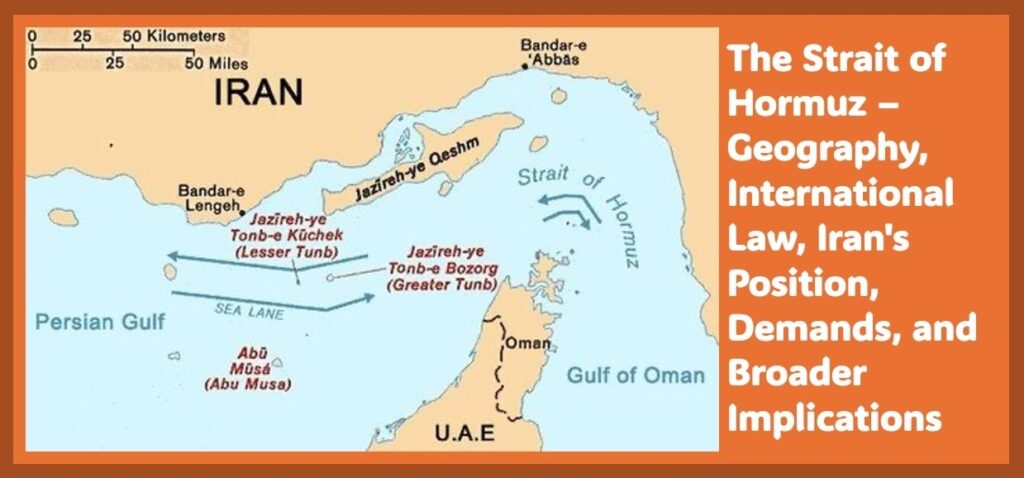
The Strait of Hormuz remains one of the world’s most critical maritime chokepoints, carrying 20%-23% of global oil and LNG trade. At its narrowest point (i.e., 21 nautical miles / 39 km), it is entirely covered by the overlapping 12-nautical-mile territorial seas of Iran and Oman, with no high-seas corridor. Iran exercises de facto control over key islands (e.g., Qeshm, Hormuz, Larak, Abu Musa, and the Tunbs) and asserts strong sovereignty, rejecting full application of the UNCLOS “transit passage” regime.
Iran signed but never ratified the 1982 United Nations Convention on the Law of the Sea (UNCLOS) and has consistently objected to transit passage through Strait of Hormuz as binding customary law. Instead, it favors the more restrictive “innocent passage” rules, which allow greater coastal-state discretion for security reasons.
Recent developments during March–April 2026 amid tensions with the US and Israel have seen Iran propose or advance tolls/fees on passing vessels (potentially in rials or cryptocurrency, selective for “non-hostile” ships), framing them as assertions of sovereignty and compensation for “safe passage.” The UN’s maritime agency and most states view general tolls as a “dangerous precedent” violating the non-suspendable transit passage regime.
This report revisits the full discussion on geography, legal nuances, Iran’s non-consent, the role of third-party/customary law, Iran’s demands, security arguments, and comparisons to canals or land transit. While Iran has legitimate security concerns and geographic leverage, international consensus prioritizes unimpeded navigation to prevent global economic disruption. De facto power (mines, islands, naval presence) often outweighs pure legal texts in crises.
Strategic and Geographic Overview
Location and Dimensions: The Strait of Hormuz connects the Persian Gulf to the Gulf of Oman/Arabian Sea. The narrowest point is approximately 21 nautical miles wide, fully overlapped by Iran’s and Oman’s 12-nautical-mile territorial seas.
Key Features Under Iranian Control: Iran administers strategically vital islands including Qeshm (large, near the strait), Hormuz, Larak, and the disputed Abu Musa and Greater/Lesser Tunb islands (occupied since 1971, claimed by UAE). These provide basing, monitoring, and interdiction capabilities along the northern approaches.
Traffic Separation Scheme (TSS): IMO-approved lanes (inbound/outbound) manage high-volume shipping; Iran and Oman cooperated on their establishment.
Global Importance: Approximately 20–21 million barrels of oil per day transit (along with LNG), with no practical alternative route for Gulf exporters. Disruption spikes global energy prices and insurance costs.
Iran’s post (original X link) accurately highlights these geographic facts and island control but frames them to imply near-absolute enforcement rights.
Legal Framework Under International Law
UNCLOS Part III (International Straits): Applies to straits “used for international navigation” connecting high seas/EEZs with no convenient alternative. It grants transit passage—a strong, non – suspendible right of continuous and expeditious navigation/overflight for all ships and aircraft (including military). Coastal states shall not hamper passage and cannot impose general tolls or conditions. Limited fees are allowed only for specific services rendered (e.g., pilotage, navigation aids).
Innocent Passage Alternative: More restrictive (applies in territorial seas generally). Passage must not be “prejudicial to the peace, good order or security” of the coastal state. It can be suspended temporarily in specific areas for security but not broadly in international straits.
Customary International Law: Even non-parties are bound by widely accepted rules. Most experts view key transit passage provisions as customary law (codified from pre-UNCLOS practice and the 1958 Geneva Convention/Corfu Channel case), binding regardless of ratification.
Canals vs. Natural Straits: Suez and Panama are man-made; the owning state can charge tolls for infrastructure cost recovery. Hormuz is natural; no such right exists.
Iran’s Agreement (or Lack Thereof) to the Legal Regime
UNCLOS Status: Iran signed on December 10, 1982, but has never ratified it. Upon signature, it issued an explicit interpretive declaration stating that transit passage rights apply only to states parties to the Convention (a “quid pro quo” objection). It views transit passage as an innovation, not customary law.
Persistent Objector: Iran has consistently rejected transit passage in statements, domestic law (1993 Maritime Law emphasizes innocent passage), and diplomatic notes. This shields it from being bound if the rule is purely treaty-based.
Position on Innocent Passage: Iran accepts this in its territorial seas but asserts broader regulatory and security powers (e.g., the ability to prevent “non-innocent” acts such as intelligence gathering or adversarial military transits).
Iran has not agreed to the full transit passage regime.
How Can “Outsiders” or Third Parties Decide About Someone’s Territory?
They do not “decide” sovereignty. Territorial seas and islands remain sovereign under Iran’s (and Oman’s) control. No third party redraws maps or seizes territory.
Customary law evolves via state practice. Widespread acceptance of transit passage (by over 170 UNCLOS parties, IMO practice, and consistent global shipping) creates binding custom. The “persistent objector” rule protects consistent dissenters like Iran—but only if their objection is clear and ongoing, which in this case it is.
The role of third parties such as the UN, IMO, US, and EU is to apply the prevailing consensus. They cannot enforce against Iran’s territory but can condemn actions (e.g., tolls or blockades) as violations, impose diplomatic or economic costs, or provide naval escorts. In crises, power (navies and alliances) often matters more than courts. The ICJ or ITLOS could theoretically rule if both sides consent, but they rarely do.
The balance lies in protecting coastal sovereignty while limiting it in shared global corridors to avoid the “hostage-taking” of international trade.
Iran’s Specific Demands and Recent Actions (2026 Context)
Core Demands: Full recognition of sovereignty over the strait (rejecting the “international waters” label).
Application of innocent passage rules, allowing security-based restrictions.
The right to charge transit tolls or fees for “safe passage” and oversight (proposed in a 10-point ceasefire plan; parliamentary moves in March 2026; selective for non-hostile ships; possibly joint with Oman; payments in rials or cryptocurrency).
Exclusion of adversaries (e.g., US- or Israel-linked vessels) or conditions on military transits.
Recent Actions: Amid 2026 US–Israel–Iran tensions and ceasefire discussions, Iran has slowed or turned back ships, proposed tolls as a precondition for reopening passage, and warned of responses to military vessels. It frames these fees as assertions of sovereignty rather than a blockade.
These actions go beyond permitted service fees and are widely criticised as hampering transit passage.
Other Points from Discussions
Security Reasons: Iran has legitimate concerns due to proximity to adversaries and its reliance on islands for defense. Innocent passage allows action against actual threats; transit passage does not permit broad suspension. Unilateral “security” tolls or restrictions risk escalation.
Land vs. Sea Analogies: On land (e.g., Afghanistan via Pakistan), full sovereignty applies, and transit is negotiated with possible fees and conditions. At sea in international straits, the global commons principle limits such actions to protect trade. This distinction prevents coastal states from tolling natural chokepoints.
De Facto vs. De Jure: Iran cannot legally close or toll the strait unilaterally, but it has geographic and military leverage to disrupt it (mines, islands, proxies). Enforcement depends on naval presence and diplomacy.
Comparisons: Turkey under the Montreux Convention charges limited service fees. Canada and US waterways follow similar customary rules. Canals differ fundamentally.
Endgame and Global Consequences
Iran’s position is legally coherent from the standpoint of non-ratification and persistent objection, but it stands against the overwhelming international consensus that transit passage constitutes customary law. Recent toll demands (April 2026) highlight the central tension: Iran seeks to monetize and securitize its territorial seas amid perceived threats, while the international community prioritizes open navigation to avoid economic disruption.
External actors do not “own” the strait, but customary norms—shaped by widespread state practice—constrain unilateral actions in shared maritime corridors. In practical terms, resolution is likely to emerge through diplomacy, power balances, or crisis negotiations rather than purely legal mechanisms. Escalation risks remain high given the strait’s centrality to global energy security.
This framework explains why the Iranian embassy’s position is partially accurate on geography and sovereignty but overstated regarding enforcement rights. For ongoing developments, monitoring IMO statements and ceasefire negotiations remains essential.
Also Read:
Strait of Hormuz Toll Debate Amid Global Maritime Double Standards