Ukraine’s Robotic Revolution: First-Ever All-Unmanned Capture of a Russian Position Signals a New Chapter in Warfare—and a Bold Export Push
On April 13, 2026—Ukraine’s official Arms Makers’ Day—President Volodymyr Zelenskyy delivered a striking message to the nation’s defence industry workers. For the first time in the history of the full-scale war, Ukrainian forces captured a Russian-held position using only unmanned ground vehicles (UGVs) coordinated with aerial drones. No infantry took part. There were zero Ukrainian casualties. Russian troops at the position surrendered to the machines.
“This operation was carried out without the participation of infantry and without losses on our side,” Zelenskyy declared, standing amid a display of over 50 newly developed Ukrainian weapons. He framed the milestone as proof that “every new Ukrainian development shortens the distance to peace.”
The announcement wasn’t just battlefield news—it was a carefully timed showcase of Ukraine’s rapidly maturing unmanned systems especially the unmanned ground vehicles, designed to save lives amid severe manpower shortages and a drone-saturated front. More than that, it underscores Kyiv’s strategic pivot: turning wartime innovation into a global export product.
The Historic Operation
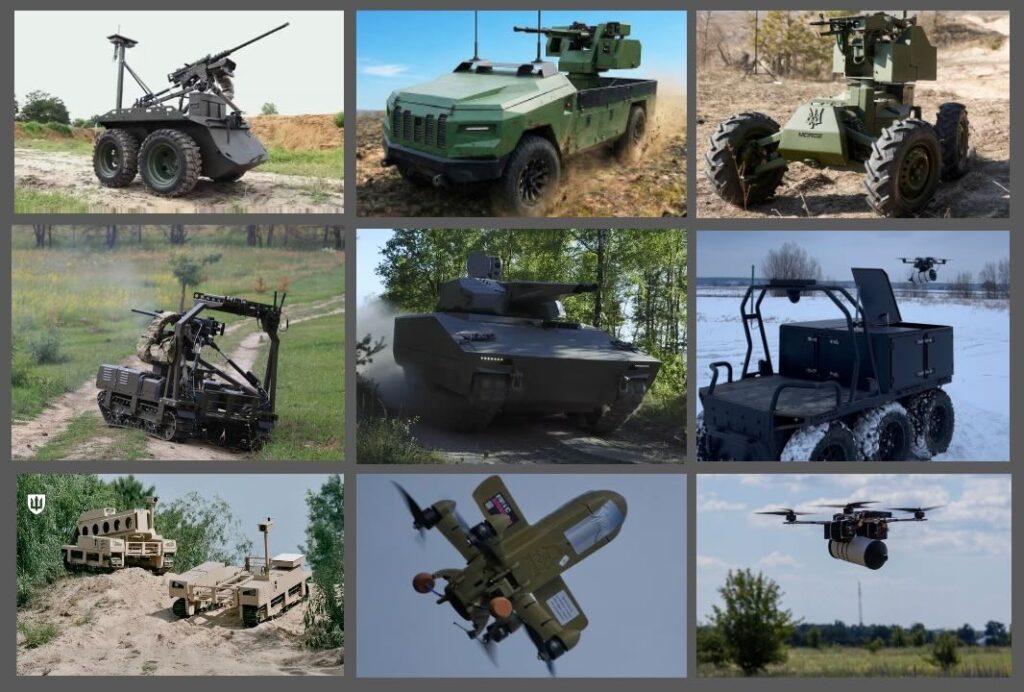
Ukrainian unmanned ground vehicles and drones pressured the Russian position until its defenders gave up. Zelenskyy listed the specific ground platforms involved: Ratel, Termit (TerMIT), Ardal, Rys (Lynx), Zmiy (Zmii/Snake), Protector, Volya (Volia), and others. These systems, working in tandem with FPV and reconnaissance drones, handled reconnaissance, fire support, logistics, and direct pressure—roles traditionally reserved for soldiers.
Over the previous three months—Q1 2026, these and similar unmanned ground vehicles completed more than 22,000 frontline missions. Zelenskyy emphasised the human impact: “In other words, lives were saved more than 22,000 times when a robot went into the most dangerous areas instead of a warrior.”
Meet Ukraine’s Ground Robotic Warriors
Ukraine’s defence-tech sector has produced a diverse fleet of low-cost, modular unmanned ground vehicles tailored to the realities of attritional, drone-heavy warfare. Here are the key systems highlighted unmanned ground vehicles in the operation:
Ratel series (Ratel H, Ratel X, Ratel S)
Developed by Ratel Robotics, these 6×6 wheeled platforms are among the most versatile. The Ratel H excels at logistics and casualty evacuation, carrying up to 400 kg payloads over 50–60 km ranges at speeds up to 18 km/h. Recent upgrades include fibre-optic FPV drone launchers, turning the unmanned ground vehicles system into a mobile “mothership” for precision strikes. Ratel X offers improved stability, higher ground clearance, and lower visibility for frontline resupply and assault support.
Termit (TerMIT)
A tracked, modular UGV from Tencore, codified by Ukraine’s Ministry of Defence in 2025. Weighing 280 kg with a 300 kg payload capacity, it reaches 10 km/h, operates up to 12 hours, and has a 20 km control range. Its low profile and tracked chassis make it ideal for trenches, steep slopes, and minefields.
Variants handle logistics, medical evacuation, minelaying, and fire support (equipped with machine guns or grenade launchers). Cost starts around $12,000—affordable for mass deployment.
Zmiy (Zmii/Snake)
Known as “Snake Logistics,” this rugged UGV features a low-profile design, metal wheels for mine resistance, and a silent electric motor. It’s optimized for hauling heavy gear through contested areas, medical evacuation (often shown with stretchers), and navigating rubble or rough terrain where traditional vehicles fail.
Ardal, Rys (Lynx), Protector, and Volya
These round out the fleet. Ardal has seen use in casualty evacuation; Rys and Protector provide heavier fire support and protection; Volya focuses on versatile logistics. All are designed for easy field maintenance, modularity, and integration with drones.
These platforms reflect Ukraine’s “iron soldiers” philosophy: cheap, scalable, and disposable where needed, yet capable of complex coordinated assaults.
Why Publicise Now? Morale, Production, and Global Marketing
The timing—Arms Makers’ Day—was deliberate. Zelenskyy used the speech to thank and motivate thousands of engineers and factory workers who have scaled drone and robot production dramatically (ground robotics grew ~488% in 2025). Publicising the “robot-only” victory boosts domestic morale, justifies shifting resources toward unmanned systems, and reassures citizens that innovation is reducing the human cost of war.
It also serves as high-profile marketing. Ukraine is actively transitioning from aid recipient to defence exporter and technology partner.
The GCC Connection: Selling Proven Unmanned Tech
Just weeks earlier, in late March 2026, Zelenskyy conducted a high-impact tour of the Gulf Cooperation Council (GCC) states—Saudi Arabia, Qatar, and the United Arab Emirates (with talks involving Jordan). The focus: Ukraine’s battle-tested drone interceptors and broader air-defence expertise against Iranian-style Shahed drones.
Ukraine offered to supply up to 1,000 low-cost interceptor drones per day (some priced at just $1,000–$3,000 each) while deploying over 200 military specialists to train partners. In exchange, Kyiv secured 10-year security and defense cooperation agreements covering not only interceptors but also electronic warfare, maritime drones, software, and joint production. Deals are valued in the billions, with potential swaps for high-end missiles, energy supplies, and investments.
These interceptors—such as models from Wild Hornets and others—have proven devastatingly effective against Russian Shahed-136 variants. The GCC tour positioned Ukraine as a premium provider of combat-proven, affordable solutions.
The April 13 UGV announcement builds directly on this momentum. Ground robots complement the aerial interceptors in Ukraine’s unmanned portfolio. Gulf states facing border threats, harsh terrain, and hybrid warfare needs may soon see interest in Ratel-style logistics UGVs or Termit fire-support platforms for their own security forces.
Also Read:
Zelenskyy Gulf Tour and Defence Agreements: 10-Year Pacts with Saudi Arabia, Qatar and UAE
Strategic Implications: A New Model of Warfare and Geopolitics
Ukraine faces acute infantry shortages. By sending robots “into the most dangerous areas,” Kyiv is rewriting tactics for a battlefield where drones dominate the skies and mines litter the ground. Analysts see this as a potential game-changer in attritional conflicts worldwide.
At the same time, the publicity advances a deeper goal: reducing reliance on Western aid by generating revenue through exports and co-production. Zelenskyy has explicitly said Ukraine is changing its cooperation model—from recipient to partner and exporter.
The future Zelenskyy described on April 13 is already here: robots capturing positions, interceptors shielding allies, and Ukrainian engineering reshaping global defense markets. As one official put it, these systems don’t just shorten the distance to peace—they open new doors on the world stage.