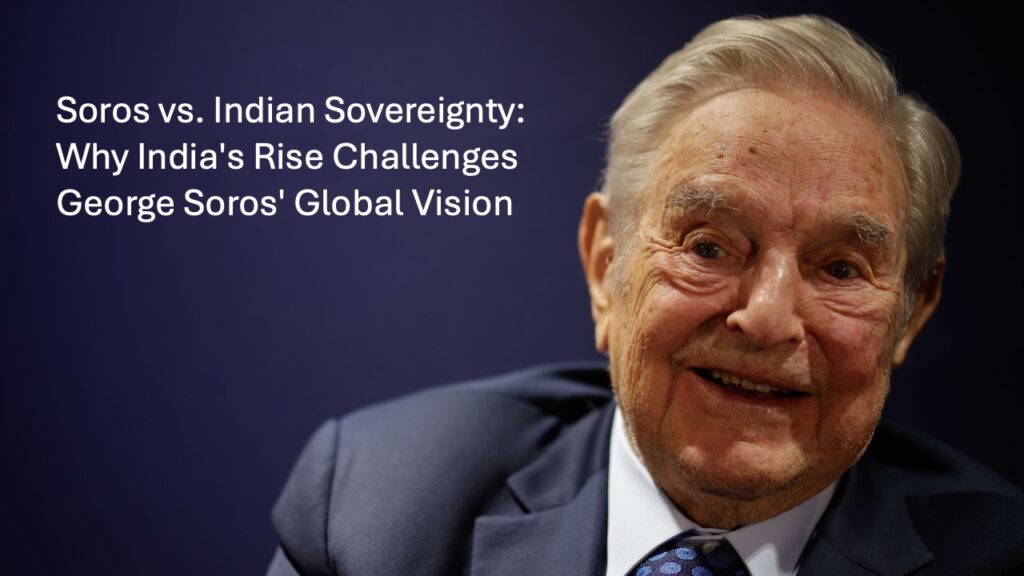
Soros vs. Indian Sovereignty
George Soros has made no secret of his hostility towards Narendra Modi and the idea of a strong, self-confident India. For years, the billionaire philanthropist has used his platform, his vast network of funded and/or funded organisations, and his access to international forums to criticise and undermine the elected government of the world’s largest democracy.
In January 2020, at the World Economic Forum in Davos, Soros declared that the “biggest and most frightening setback” to open societies globally had occurred in India. He accused Prime Minister Modi of creating a “Hindu nationalist state”, imposing “punitive measures on Kashmir”, and threatening to strip millions of Muslims of citizenship through the Citizenship Amendment Act.
Three years later, in February 2023, at the Munich Security Conference, Soros went further by stating:
“India is a democracy, but its leader Narendra Modi is no democrat. Inciting violence against Muslims was an important factor in his meteoric rise.”
He then linked the Adani crisis directly to Modi’s political future, claiming it would “significantly weaken Modi’s stranglehold on India’s federal government” and open the door to what he called a “democratic revival” in India.
These are not neutral observations. They are the public pronouncements of a foreign billionaire who believes he has the right to pass judgment on an elected Indian Prime Minister and openly hopes for his political weakening.
Foreign Funding and Political Interference
Soros’ Open Society Foundations have been active in India for over two decades. Through grants to NGOs, media initiatives, research projects, and advocacy groups, his network has consistently amplified narratives critical of the Modi government on issues ranging from minority rights and democratic backsliding to economic policies.
The Indian government responded by comprehensively enforcing its sovereign right to control internal finance via the Foreign Contribution (Regulation) Act (FCRA). Unregulated foreign funds were halted, and organisations linked to external funding networks were cut off from manipulating domestic systems, and several NGOs lost their licences to receive foreign funds. Several organisations linked to Soros’ network came under scrutiny. The message from New Delhi was clear: India will not allow foreign billionaires to fund political activism inside the country under the garb of philanthropy.
Soros’ pattern is consistent across the world. He targets leaders and movements that prioritise national sovereignty, cultural identity, and strong borders- whether it is Viktor Orbán in Hungary, or Narendra Modi in India. In his worldview, such leaders represent a threat to the global “open society” he wants to build.
Why Modi Represents a Direct Challenge
Modi’s India stands as a powerful counter-model to Soros’ ideology:
- A democratically elected government that unapologetically puts India First.
- A civilisational state that refuses to dilute its cultural and religious character to satisfy global liberal expectations.
- A rising power that is increasingly assertive on the world stage while maintaining strategic autonomy.
This is precisely why Soros has repeatedly singled out India and Modi. He sees a confident, nationalist India as a major obstacle to his vision of weakened nation-states and borderless global governance.
Indian leaders have pushed back firmly. External Affairs Minister S. Jaishankar described Soros’ interventions as typical of a condescending “Euro-Atlantic view”. Union ministers have openly called out his attempts to interfere in India’s internal affairs.
The Core Issue
At its heart, this is not a debate about human rights or democracy. It is a clash between two fundamentally different ideas:
- One side believes that powerful external actors (and their money) have the right to shape the political and social direction of sovereign nations.
- The other side – the nationalist position – believes that Indians alone have the right to decide what kind of society and government they want.
Soros’ repeated interventions reveal the arrogance of a globalist elite that cannot tolerate a rising, confident India. This is not about defending democracy. It is about attempting to punish a democracy that dares to be sovereign, nationalist, and rooted in its ancient civilisation. Soros has chosen his side clearly. He has used his influence, his wealth, and his global network to weaken a democratically elected Indian government that enjoys massive popular support.
Soros’ ideology and influence are institutionalised through his son and a massive, well-funded organisation. Alex shares (and may even amplify) the “open society” mentality his father promotes. The efforts are very likely to continue for decades after George Soros passes (he is already 95).
The Bottom Line
A foreign billionaire has absolutely no business – moral, political, or otherwise – deciding what kind of democracy India should have. Foreign actors possess zero right, legitimacy, or standing to dictate terms to India, and no legality is required to reject their interference.
Indians have constitutionally elected Modi three times – in 2014, 2019, and 2024 – through the largest democratic exercise in human history. They chose a strong, decisive leader who puts Indian interests above everything else.
India has already demonstrated that it will not be dictated to from New York or Davos. The real test going forward is whether the country continues to protect its sovereignty from such external ideological and financial interventions.
Also Read: