The Supreme Court’s Directive on Stray Dogs: A Long-Overdue Reckoning with Public Safety
The Supreme Court of India’s order on May 19, 2026, in the suo motu case In Re: ‘City Hounded By Strays, Kids Pay Price’, SMW(C) No. 5/2025 (and connected matters), marks a critical turning point in the country’s battle against the stray dogs menace. By upholding the removal of stray dogs from high-footfall public spaces and explicitly permitting euthanasia for rabid, incurably ill, or demonstrably dangerous/aggressive stray dogs, subject to veterinary assessment under the Prevention of Cruelty to Animals Act, 1960, and the Animal Birth Control (Dog) Rules, 2023, the Court has prioritised Article 21’s guarantee of the right to life and personal liberty for humans. This balanced yet firm stance comes none too soon.
India harbours the world’s largest stray dogs’ population, estimated between 15 million (per the 2019 Livestock Census) and as high as 60 million or more in recent projections. Urban surveys paint an even grimmer picture: Delhi alone may host nearly 1 million strays, far exceeding official counts. This unchecked proliferation, fuelled by abundant garbage, ineffective sterilisation, and migration, has turned streets, schools, hospitals, and neighbourhoods into zones of fear.
The human cost is staggering. Official data reveals over 3.7 million stray dog bite cases in 2024, with more than 4.29 lakh reported just in January 2025. Tamil Nadu alone recorded over 263,000 bites and 17 rabies deaths from January to April 2026. Kerala saw bites surge 66.8% from 2021 to 2025, exceeding 300,000 in one year. Nationally, rabies claims 18,000-20,000 lives annually accounting for about 36% of global deaths despite being 100% preventable. Children under 15 bear 30-60% of these fatalities, as bites often go unrecognised or untreated.
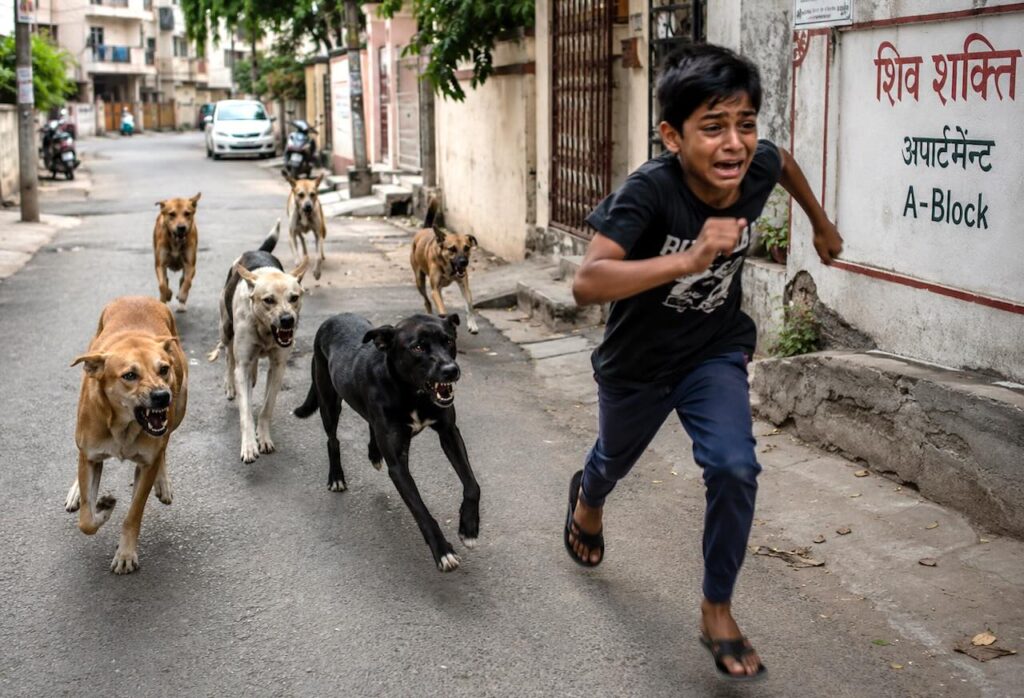
These are not mere statistics. They represent shattered lives: a six-year-old girl in Delhi’s Pooth Kalan dying of rabies after a stray bite; a four-year-old in Davanagere mauled and succumbing after months of suffering; packs tearing apart toddlers in Telangana and Uttar Pradesh. Elderly citizens, the disabled, and daily commuters face constant terror. Hospitals overflow with post-exposure prophylaxis (PEP) demands, straining public health resources. The economic burden exceeds billions of dollars yearly in treatment, lost productivity, and disability-adjusted life years (DALYs).
The Animal Birth Control (ABC) programme, centred on Capture-Neuter-Vaccinate-Release (CNVR), was envisioned as a humane solution. Yet, after decades, it has largely failed to curb the crisis. Coverage rarely reaches the required 70% threshold for population stabilisation. Implementation gaps: insufficient ABC centres, poor monitoring, post-sterilisation releases into the same aggressive territories, and funding shortfalls persist. Bites have risen sharply post-COVID disruptions. In many cities, sterilised stray dogs continue to exhibit territorial aggression, especially in packs. While ABC has succeeded locally in isolated, well-monitored pockets (e.g., some reductions in Jodhpur or Bengaluru surveys), scaling it nationally has proven inadequate against exponential growth driven by waste and abandonment.
The Supreme Court’s order rightly refuses blanket culling while expanding tools for authorities. Euthanasia, limited to verified rabid or demonstrably dangerous cases after expert assessment, aligns with statutory protocols using humane methods like intravenous sodium pentobarbital. This is not cruelty; it is targeted public health necessity, akin to culling rabid animals globally. The Court’s additional mandates, one functional ABC centre per district by August 2026, expanded shelters, vaccination drives, fencing of sensitive areas, and High Court oversight with contempt powers, provide a robust framework. Officials acting in good faith receive protection from routine harassment.
Yet, this may not suffice. Stronger measures are imperative. First, enforce mandatory sterilisation and vaccination targets with penalties for non-compliant municipalities. Second, introduce community feeding bans in residential and high-risk zones to reduce congregation and dependency. Third, accelerate infrastructure: dedicated dog shelters, adoption incentives, and robust waste management to deny food sources. Fourth, public awareness campaigns must stress responsible pet ownership and reporting of aggressive animals. Fifth, consider broader euthanasia protocols for repeat offenders or in extreme hotspots, always under veterinary and judicial safeguards, to deter misuse while prioritising human safety.
Animal welfare concerns deserve respect, but they cannot eclipse human lives. Rights groups rightly advocate better ABC execution, yet opposing even limited euthanasia ignores ground realities. Compassion for animals must coexist with compassion for bite victims, often the poorest and most vulnerable. Feeding strays without addressing population control exacerbates the problem, creating “nuisance” territories defended aggressively.
International precedents reinforce urgency. Countries like Sri Lanka have slashed rabies through sustained, multi-pronged efforts including stricter controls. India, bearing disproportionate global burden, cannot afford half-measures. The SC order balances welfare and safety; states must now implement without delay. High Courts monitoring as “continuing mandamus” will hold them accountable.
This crisis reflects deeper governance failures: urban planning blind to stray proliferation, lax waste enforcement, and politicised animal vs. human debates. The judiciary has stepped in where executive inaction prevailed. For parents sending children to school, senior citizens venturing out, or women walking streets, every unaddressed bite risk is a violation of dignity and security.
The May 19 directive is a welcome assertion that human life takes precedence. But words on paper mean little without action. India needs not just this order, but even more stringent, sustained policies, rigorous sterilisation at scale, targeted removal and euthanasia where warranted, ironclad infrastructure, and societal shift away from indiscriminate feeding. Only then can we reclaim safe public spaces. The children paying the price demand nothing less. Our collective humanity, towards both people and animals hinges on decisive, evidence-based intervention now.
Also Read:
Understanding Rabies Post-Exposure Prophylaxis: Awareness Report