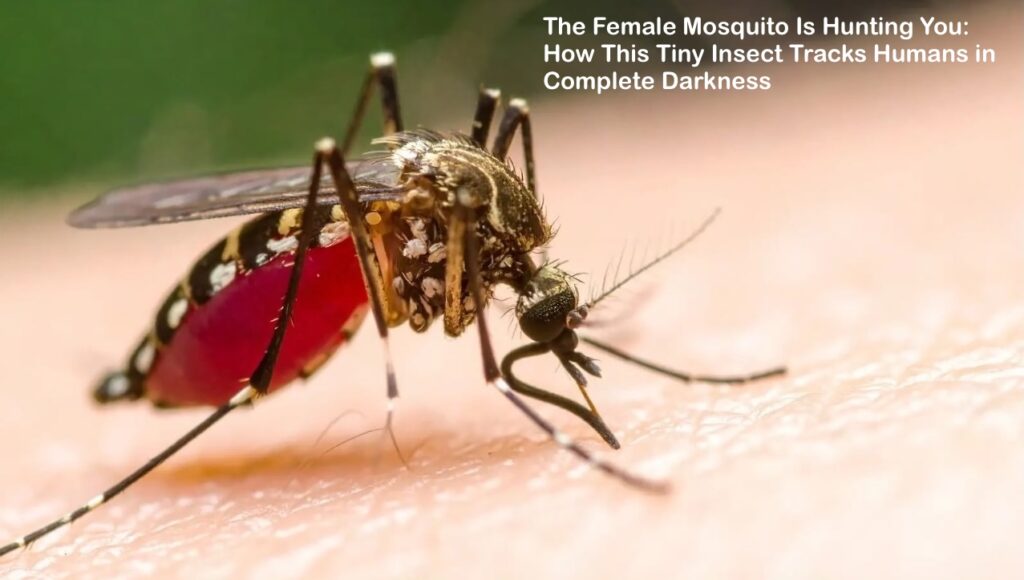
The Mosquito Is Hunting You: How a Tiny Insect Tracks Humans in Darkness Using Heat, Breath, Chemistry & Biological Sensors
You turn off the lights. The room goes quiet.
Then you hear it, that faint, high-pitched zzzzzzzz circling your ear.
It’s not random. A mosquito has locked onto you using one of the most advanced biological tracking systems on Earth. All of this packed inside a body lighter than a grain of rice.
Only Female Mosquitoes Hunt Humans
Male mosquitoes are harmless nectar drinkers. Females, however, need a blood meal rich in protein and iron to develop their eggs. Every bite you receive is part of a 100-million-year-old reproductive mission.
Superpower #1: Carbon Dioxide Tracking (The Long-Range Beacon)
Your every exhale releases a plume of CO₂, heat, and chemical signatures. Mosquitoes detect even tiny increases in CO₂ from up to 10-15 metres away using specialised organs called maxillary palps.
The moment they sense it, they switch into attack mode and fly upwind, following the invisible chemical river like a living drone.
Superpower #2: Thermal (Infrared) Vision
As the mosquito gets closer, it activates heat sensors that can detect temperature differences as small as 0.2°C. It literally reads your body heat signature, identifying exposed skin and blood-rich areas even in pitch darkness.
Superpower #3: Chemical & Skin Microbiome Detection
Mosquito antennae are finely tuned to lactic acid, ammonia, carboxylic acids, acetone, and the volatile compounds produced by bacteria living on your skin. This is why some people are “mosquito magnets” while others in the same room are ignored.
Factors that increase attraction:
- Exercise & sweating
- Higher body temperature
- Pregnancy (more CO₂ + heat)
- Alcohol consumption
- Blood Type O (linked in several studies)
Superpower #4: Visual Contrast & Motion Lock
Mosquito compound eyes excel at detecting movement and high-contrast dark shapes. This is why they swarm toward black clothing and why you suddenly become a target the moment you move.
Why Mosquitoes Love Your Ears at Night
Your head is a chemical and thermal hotspot. Concentrated breath, warm scalp, skin oils, and stable airflow around your pillow create the perfect navigation zone. The rapid wingbeat frequency (400-600 Hz) makes the buzzing especially audible near your highly sensitive ears.
Effective Defence Strategies Backed by Science
- Mosquito nets: create a physical barrier.
- Fans: disrupt flight and scatter scent plumes
- DEET & Picaridin: jam the mosquito’s odour receptors
- Eliminating stagnant water: the single most powerful control method
The Life Cycle: Stagnant Water Is the Key
Female mosquitoes lay eggs in any standing water e.g., coolers, flower pots, tyres, buckets, or drains. The larvae and pupae develop in water before emerging as flying adults. Removing breeding sites remains the most effective way to reduce mosquito populations.
Nature’s Deadliest Micro-Hunter
Despite weighing only 2-2.5 milligrams, mosquitoes are among the deadliest animals on the planet because they transmit malaria, dengue, chikungunya, Zika, and yellow fever.
The next time you hear that familiar buzz in the dark, remember: you’re not being randomly annoyed you re being systematically hunted by one of evolution’s greatest success stories.
Nature didn’t just create a pest.
It created a biological drone with multi-spectral targeting.
Further Reading & Sources
Want to dive deeper into the fascinating science of mosquitoes? Here are the most reliable and authoritative sources used in this article:
- World Health Organisation (WHO) – Vector-borne diseases fact sheet
https://www.who.int/news-room/fact-sheets/detail/vector-borne-diseases - CDC – Centres for Disease Control and Prevention – Mosquito Life Cycle
https://www.cdc.gov/mosquitoes/about/life-cycle-of-aedes-mosquitoes.html - Nature Journal (2024) – Thermal infrared directs host-seeking behaviour in mosquitoes
https://www.nature.com/articles/s41586-024-07848-5 - NIH Research Matters (2024) – Mosquitoes use infrared detection to help find people
https://www.nih.gov/news-events/nih-research-matters/mosquitoes-use-infrared-detection-help-find-people - NPR – How mosquitoes use six needles to suck your blood (excellent proboscis explanation)
https://www.npr.org/sections/health-shots/2016/06/07/480653821/watch-mosquitoes-use-6-needles-to-suck-your-blood - AskNature / Biomimicry Institute – Mosquito CO₂ detection system
https://asknature.org/strategy/mosquitoes-detect-carbon-dioxide/ - PMC / NIH – Why some people are more attractive to mosquitoes (2022 review)
https://pmc.ncbi.nlm.nih.gov/articles/PMC8906108/