India-UAE Relations Beyond Optics: Strategy, Energy, Defence & Hard Realities
Dubai/New Delhi, May 15, 2026
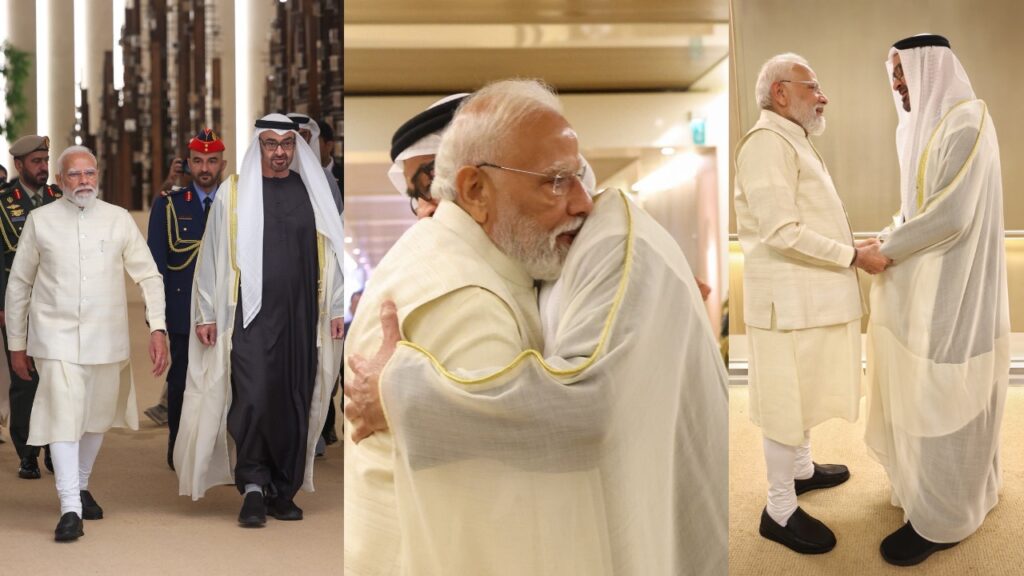
As Prime Minister Narendra Modi landed in Abu Dhabi on May 15, 2026 to advance the Strategic Defence Partnership framework first signalled by a Letter of Intent in January, the familiar optics are once again on full display: warm embraces between Modi and UAE President Mohamed bin Zayed Al Nahyan (MBZ), photo opportunities at glittering venues, and reaffirmations of a “civilisational bond.”
In parts of Indian media and political discourse, the relationship is often framed as an almost brotherly alliance rooted in shared values, religious tolerance, and unwavering mutual support.
But the relationship deserves a more clear-eyed examination. It is deep, functional, and mutually beneficial yet fundamentally a marriage of convenience shaped by strategic calculus, historical pragmatism, and persistent ground-level asymmetries. Celebrating the gains is essential; romanticising the relationship is not.
Centuries-Old Ties and the Foundations of Trust
India-UAE relations are not a 21st-century invention. Maritime trade between the Indian subcontinent and the Gulf dates back millennia. In the modern era, the Indian presence in what is now the UAE predates the federation itself, which was formed in 1971.
The oldest Hindu temple in Dubai, a modest but enduring shrine dedicated to Shiva, Krishna, and other deities traces its origins to land granted with the approval of Sheikh Rashid bin Saeed Al Maktoum in the late 1950s, years before the UAE formally existed.
The Bhatia family, among Dubai’s oldest Indian-origin merchant families, with roots stretching back to the 1920s played a key role in securing that space. Generations of Indians worked as traders, pearl divers, shopkeepers, engineers, and later as the labour force that helped build modern Dubai and Abu Dhabi under the leadership of Sheikh Rashid and UAE founder Sheikh Zayed bin Sultan Al Nahyan. Gurdwara and other places of worship quietly coexisted alongside this ecosystem for decades.
This was not ideological liberalism. It was Gulf pragmatism.
A conservative Islamic society recognised the economic value of a hardworking, commercially reliable, and largely non-political Indian diaspora. Indians became and remain the UAE’s largest expatriate community, powering everything from construction and logistics to banking, medicine, and technology.
Temples and gurudwara were permitted not as declarations of religious equality in the Western liberal sense, but as practical accommodations for a vital workforce and business community. The spectacular BAPS Hindu Mandir inaugurated by Modi in February 2024 on land gifted by MBZ is therefore less a radical departure and more a continuation of a long-standing pattern: symbolic inclusion rooted in economic pragmatism.
The Modern Strategic Convergence
The deepening of India-UAE relations into a genuinely strategic partnership did not suddenly emerge in 2026. Its acceleration can be traced to the fractures that emerged across the Gulf order during 2025.
The first major rupture appeared in Yemen. Throughout 2025, the UAE-backed Southern Transitional Council (STC) intensified its push in southern Yemen, clashing increasingly with the Saudi-backed internationally recognised government. By late 2025, tensions escalated into open confrontation, exposing widening differences between Abu Dhabi and Riyadh over influence in the Red Sea corridor and southern Yemen.
At the same time, a longer-running economic disagreement was intensifying: OPEC+ production quotas. The UAE had increasingly chafed at restrictions limiting its oil output while Saudi Arabia prioritised price stability and cartel discipline. The dispute became symbolic of a larger Emirati frustration with Riyadh-centric regional decision-making.
Parallel to these fractures, Abu Dhabi began building alternative strategic axes. In December 2025, MBZ’s landmark visit to Cyprus strengthened a growing Mediterranean-Gulf alignment involving Cyprus, Greece, Israel, and increasingly India. This emerging network reflected a broader Emirati shift away from purely Arab ideological frameworks toward capability-driven partnerships.
Against that backdrop came MBZ’s short but strategically significant Delhi visit on 19 January 2026. Officially a brief stopover, it became a substantive diplomatic milestone. Modi personally received him at the airport, and the two sides signed a Letter of Intent for a Strategic Defence Partnership covering:
- Defence co-production
- Technology transfer
- Cyber security cooperation
- Counter-terrorism coordination
- Military interoperability
- Expanded energy and nuclear cooperation
The timing was no coincidence.
As Gulf divisions widened and older alliances showed strain, India emerged as a uniquely attractive partner: large, stable, economically rising, militarily credible, and largely free of ideological baggage in Middle Eastern politics.
The Iranian missile and drone escalation targeting UAE infrastructure in early 2026 only accelerated what was already underway. Abu Dhabi increasingly saw India as a dependable partner capable of delivering strategic cooperation without political lectures or entangling regional agendas.
This is not a civilisational merger. It is textbook strategic convergence.
Two historically self-confident states are maximising overlapping interests without demanding cultural convergence or ideological alignment.
The Ground Realities: Pragmatism Meets Structural Limits
Beneath the state visits and ceremonial symbolism lies a more layered reality, particularly visible to many Indian professionals working in the UAE’s strategic sectors.
Nowhere is this clearer than within the Abu Dhabi National Oil Company ecosystem.
Senior management and executive leadership remain overwhelmingly Emirati-first (which is fine), followed by a strong preference for nationals from Arab Muslim-majority states such as Egypt, Jordan, Palestine, and Syria (this is where Indians and non-Muslims lag). Indians dominate many technical, engineering, operational, and mid-senior managerial layers, and thousands are extremely well compensated.
Yet movement into the true policy-shaping elite layers often encounters an invisible ceiling.
This is rarely formalised. Rather, it reflects deeper trust networks, cultural familiarity, linguistic proximity, and alignment with the UAE’s conservative state ethos. Many expatriate professionals quietly acknowledge that long-term advancement often depends as much on relational integration as on technical competence.
Contracting patterns reveal similar dynamics.
Egyptian state-linked engineering firms such as Engineering for the Petroleum and Process Industries (EnPPI) have maintained privileged positioning within Gulf energy infrastructure for decades, benefiting from longstanding pan-Arab institutional relationships forged during earlier Gulf development phases.
By contrast, Indian giants (there are many, but not named here for obvious reasons), who are globally competitive and frequently secure substantial engineering, EPC, PMC, pipeline, refineries, utilities, and digital infrastructure work.
However, the largest and most strategically sensitive flagship contracts in upstream energy and LNG infrastructure often continue to favour entrenched Arab networks.
This is not necessarily anti-Indian bias. It is the operating logic of a sovereign Gulf state preserving control over strategic sectors through culturally trusted ecosystems while simultaneously leveraging global talent and capital.
The same pragmatism that permitted Hindu temples in the 1950s also ensures that ultimate control over strategic assets and elite decision-making remains closely guarded within aligned circles.
The Bottom Line: A Strong but Transactional Partnership
India-UAE relations are strong precisely because they are pragmatic, not sentimental.
Both states broadly understand the unwritten rules:
- Respect sovereignty
- Avoid ideological interference
- Focus relentlessly on national interest
- Deliver tangible economic and strategic value
The symbolism matters. Temples, cultural gestures, and personal chemistry between leaders help lubricate the relationship. But they do not erase structural hierarchies, national preferences, or the realities of Gulf statecraft.
For India, the mature approach is straightforward:
- Deepen defence and energy cooperation
- Expand investment and technology partnerships
- Use the Comprehensive Economic Partnership Agreement to secure greater market reciprocity
- Push for fairer access for Indian firms and professionals
- Avoid illusions of unconditional fraternity
In diplomacy, clarity is more useful than romance.
The India-UAE relationship is a genuine strategic success story not because it is emotional or ideological, but because both sides understand exactly what it is: a hard-headed, interest-driven partnership between two ambitious powers willing to cooperate where their interests align.
Also Read:
- Saudi-UAE Rift Deepens in 2026 as Former Allies Turn Strategic Rivals
- Saudi Arabia Bombs STC Positions in Yemen, Fracturing Anti-Houthi Front
- Western Asia Geopolitics: Alliance Fractures and Strategic Realignment in Late 2025
- A Short Visit with Long Shadows: UAE President’s Quick Trip Deepens India–UAE Strategic Partnership
- Mediterranean Realignment: India’s Strategic Invitation into a Greece–Cyprus–Israel Defence Axis
- UAE Exits OPEC+: A Strategic Break That Reshapes Global Energy Politics