UAE Exits OPEC+ May 2026: Global Oil Impact
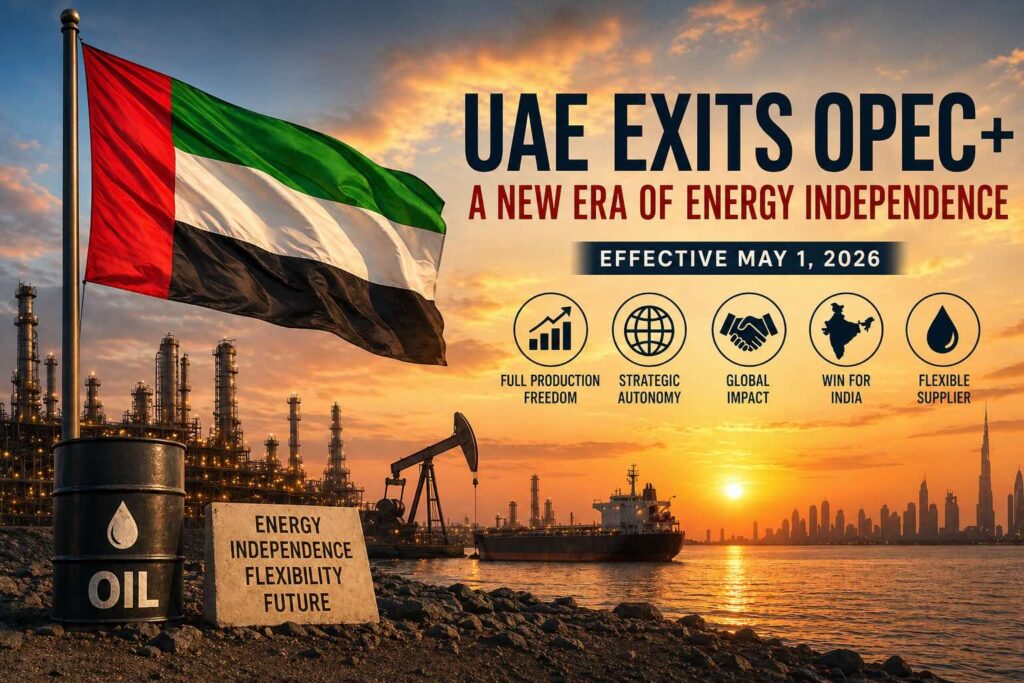
In a move that marks a decisive shift in global energy geopolitics, the United Arab Emirates has formally announced its withdrawal from both OPEC and the broader OPEC+ framework, effective May 1, 2026. UAE Exits OPEC+ ends more than five decades of membership in one of the world’s most influential oil-producing blocs.
Officially framed as a strategic step toward economic flexibility and long-term national priorities, the decision is, in reality, rooted in deeper geopolitical tensions, market dynamics, and shifting global alliances. Triggered in part by the ongoing Iran conflict and long-standing friction with Saudi Arabia, the UAE’s exit signals a move toward independent energy policymaking.
As OPEC’s third-largest producer, the UAE’s departure weakens cartel cohesion while enhancing its own capacity to act as a flexible, high-output supplier. For energy-importing nations like India, the development could translate into more stable and diversified supply arrangements.
A Strategic Exit: Official Position vs. Underlying Reality
The UAE, through its official news agency WAM, has described the withdrawal as part of a “long-term strategic and economic vision.” This includes expanding production capacity, accelerating energy investments, and positioning itself to meet global demand more effectively in volatile times.
However, beneath UAE Exits OPEC+ official narrative lies a more complex reality. For years, the UAE has expressed dissatisfaction with OPEC+ production quotas, which have restricted its output despite its significant spare capacity. The issue came to a head during the 2021 quota dispute, when Abu Dhabi challenged a Saudi-led agreement until its production baseline was revised.
By exiting OPEC+, the UAE—primarily through Abu Dhabi National Oil Company—gains full autonomy over its oil output. This allows it to capitalize on favorable market conditions without waiting for consensus within the cartel, particularly at a time when oil prices are elevated.
The Iran Conflict: Immediate Catalyst for Change
The ongoing conflict involving Iran has played a critical role in accelerating the UAE’s decision. Disruptions in the Strait of Hormuz—through which nearly 20% of global oil supply passes—have created significant uncertainty in global markets. Prices have surged past $111 per barrel amid fears of prolonged instability.
In this context, the UAE has positioned itself as a reliable alternative supplier. Free from OPEC+ constraints, it can respond more quickly to supply shortages and stabilize markets independently.
The conflict has also exposed diverging priorities within the Gulf. While the UAE has aligned more closely with Western efforts to counter Iran, Saudi Arabia has emphasized regional stability and de-escalation. These differences have widened existing cracks in Gulf cooperation frameworks.
Saudi-UAE Rivalry: A Struggle for Regional Influence
At the heart of the UAE Exits OPEC+ lies an evolving power dynamic with Saudi Arabia, the de facto leader of OPEC+. What was once a closely aligned partnership has increasingly turned into strategic competition.
Economically, both nations are racing to diversify beyond oil. Saudi Arabia’s Vision 2030 aims to transform its economy, while the UAE has already achieved significant diversification, with non-oil sectors contributing roughly 75% of GDP.
Geopolitically, the UAE has pursued a more independent foreign policy. Its participation in the Abraham Accords, closer ties with India and China, and involvement in emerging global groupings reflect a willingness to act outside traditional Gulf consensus.
The UAE Exits OPEC+ is thus not merely an economic decision—it is a direct assertion of autonomy and a challenge to Saudi Arabia’s leadership within the oil bloc.
Global Implications: Fragmentation of the Oil Order
The UAE’s departure carries significant implications for the global energy system.
First, it weakens the Saudi-Russia axis that underpins OPEC+. The alliance, formed in 2016 to counter U.S. shale production and stabilize prices, relies heavily on coordination among major producers. Losing a top-five producer like the UAE reduces the group’s ability to manage supply effectively.
Second, the move aligns with long-standing U.S. criticism of OPEC as a price-influencing cartel. The UAE’s close security and economic ties with Washington suggest a convergence of interests in promoting a more competitive energy market.
Third, it benefits major importers such as India, which relies on imports for nearly 85% of its oil needs. Greater flexibility from UAE supply could lead to more favorable pricing and stronger bilateral partnerships.
Finally, the decision reflects a broader shift toward multipolarity in global energy politics. Traditional alliances are giving way to more fluid, interest-driven relationships as countries navigate geopolitical tensions and energy transitions.
What the UAE Gains: Strategic and Economic Advantages
From a purely economic perspective, the UAE stands to gain significantly from its exit.
The most immediate benefit is full production freedom. Previously capped at around 3.2–3.5 million barrels per day under OPEC+ quotas, the UAE now has the potential to increase output toward its target of 5 million bpd by 2027. This could translate into substantial additional revenue, particularly in a high-price environment.
The move also aligns with the UAE’s broader economic strategy. By controlling its production levels, it can better integrate oil policy with domestic development goals and long-term diversification plans.
Timing is another advantage. With current supply disruptions largely driven by logistical constraints rather than production limits, the short-term impact of leaving OPEC+ is minimal. As conditions stabilize, however, the UAE will be well-positioned to expand its market share.
Risks and Constraints: Limited but Manageable
While the benefits are clear, the UAE’s decision is not without risks.
Diplomatic tensions with Saudi Arabia are perhaps the most immediate concern. However, both nations have strong incentives to avoid escalation, given their shared economic and regional interests.
Another potential drawback is the loss of influence within OPEC decision-making. Yet, this is offset by the UAE’s increased ability to shape markets through independent production decisions.
There is also the possibility of price volatility if the UAE significantly increases output. However, as a low-cost producer, it is better equipped than many competitors to withstand lower prices.
OPEC’s Limited Response Options
Despite the significance of the UAE’s exit, OPEC has little ability to retaliate.
As a voluntary organization, it lacks enforcement mechanisms such as penalties or sanctions. Past departures by countries like Qatar and Ecuador have not resulted in any meaningful consequences.
Saudi Arabia could theoretically initiate a price war by increasing its own production, but such a move would be economically damaging for all parties involved, including itself.
In reality, the greatest impact is on OPEC itself. The loss of a major producer reduces its overall market share and complicates efforts to coordinate supply cuts, potentially leading to greater price volatility.
The Bigger Picture: A Shift Toward Energy Independence
The UAE’s exit underscores a broader transformation in global energy dynamics. In an era defined by geopolitical uncertainty, energy transition, and shifting alliances, countries are increasingly prioritizing national interests over collective frameworks.
For the UAE, this means positioning itself as a flexible, reliable supplier capable of responding quickly to market changes. For OPEC, it raises questions about the future relevance of coordinated production strategies.
For consumers, particularly large importers like India, it offers an opportunity to build more diversified and resilient energy partnerships.
In Perspective
The UAE’s withdrawal from OPEC and OPEC+ is not an isolated event but a reflection of deeper structural changes in the global energy landscape. It highlights the growing importance of flexibility, autonomy, and strategic alignment in an increasingly complex world.
While the immediate market impact may be limited, the long-term implications are profound. The move weakens traditional producer alliances, strengthens the UAE’s global position, and accelerates the transition toward a more competitive and decentralized oil market.
As the world adapts to these changes, one thing is clear: the era of rigid, cartel-driven energy governance is giving way to a more dynamic and multipolar system—one in which agility and national strategy will define success.