The Strait of Hormuz Crisis: Oil, War, and the Hormuz Illusion
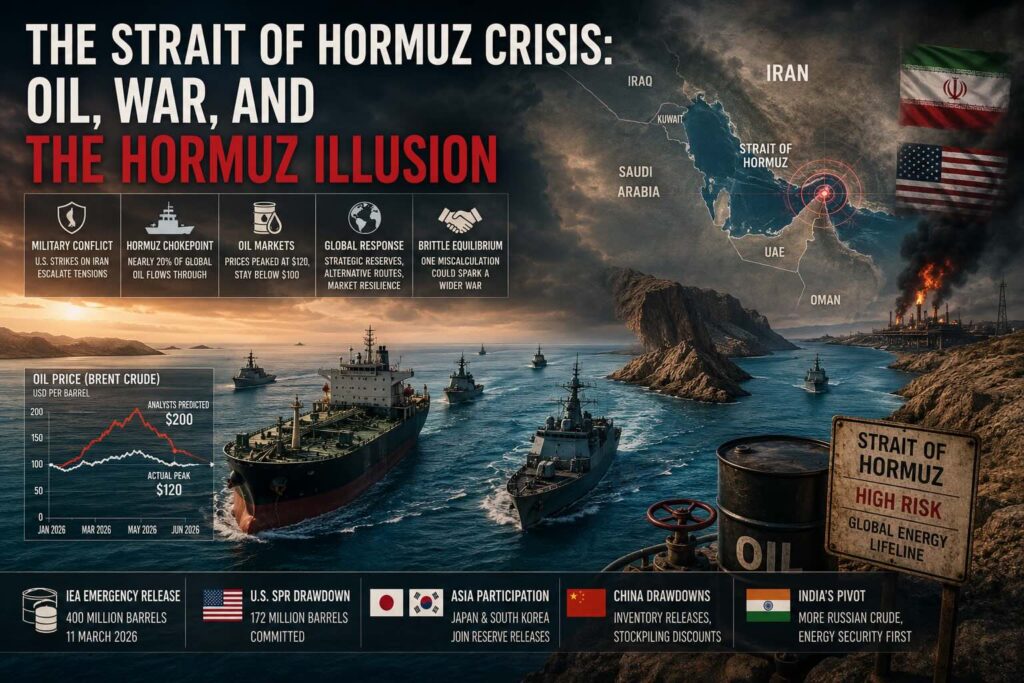
The Strait of Hormuz, the global economy’s primary energy windpipe through which, according to International Energy Agency (IEA), nearly 20% of the world’s oil flows, is once again the epicentre of geopolitical instability. Following U.S. military strikes on Iran in late February 2026, tensions escalated dramatically by June when Tehran declared the chokepoint “closed,” threatening to strike any transiting vessel.
Multiple sources report fresh U.S. strikes on Iranian targets on June 9-10. The gravity of the situation was laid bare on June 10, 2026, when a fatal attack on an Indian merchant ship, reportedly killed two sellers and left one missing. The subsequent formal protest from New Delhi to Washington underscored a harsh reality: even neutral trading nations are being aggressively dragged into the crossfire.
Yet, Iran’s declaration of closure has proven more symbolic than absolute. While Tehran signals defiance, Washington has demonstrated it can still move crude under heavy military protection. This dual reality, rhetorically closed but partially operational in practice, has fundamentally dictated the global oil market’s surprisingly resilient response.
Tactical Realities: The Shadow Tanker War
Despite active conflict, the United States has continued shipping millions of barrels of crude out of the Persian Gulf. To achieve this, Washington is relying on a high-stakes mix of naval escorts, alternative regional pipeline networks, and “dark” tanker transits where vessels completely disable their tracking systems.
This high-risk strategy serves a dual purpose:
Market Signalling: Continual flows reassure global traders that a total supply cutoff will be prevented.
Strategic Leverage: Successful transits actively expose the limitations of Tehran’s enforcement capacity.
However, this tactic is a geopolitical tightrope. Each escorted tanker is a potential flashpoint; a single successful Iranian strike on a U.S.-protected vessel could spiral the conflict into an uncontrollable regional war.
Expectations vs. Reality: Debunking the $200 Barrel
At the onset of the crisis in March 2026, several energy analysts warned that crude prices could skyrocket to $200 per barrel. Instead, prices peaked at $120 and have mostly stabilised below the $100 mark. This massive gap between prediction and reality comes down to rapid, adaptive global cushioning.
Coordinated Strategic Reserve Releases
The market’s resilience was not solely the result of military escorts or alternative supply routes. Equally important was a coordinated release of strategic oil reserves designed to reassure traders that governments possessed sufficient emergency inventories to offset short-term disruptions.
On 11 March 2026, the International Energy Agency (IEA) approved what was reported as the largest emergency stock release in its history, authorising member states to collectively release approximately 400 million barrels of crude and petroleum products to stabilise global markets following the escalation of the U.S.-Iran conflict.
The United States committed roughly 172 million barrels through its Strategic Petroleum Reserve (SPR), while European member states activated emergency stockpiles under the IEA framework.
Asia’s major energy importers also played a critical role. Japan and South Korea participated in coordinated reserve releases and strengthened bilateral energy-sharing arrangements to safeguard regional supply chains.
China, while operating outside the IEA system, reportedly began drawing down commercial and strategic inventories as prices surged, while simultaneously expanding purchases of discounted Russian crude to reinforce domestic energy security.
The combined effect was psychological as much as physical. By signalling that hundreds of millions of barrels could be mobilised at short notice, governments helped suppress panic buying, moderate speculative price spikes, and reassure markets that a complete supply shock from the Strait of Hormuz would not be allowed to develop into a full-scale energy crisis.
India’s Pragmatic Pivot
India’s energy strategy emerged as a pivotal economic stabiliser. Rather than depleting its domestic SPR prematurely, New Delhi aggressively ramped up its procurement of Russian crude, which was heavily discounted due to Western sanctions.
This pragmatic balancing act diversified India’s supply base and insulated its economy from the worst of the Gulf shocks, indicating how energy security considerations often outweigh broader geopolitical alignments.
Macroeconomic Cushions
Simultaneously, alternative suppliers stepped in. Saudi Arabia and the UAE successfully bypassed the chokepoint by increasing export volumes through overland pipelines. Furthermore, structural economic sluggishness in both Europe and China capped global consumption, preventing demand from outstripping supply.
Historical Precedents: The Resilient Chain
The 2026 Hormuz crisis echoes past conflicts and suggests that energy markets have become more resilient.
During the 1980s Tanker War of the Iran-Iraq conflict, both sides routinely targeted commercial shipping, prompting the U.S. to launch Operation Earnest Will to escort reflagged Kuwaiti tankers. Similarly, the 2019 Hormuz Tensions saw brief tanker seizures, but prices spiked only modestly because traders had already learned to discount Tehran’s rhetoric.
The current environment is arguably more volatile than 2019 because the U.S. has shown a willingness to strike targets directly inside Iranian territory. However, global supply chains are far more diversified, and strategic reserves are significantly larger than they were during the 1980s. Just as coordinated emergency drawdowns tamed market panic during the 1991 Gulf War and the disruption caused by Libya’s 2011 civil war, collective global action has once again tempered catastrophe.
Conclusion: A Brittle Equilibrium
The current crisis demonstrates that while global oil infrastructure is highly adaptive, geopolitics remains incredibly brittle. The battlefield in the Strait of Hormuz is fundamentally less about physical barrels of oil and more about international power projection, with Iran seeking to demonstrate its ability to disrupt global commerce and the United States seeking to demonstrate its ability to keep those routes open.
While a catastrophic $200 super-spike has been successfully averted through supply diversification and coordinated interventions, the equilibrium remains fragile. A single severe miscalculation – the sinking of a naval escort, a diplomatic rupture, or the exhaustion of emergency reserves – could still trigger the very market shock that governments have thus far managed to contain.
Sources:
- International Energy Agency (IEA), emergency stock release announcement, 11 March 2026.
- Reuters, coverage of the IEA-coordinated 400-million-barrel release programme, March 2026.
- Reuters and The Hindu, reporting on U.S., Japanese and South Korean participation in strategic stock drawdowns, March-April 2026.
- QCIntel, analysis of Chinese inventory drawdowns and reserve utilisation, June 2026.
- Energy Connects, reporting on China’s commercial stockpile releases and market stabilisation measures, June 2026.