Originally Published on: August 23, 2025
Last Updated on: April 02, 2026
Key Insight
- Unbalanced Contracts in India’s Oil & Gas PSUs
- Contractors routinely absorb heavy financial losses from client-attributable delays in Right of Way (ROW), approvals, and free-issue materials.
- Rigid enforcement of bid-stage technical submissions, coupled with a prevalent “don’t rock the boat” culture, suppresses legitimate claims and discourages open communication.
- PSU-curated arbitration panels often compromise neutrality; Indian courts have repeatedly described arbitrary blacklisting as “civil death” for contractors.
- Statutory rights and protections exist under Indian Contract Law, but enforcement through arbitration or litigation remains slow and expensive.
- Five targeted reforms — independent dispute redressal, fairer contract templates, ROW accountability, protection of project staff, and stronger procurement integrity — can restore balance and accelerate project delivery without compromising national energy goals.
The Structural Imbalance in India’s Energy Contracting Ecosystem
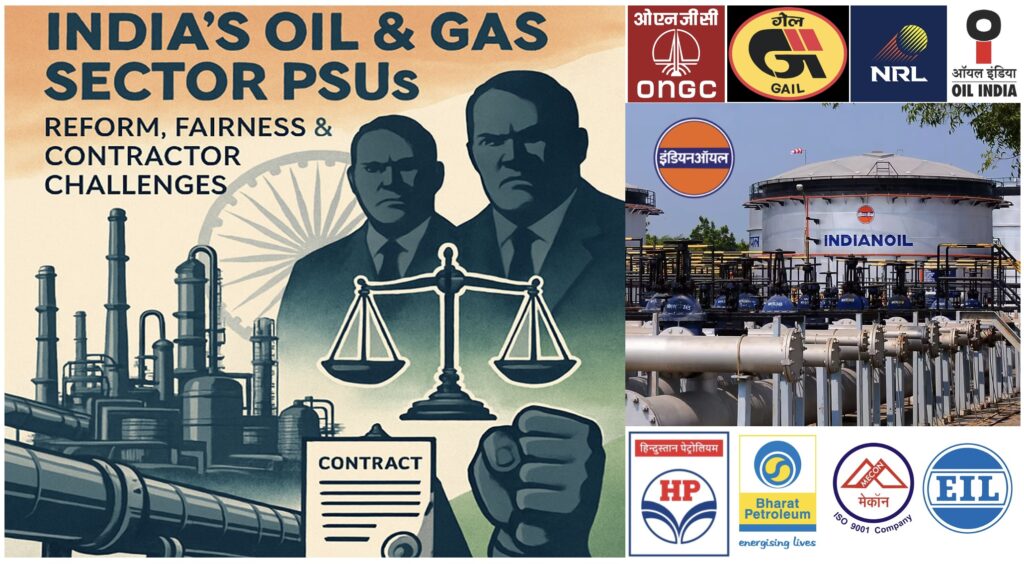
Contractors are the operational backbone of India’s Oil & Gas sector—mobilising labour, machinery, and engineering expertise to turn the nation’s complex energy infrastructure visions into reality. Yet, a persistent structural issue continues to affect project execution: unbalanced PSU contracts that often transfer client-side risks onto contractors.
Behind project milestones lies a difficult reality: contractors operate within systems that often transfer the burden of client delays onto them, constrain their ability to raise legitimate claims, and discourage open documentation of issues through restrictive contractual frameworks drafted by the clients themselves.
India’s oil & gas infrastructure is predominantly driven by large Public Sector Undertakings (PSUs), including entities such as Indian Oil Corporation Limited, Oil and Natural Gas Corporation, and Gas Authority of India Limited, along with their associated engineering consultancies. While project execution is outsourced through competitive contracting, the institutional structure often results in disproportionate risk allocation, with contractors bearing a significant share of uncertainties despite limited control.
When Client Delays Become Contractor Burdens
A common but overlooked problem is how contractors of such Unbalanced Contracts in India’s Oil & Gas bear the financial brunt of delays caused entirely by the client. These include:
- Delays in handing over Right of Way (ROW) due to land compensation issues or local disputes
- Slow approvals of contractor deliverables or mid-project changes
- Non-availability or quality issues of free-issue materials like pipes and valves
- Workfront not ready because of administrative hurdles
While Indian Contract Law allows compensation and extensions, contract wordings and PSU practices often block claims. Contractors absorb idle manpower and machinery costs, sometimes under pressure to withdraw claims
Technical Submissions Used as Enforcement Tools
Technical submissions, such as resource deployment plans submitted during bidding, are intended to demonstrate preparedness. However, in practice, these are often applied rigidly during execution—penalising contractors for deviations even when driven by client-side delays or lack of site access.
This can eventually lead to pressure through contractual provisions, including delayed certifications, payment holdbacks, or the risk of blacklisting, thereby shifting the operational burden disproportionately onto contractors.
A Culture of Silence and Fear
This environment has bred a culture where contractors are afraid to speak up. Project managers hesitate to document client defaults. The unspoken rule is: “Don’t rock the boat if you want timely payments or future work.”
Removal clauses are often misused in India to intimidate Contractor’s staff.
Skewed Arbitration and Dispute Resolution
Even when escalated, arbitration is heavily skewed. Earlier PSU clients used to control arbitrator selection from curated panels. Fixed venues and mandatory conciliation further tilt outcomes. Recent judicial observations and government nudges highlight the need for impartiality in Unbalanced Contracts in India’s Oil & Gas PSUs.
Legal Rights Exist, But Enforcement Remains Challenging
India’s courts have recognised contractors’ statutory rights to claim damages for employer-caused delays and have also taken a critical view of arbitrary blacklisting.
However, in practice, enforcement remains challenging due to:
- Arbitration processes that can be time-consuming and procedurally constrained
- Litigation involving significant cost and prolonged timelines
- Limited relief for interim financial stress during dispute resolution
- Perceived risk of wider exclusion from future PSU opportunities following disputes
Five Reforms to Restore Balance
To align contracting practices with modern infrastructure needs, PSUs must adopt:
- Independent Dispute Redressal: Time-bound, impartial mechanisms free from PSU influence.
- Fair Contract Templates: Remove exclusionary clauses barring claims for client delays; compensate additional works outside original scope.
- Accountability for Right of Way Delays: PSUs must own land acquisition delays and compensate fairly.
- Protection for Contractor’s Project Staff: Limit removal clauses to genuine performance issues.
- Enforce a Code of Integrity in PSU Procurement: Embed transparency beyond checkboxes.
Forging Equitable Partnerships for Sustainable Energy Progress
India’s PSUs have been central to nation-building. As the sector enters a new growth phase, fairer contracting frameworks are essential. Contractors are not merely vendors; they are partners in progress. Suppressing their voices and penalising them for client-side lapses is unsustainable. Without contractors, there is no pipeline, no plant, no progress.
Frequently Asked Questions on Oil & Gas Contracting Reforms in India
Why do contractors in India’s oil & gas sector face disproportionate risks?
PSU contracts often allocate client-side delays (ROW, approvals, materials) to contractors while restricting claims, creating structural imbalance.
What is the “don’t rock the boat” culture in PSU projects?
It refers to the fear of retaliation—delayed payments, blacklisting or staff removal—when contractors document client defaults or raise legitimate claims.
Are arbitration processes in oil & gas PSUs truly neutral?
Many contracts allow PSUs to influence arbitrator selection from internal panels, raising concerns about impartiality that courts and policy makers continue to address.
What recent government actions address these issues?
The Directorate General of Hydrocarbons (DGH) Joint Working Group has recommended excusable delays and extensions for statutory clearances; MoPNG has issued directions to fast-track approvals and land access for natural gas infrastructure.
How can fairer contracts benefit India’s energy goals?
Balanced frameworks reduce litigation, accelerate project execution and attract quality contractors—critical for meeting India’s hydrocarbon production and infrastructure targets.
References & Citations
- Directorate General of Hydrocarbons (DGH) & Ministry of Petroleum and Natural Gas – Report of the Joint Working Group on Issues related to Ease of Doing Business in Indian Upstream Sector (2025).
- Ministry of Petroleum and Natural Gas – Directions on strengthening natural gas infrastructure and addressing delays (March 2026).
- Supreme Court of India judgments on blacklisting as “civil death” and contractor rights (e.g., cases involving arbitrary PSU bans).
- Press reports on PSU arbitration clause reforms and ongoing bias concerns (2025–2026).
ALSO READ: Why Arbitration Fails in India’s Oil & Gas PSU Contracts
Author
Praveen Chand is an infrastructure and energy professional with over 38 years of experience across large-scale EPCC projects, including oil & gas, civil infrastructure, and emerging sectors such as renewable energy. He has held senior leadership roles such as Project Director, SBU Head, and Country Head, and has worked across West to East Asia in multiple international assignments.
He holds a Bachelor’s degree in Civil Engineering from NIT Trichy and a Master’s degree in Construction Law from Robert Gordon University, Aberdeen (UK), and brings a practitioner’s perspective to global developments at the intersection of geopolitics, energy security, infrastructure, and economic strategy.
Having travelled to over 30 countries, his writing reflects a broad, ground-level understanding of geopolitics, international systems, policy environments, and regional dynamics, along with practical insights into international travel and on-ground logistics.