Delhi Riots ‘Larger Conspiracy’: SC Denies Bail to Umar Khalid, Sharjeel Imam
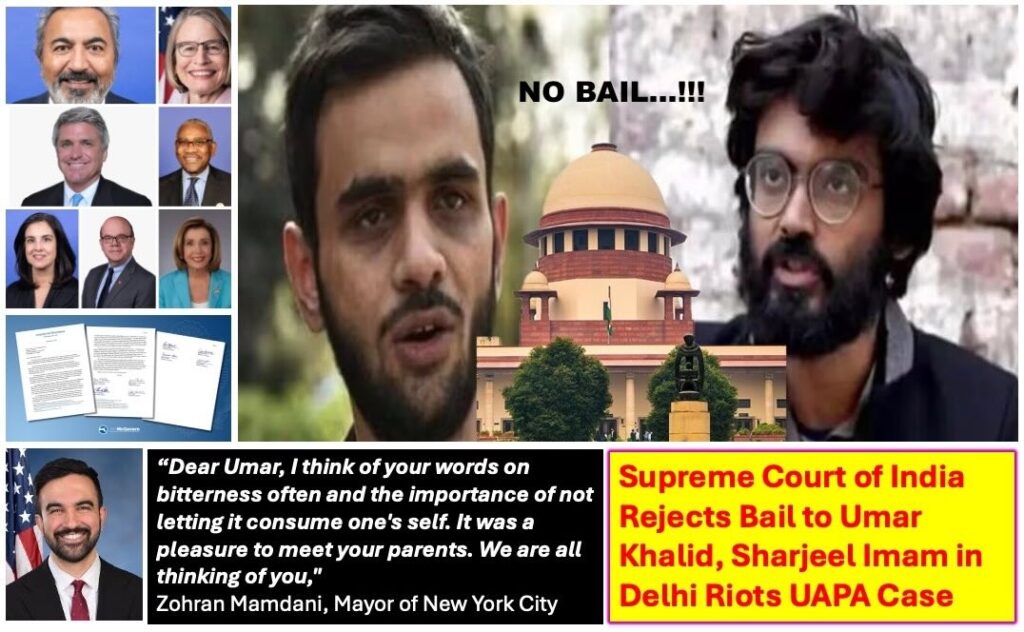
The Supreme Court on Monday rejected bail pleas filed by activist Umar Khalid and scholar Sharjeel Imam in the alleged “larger conspiracy” case linked to the February 2020 northeast Delhi riots, holding that both accused stand on a footing distinct from other co-accused who have been granted relief. The court, however, permitted them to renew their bail applications after one year.
The ruling keeps both former Jawaharlal Nehru University students in continued custody under the Unlawful Activities (Prevention) Act, even as the bench granted bail to at least five other accused booked under the same conspiracy FIR.
Supreme Court’s Findings on Bail Under UAPA
A bench comprising Justice Aravind Kumar and Justice N V Anjaria delivered the judgment on a batch of bail petitions arising from FIR 59 of 2020, which deals with the alleged conspiracy behind the communal violence in northeast Delhi.
The court held that bail under the UAPA must be examined on an accused-specific basis, and that Umar Khalid bail claims could not be equated with those of other petitioners. According to the bench, Khalid and Imam were attributed roles that placed them on a “qualitatively different footing”.
Interpreting Section 43D(5) of the UAPA, the court reiterated that prolonged incarceration or delay in trial cannot, by itself, override the statutory bar on bail if the prosecution material discloses a prima facie case. The bench clarified that courts cannot re-appreciate evidence at the bail stage as in a full trial.
Why Umar Khalid and Sharjeel Imam Were Denied Bail
The Supreme Court upheld the Delhi High Court’s earlier assessment that both Umar Khalid and Sharjeel Imam were allegedly central to the planning and mobilisation phase of protests following the passage of the Citizenship (Amendment) Act.
Investigators have claimed that the two acted as early mobilisers and ideological drivers of the agitation, coordinating protests, road blockades, and “chakka jams”. The prosecution relied on WhatsApp groups such as the Delhi Protest Support Group, call detail records, chats, speeches, and alleged meetings.
The Delhi High Court had earlier held that the material could indicate involvement amounting to terrorist acts under the UAPA. The Supreme Court declined to interfere with this prima facie view at the bail stage.
Court’s Interpretation of ‘Terrorist Act’
The bench clarified that Section 15 of the UAPA is not limited to physical violence. Activities that disrupt essential services, supply chains, or economic stability may also fall within the definition of terrorist acts.
Delhi Police alleged that the conspiracy involved nationwide road blockades and economic disruption intended to destabilise the state during a sensitive period in February 2020.
The court noted that such allegations, if supported by material, are sufficient at the bail stage to invoke UAPA’s restrictive provisions, without expressing any final view on guilt.
Background of the Delhi Riots Conspiracy Case
The case stems from the February 2020 communal violence in northeast Delhi, which left 53 dead, over 700 injured, and led to more than 750 FIRs.
Umar Khalid was arrested in September 2020 and has remained in custody since. Sharjeel Imam, accused of delivering inflammatory speeches, is also in custody under the same conspiracy FIR.
One-Year Window and Bail for Co-Accused
While denying bail, the Supreme Court allowed Khalid and Imam to reapply after one year, depending on trial progress.
At the same time, bail was granted to several co-accused, as the court found the evidence against them did not meet the same prima facie threshold under UAPA.
The ruling reinforces the principle of individualised assessment in terrorism-related cases, even within a single conspiracy FIR.