Russian President Putin Condoles Uttar Pradesh Storm Tragedy as Official Death Toll Reaches 89
Lucknow, May 14, 2026 | In a powerful gesture of solidarity, Russian President Vladimir Putin on Thursday extended his deepest condolences to India over the devastating pre-monsoon storm that ripped through Uttar Pradesh on Wednesday evening, leaving at least 89 people dead and scores injured.
In a formal message addressed to President Droupadi Murmu and Prime Minister Narendra Modi, Putin wrote: Please accept my deepest condolences over the heavy loss of life and large-scale destruction caused by the cyclone in Uttar Pradesh. Please convey my words of sympathy and support to the families and loved ones of those who perished, as well as wishes for a speedy recovery to all those injured as a result of this natural disaster.
The condolence message, released by the Kremlin, comes exactly 24 hours after the violent thunder-squall accompanied by dust storms, heavy rain, hail, lightning, and winds gusting up to 100 km/h struck multiple districts in the state during the evening and night of May 13.
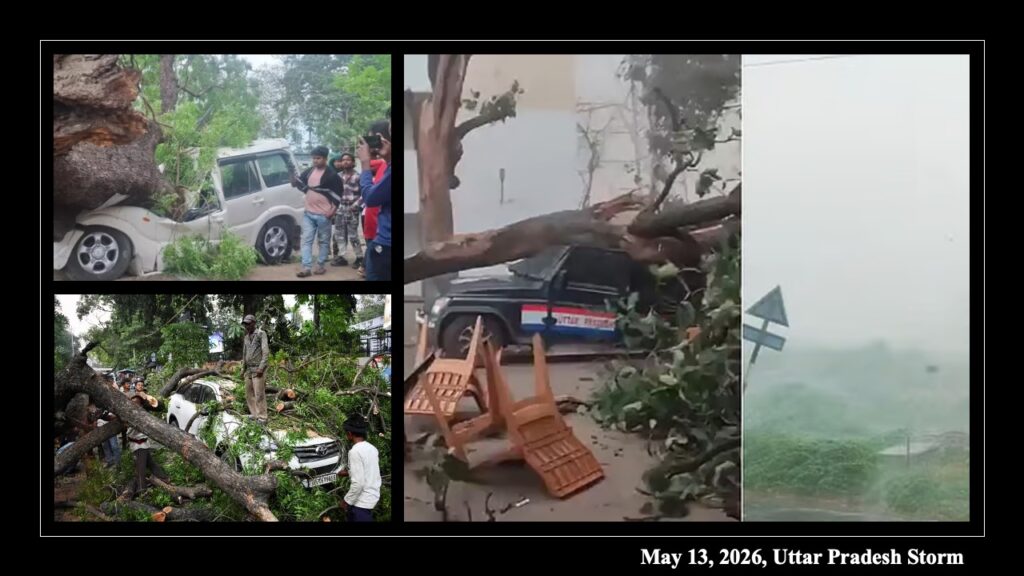
According to the latest official figures released by the Uttar Pradesh Relief Commissioner’s office on Thursday morning, the storm claimed 89 lives, injured 53 people, killed 114 livestock, and damaged 87 houses across 19 districts. The fatalities were primarily due to lightning strikes, falling trees, collapsing walls, and electrocution.
Prayagraj emerged as the worst-hit district with 21 deaths, followed by Sant Ravidas Nagar (Bhadohi) with 14, Fatehpur with 11, and Mirzapur with 10. Other affected areas include Badaun, Bareilly, Pratapgarh, Chandauli, Sonbhadra, Unnao, and Kushinagar, where the sudden fury of nature left behind a trail of uprooted trees, snapped electric poles, and disrupted power and road networks.
One of the most heart-wrenching and widely shared incidents came from Bareilly, where 50-year-old e-rickshaw driver Nanhe Miyan was dramatically lifted into the air along with a tin shed he was trying to secure at a wedding venue in Babiyana village. Viral videos showed the man being tossed dozens of feet by the powerful gusts before crashing into a nearby field. Miraculously, he survived but sustained fractures in both arms and legs and is currently recovering in hospital.
Chief Minister Yogi Adityanath has taken swift cognisance of the tragedy. He has directed all Divisional Commissioners and District Magistrates to carry out immediate on-ground verification of incidents with full sensitivity, ensure financial assistance reaches affected families within 24 hours, and maintain direct communication with the victims kin. The state government has begun releasing relief funds, and senior officials are overseeing restoration work in the worst-affected regions.
The unseasonal storm, triggered by intense pre-monsoon activity, caught many residents off guard as dust storms rapidly turned into a full-blown thunder-squall between 8:00 PM and 11:30 PM on Wednesday. While no fresh fatalities have been reported today, rescue and restoration efforts continue in several pockets.
As Uttar Pradesh grapples with the aftermath, Putin’s message underscores the enduring India-Russia friendship and global concern over the human cost of this natural calamity. Relief operations are in full swing, with authorities urging residents in vulnerable areas to remain cautious amid lingering weather alerts.
Why These Deadly Pre-Monsoon Storms Recur Every May in Uttar Pradesh
Violent dust storms and thunder-squalls, locally known as “Andhi,” are an annual feature of North India’s pre-monsoon season, particularly in April and May. The deadly May 13, 2026 storm followed the same classic pattern.
Intense daytime heating over the Thar Desert creates a huge mass of hot, dry air. Meanwhile, moist winds from the Bay of Bengal begin advancing northward. When these contrasting air masses collide, they trigger massive atmospheric instability, leading to sudden strong winds (up to 100 km/h), dust walls, lightning, hail, and heavy rain.
Such storms typically strike between 5 PM and 11 PM, turning the sky pitch dark within minutes exactly as many residents, including those who recall the severe May 1980 dust storm, remember. While Western Disturbances often act as triggers, rising temperatures due to climate change are believed to be making these events more frequent and intense in recent years.
This recurring natural phenomenon highlights the need for better early warning systems and public awareness every summer.
Also Read: