North Korea unveils Su-25 jets with “Taurus-style” missiles – a new era of stand-off strikes
Why this matters: a propaganda display with serious implications for the Korean Peninsula
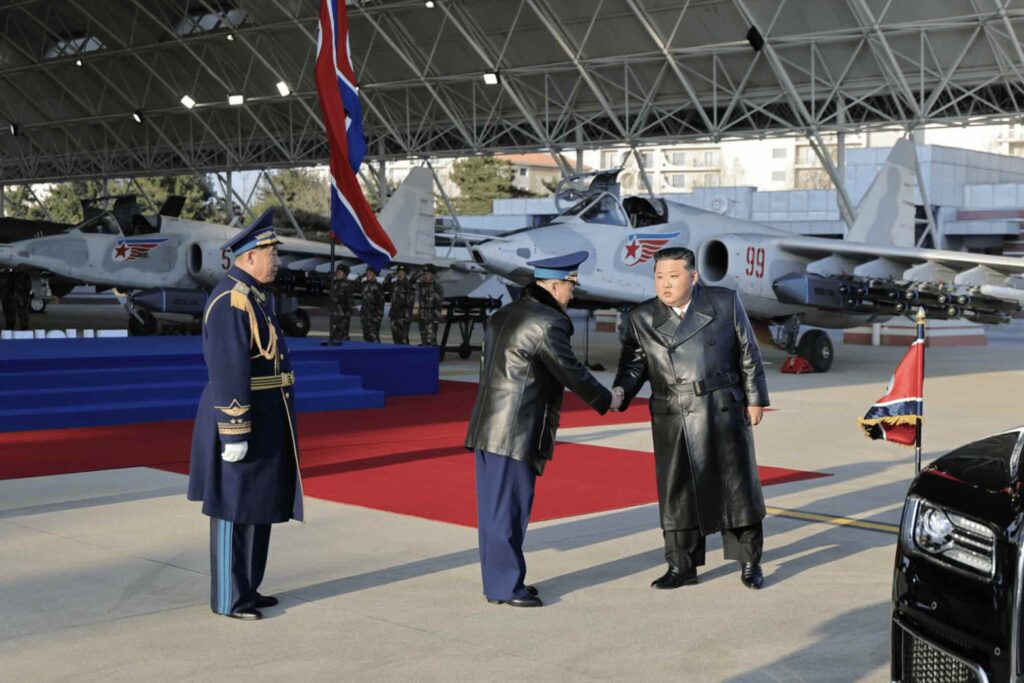
On 28 November 2025, during the 80th-anniversary celebrations of the Korean People’s Army Air Force at Kalma Airbase, state media released imagery of Sukhoi Su-25 attack jets carrying what appear to be newly developed long-range, air-launched cruise missiles along with precision-guided munitions.
The missiles visually resemble the western “stand-off” family – sometimes compared to Taurus KEPD 350 or the Franco-British Storm Shadow – featuring a nose-mounted sensor, aerodynamic body, and folding wings that suggest terrain-hugging low-altitude flight.
This is the first time North Korea has publicly displayed a long-range cruise missile integrated on a combat aircraft – an upgrade that, if operational, could give Pyongyang a standoff-strike capability that bypasses traditional air-defence envelopes.
What was revealed: weapons loadout and official messaging
The Su-25 jets in the photographs bore tail-numbers “99” and “57.” According to media and analysts, each carried at least one large air-to-ground cruise missile, along with smaller glide bombs or precision-guided munitions, and short-range self-defence missiles.
The cruise missile’s design – exposed seeker nose, aerodynamic body, mid-body wings – closely mirrors that of Western stand-off missiles like the Taurus or Storm Shadow, though North Korean analysts suggest possible lineage from rockets such as the Russian Kh-59MK2. Estimated range has been put between
200-500 km, enough to reach deep into South Korean territory while staying outside most air-defence zones.
At the event, leader Kim Jong-un announced that the Air Force would receive “new strategic military assets” and assigned “new missions,” framing the display as part of a broader push to modernise Pyongyang’s air-to-ground strike capabilities and integrate them into its strategic deterrence posture.
Strategic Implications: Why Seoul, Washington and Allies Are Watching Closely
Stand-off strike capacity: If functional, the new missiles extend the reach of legacy-era Su-25 jets far beyond their traditional close-support role. This gives Pyongyang the ability to threaten command-and-control nodes, air-defences or critical infrastructure in South Korea from a distance – complicating pre-emptive strike planning by Seoul and allied forces.
Deterrent recalibration: The demonstration serves as both propaganda and real strategic signalling. Pyongyang appears to be asserting a credible, modern strike capability, potentially altering calculations about deterrence, retaliation, or pre-emptive options in a crisis.
Arms modernisation under sanctions: The reveal underscores that despite years of isolation and sanctions, North Korea’s arms development continues – possibly aided by covert transfers, reverse engineering, or clandestine procurement. The display challenges assumptions that Pyongyang’s air fleet remains limited to outdated close-support systems.
Regional escalation risk: The new capability may trigger an arms-spiral or rapid re-calibration of defence postures in South Korea, Japan, and among US-allied forces. Early-warning, air-defence layering and strike-response plans may need significant updates.
Blurred line between theatre and strategic weapons: By integrating long-range missiles on tactical jets, North Korea is eroding the traditional boundary between short-range support aircraft and strategic strike platforms – a shift with wide-ranging consequences for deterrence stability.
What remains uncertain – and why caution is needed
While the imagery is clear, several critical questions remain unanswered:
- There is no independent verification that the missiles are operational – prior displays by Pyongyang have occasionally used mock-ups or non-functional replicas.
- Details about guidance systems (GPS/INS/TERCOM), avionics integration, production numbers, reliability, and maintenance are unknown.
- It’s unclear whether newly developed radars or sensors are in place to enable the precision-strike capability – especially given the age of the Su-25 airframe.
Therefore, while the reveal is serious, it remains uncertain whether the capability is fully combat-ready or primarily intended as demonstration and deterrence.
What to Watch Next
Moving forward, analysts and militaries will focus on:
- Monitoring satellite imagery or open-source intelligence for evidence of production, deployment or test-launches.
- Signals from South Korea, US and allied forces – any shift in alert status, air-defence posture, or pre-emptive planning would indicate how seriously the threat is taken.
- Further revelations from North Korean state media – especially test-launch footage, specifications, or statements that move beyond symbolic display.
- Diplomatic responses: whether the reveal prompts renewed calls for sanctions, dialogue, or increased military cooperation among stakeholders.
In the volatile strategic context of East Asia, the sight of Su-25 jets carrying what appear to be long-range cruise missiles is more than propaganda: it could be the first public sign of a new strike capability – and a fresh variable in the security calculus of the region.