New Year Violence Rocks Europe: Dead and Injured
New Year Violence and Fires Expose Deepening Public Safety Crisis Across Europe
New Year celebrations across multiple European countries descended into widespread
violence, arson, and fatal accidents between December 31, 2025, and January 1, 2026, leaving dozens dead or injured and triggering hundreds of arrests. Authorities across
the continent reported attacks on emergency services, large-scale fires, and severe property damage, raising urgent
questions about public safety and the continued use of consumer fireworks.
Incidents were reported across the Netherlands, Germany, France, Belgium,
Switzerland, and Sweden, underscoring a pattern of disorder that has become
increasingly familiar during year-end celebrations.
Alongside the street violence, the events sparked an intense social media backlash, with
sections of online discourse blaming illegal immigration and specific communities for the unrest—claims that
authorities have urged the public to approach cautiously.
Netherlands: Fatalities, Arson, and a Historic Church Destroyed
In the Netherlands, two people were killed
in fireworks-related incidents, including a 38-year-old man in Aalsmeer near Amsterdam and a 17-year-old boy in Nijmegen. Police described the night as “unprecedented,” citing coordinated attacks on officers
and firefighters using fireworks, petrol bombs, and other projectiles in cities such as Amsterdam and
Breda.
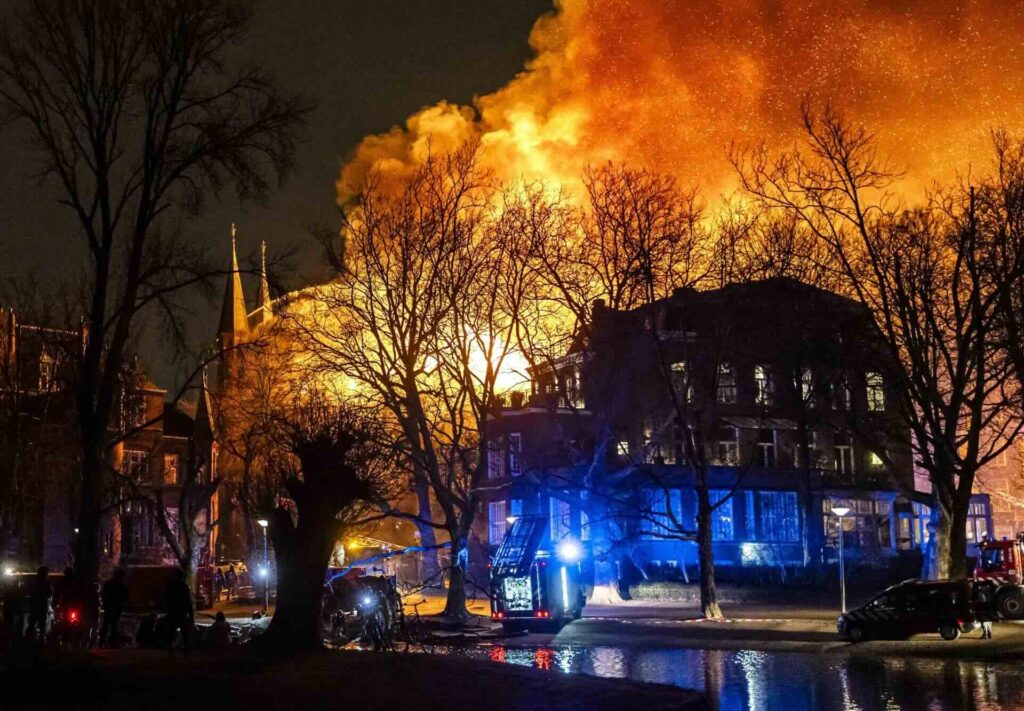
One of the most symbolic losses was the destruction of the Vondelkerk, a 150-year-old neo-Gothic church in Amsterdam. The building was completely gutted by
fire, which authorities believe was sparked by stray fireworks. The church’s spire and tower collapsed as crowds
looked on, and officials later confirmed that the structure could not be restored.
Nationwide, around 250 arrests were made
for arson, illegal pyrotechnics, and assaults on emergency personnel. The violence unfolded during what authorities
confirmed would be the final year of consumer fireworks sales, ahead
of a nationwide ban scheduled for 2026.
Germany: Riots, Weaponised Fireworks, and Multiple Deaths
Germany also experienced severe unrest. Authorities confirmed five
deaths linked to fireworks incidents, including accidents involving homemade
explosive devices. In Berlin, police detained more than 400
people as riots erupted in districts such as Neukölln, Kreuzberg, and
Moabit.
Fireworks were used as weapons against police officers, firefighters, and ambulance
crews. More than 30 police officersand at least one
firefighter were injured during the night. Additional violence was reported in
Hamburg, Leipzig, and Munich, prompting renewed warnings from police
unions about the growing risks faced by emergency services.
While officials noted that some areas were marginally calmer than previous years, police
described parts of Berlin as resembling “a version of hell” due to the scale of pyrotechnic misuse.
France: Hundreds of Vehicles Burned in Coordinated Arson
France witnessed one of the most destructive New Year nights, with the Interior Ministry
reporting 813 vehicles set on fire nationwide. The highest
concentrations were recorded in Strasbourg, where 117
cars were torched, alongside widespread vandalism in other cities.
At least two people, including a
12-year-old child, suffered severe injuries from fireworks mishandling,
including amputations. Police detained over 500 individuals, with
403 placed in custody. In Paris, 125 arrests were made, including 33 for violent acts and 15 for participation in
organised destructive gatherings.
Although authorities stated that some suburban areas were calmer than in 2025, urban
centres remained flashpoints for unrest.
Police in the Netherlands, Germany, and France have stated that investigations remain
ongoing and have not released demographic breakdowns linked to the violence.
Belgium, Switzerland, and Beyond: A Continental Pattern
Violence extended beyond Europe’s largest states. In Belgium, cities such as Brussels and Antwerp
reported arson attacks, vandalism, and assaults on police and firefighters. Local officials condemned the incidents
and promised thorough investigations.
The deadliest single incident occurred in Switzerland, where a fire at an Alpine bar killed
approximately 40 people and injured at least 115, turning celebrations into tragedy. Sweden
and other countries reported scattered riots and fireworks-related injuries, contributing to a continent-wide toll
of dozens dead and hundreds injured.
Fireworks, Public Disorder, and Political Fallout
Authorities across Europe pointed to the widespread misuse of private
fireworks as a central driver of the violence. While social media narratives
sought to attribute responsibility to specific groups, official statements consistently emphasised
generalised disorder, reckless pyrotechnic use, and opportunistic
violence.
Economic factors also played a role. In the Netherlands, fireworks sales surged ahead of
the impending ban, amplifying the scale of incidents. Across Europe, police forces deployed heightened security
measures, enforced fireworks exclusion zones, and conducted rapid mass arrests.
Political leaders are now facing renewed pressure to expand fireworks bans, tighten
enforcement, and rethink how large-scale public celebrations are managed. As investigations continue, authorities
across the continent have urged restraint, accountability, and reforms aimed at preventing a repeat of the chaos
witnessed at the start of 2026.