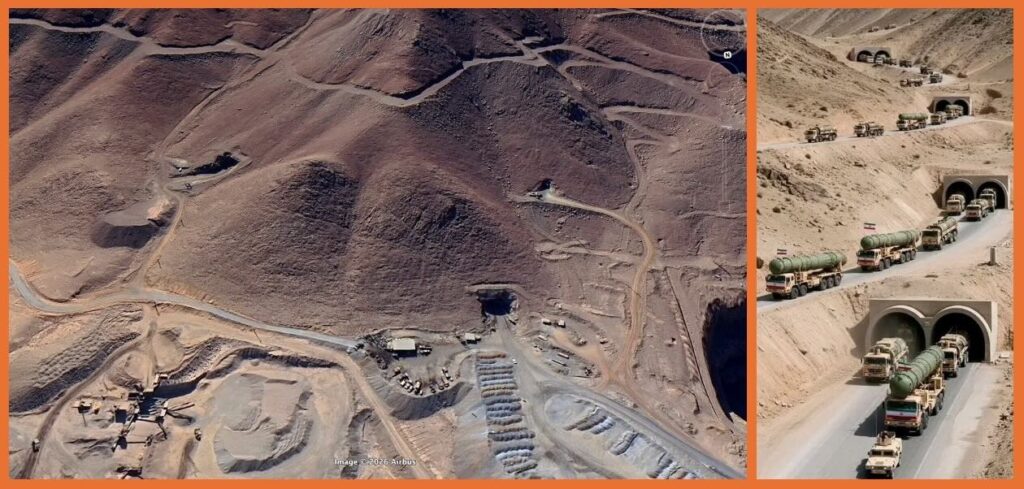
For years, Iran’s Islamic Revolutionary Guard Corps (IRGC) and state media released high-quality videos showing vast underground “missile cities” — enormous tunnel networks carved deep into mountains, lined with rows of ballistic missiles, drone assembly lines, and rail-linked launch systems. Troops were filmed praying inside illuminated chambers. Commanders toured arsenals stocked with Kheybar Shekan, Sejil, and cruise missiles. Naval tunnels packed with fast-attack boats and anti-ship weapons were also displayed openly.
Yet much of the world — Western analysts, mainstream media, and self-proclaimed geopolitical experts on social media — dismissed Iran’s own footage as staged propaganda or crude AI-generated fakes. “Too cinematic,” they scoffed. “Exaggerated for domestic consumption.” This collective refusal to take Iran’s documented preparations seriously became one of the most costly intelligence and analytical failures of the 2026 Iran conflict.
The outcome was a US-Israel air campaign that inflicted significant surface damage but failed to deliver the quick knockout many had predicted. The prolonged resistance transformed the war into a major strategic gift for Russia and China, while exposing the limits of airpower against a deeply prepared adversary.
Iran’s Open Secret: The Footage That Was Never Hidden
Iran learned bitter lessons during the 1980–88 Iran-Iraq War: anything above ground is vulnerable to superior air forces and satellite surveillance. From the 1990s onward, it pursued a deliberate doctrine — “anything above ground is satellite bait” — and invested decades dispersing its military capabilities underground.
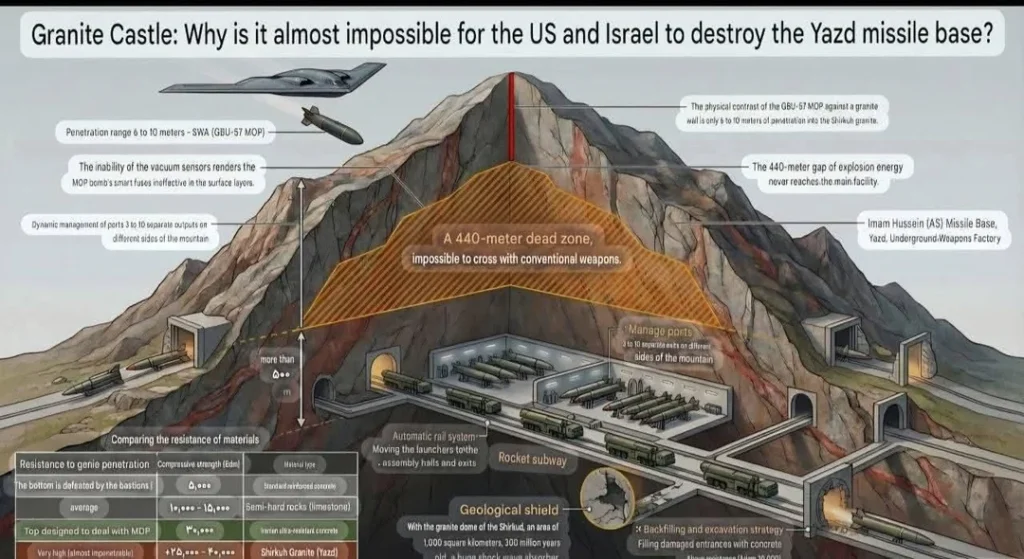
The “missile cities” are sophisticated networks dug 100 to 500+ metres deep into solid granite mountains in the Zagros range, near Isfahan, Qeshm, and other sites. They feature compartmentalised chambers, multiple independent exits, blast doors, rail transport systems, and automated launch capabilities. The design ensures that damage to one section does not collapse the entire network.
IRGC videos from 2025 and early 2026 showed precisely this: vast illuminated tunnels with missiles on mobile launchers, underground manufacturing and repair bays, and naval facilities housing speedboats and mines. Despite this public evidence in Iran’s own footage, the dominant Western narrative clung to assumptions of technological overmatch — that F-35s, carrier strike groups, Patriots, THAAD, and Iron Dome would easily dominate.
The Catastrophic Failure to Believe What Was in Plain Sight
This dismissal stemmed from over-reliance on surface-level satellite imagery, an echo chamber of US technological superiority, and a reflexive tendency to label all Iranian releases as propaganda.
When strikes began in late February 2026, US and Israeli forces hammered observable tunnel entrances and surface factories. Official briefings claimed roughly 85% of Iran’s defence-industrial base destroyed, most ballistic missiles and launchers neutralised, the entire navy (over 150 vessels and all submarines) wiped out, and key nuclear sites like Parchin penetrated by bunker-busters.
Reality proved far more mixed. Surface plants were heavily damaged, but underground repair shops and pre-positioned stockpiles enabled rapid recovery in many areas. Only about one-third of ballistic missiles were confirmed destroyed. Many launchers buried under rubble were later recovered and returned to limited service. The surface navy was largely sunk, yet asymmetric threats from shore-based missiles and naval mines persisted. The deepest chambers — well beyond the effective reach of even the GBU-57 Massive Ordnance Penetrator in hard granite — remained largely untouched.
Because the world refused to credit Iran’s own footage, expectations were wildly optimistic. The conflict stretched into weeks rather than days. US munitions stocks, especially PAC-3 interceptors, became strained across multiple theatres, diverting attention and resources.
The Strategic Price: Russia and China Collect the Dividend
This prolonged resistance created space for America’s strategic competitors to benefit without firing a shot.
From Sanctions to Surplus: Russia’s Oil Revenue Windfall
Russia built its 2026 federal budget around a conservative Urals price of roughly $59 per barrel. In February 2026, before the war broke out on 28 February, Urals averaged just $44.59 per barrel.
The conflict triggered an immediate surge. Within nine days Urals had more than doubled to nearly $91, and the full-month March average reached $77 per barrel — a 73% jump from February.
Because Russia’s mineral extraction tax (its largest single oil revenue source) is calculated with a one-month lag, March tax receipts were still low at 327 billion roubles (~$4.2 billion). But April’s tax is projected to nearly double to around 700 billion roubles (~$9 billion), according to Reuters calculations. This equates to an extra roughly $150 million per day in additional state revenue in April.
Even the earlier March price surge delivered higher physical export earnings right away. The windfall is now materially strengthening Russia’s budget, helping offset part of the projected deficit and financing sustained military spending in Ukraine.
China’s Quiet Strategic Harvest
China played a quieter but equally calculated role. In September 2025, Russia and China signed a legally binding memorandum on the Power of Siberia 2 pipeline, designed to deliver 50 billion cubic metres of natural gas per year via Mongolia, alongside expansions of existing overland corridors. This infrastructure gained immediate strategic value as sea lanes faced disruption.
Beyond energy security, China accelerated renminbi settlements and closely monitored US operations. The war gave both Russia and China a live, high-intensity tutorial on how US F-35s, carrier strike groups (including Lincoln and Ford), Patriots, THAAD, Iron Dome, and overall American doctrine perform under sustained Iranian missile and drone barrages. This priceless battlefield intelligence on munitions performance, electronic warfare, and logistics amounts to free, high-value R&D, courtesy of Washington.
The crisis further tightened Russia-China military-intelligence cooperation. Both powers provided Iran indirect support — satellite imagery, components, and targeting data — while avoiding direct entanglement, turning the conflict into a real-world laboratory for future scenarios in Ukraine or the Indo-Pacific.
The Wider Shockwaves
The parallels to Ukraine are unmistakable — only this time the script has flipped. Just as the United States and its partners turned Ukraine into a grinding war of attrition that drained Russian resources and attention, Russia and China helped prolong the Iran conflict through proxies, supplies, and real-time intelligence support.
Iran refused to collapse or seek unconditional surrender. Its air defences and asymmetric tactics held far longer than most analysts predicted. Tehran claimed — and in several cases confirmed — the downing or damaging of multiple high-value US and allied aircraft, including at least two F-35s, several F-15E Strike Eagles, A-10s, and a significant number of MQ-9 Reapers. Iran also appears responsible for the loss of a US Navy MQ-4C Triton high-altitude surveillance drone (valued at over $200 million) that disappeared over the Strait of Hormuz on April 9 while on patrol.
Additionally, Iran conducted a targeted campaign to degrade US and GCC air defences across the region. It struck key radar systems that serve as the “eyes” of Patriot and THAAD batteries — most notably completely destroying an AN/TPY-2 radar in Jordan and damaging similar high-value radars in Qatar, the UAE, Saudi Arabia, Bahrain and Kuwait. These strikes forced the US and its partners to expend large stocks of interceptors and exposed vulnerabilities in the integrated missile defence network.
This was never “Iran alone versus the combined might of the US and Israel.” Backed by four decades of hardened tunnel networks, dispersed assets, proxy depth, and real-time intelligence from Russia and China, Iran turned what was widely billed as a swift campaign into a bitterly contested and far more costly affair.
Gulf Cooperation Council (GCC) economies faced severe pressure from sustained high oil prices, disruptions in the Strait of Hormuz, collapsed imports, and threats to desalination plants and food security. A United Nations Development Programme assessment estimated potential GDP losses of $120–194 billion across Arab states, pushing several countries toward serious fiscal strain.
The quagmire risk remains very real. In a purely aerial campaign, Iran can sustain low-level harassment using missiles, drones, and naval mines for months. A ground invasion, however, would risk turning into a Vietnam or Iraq 2.0-style nightmare — urban and mountainous fighting across a vast country, supported by Russian and Chinese intelligence.
As of April 12, President Trump’s announcement of a US Navy blockade of the Strait of Hormuz signals possible further escalation. The ceasefire remains extremely fragile, while Israel continues its operations against Hezbollah in Lebanon.