India Commissions INS Taragiri: New Stealth Frigate Strengthens Naval Fleet
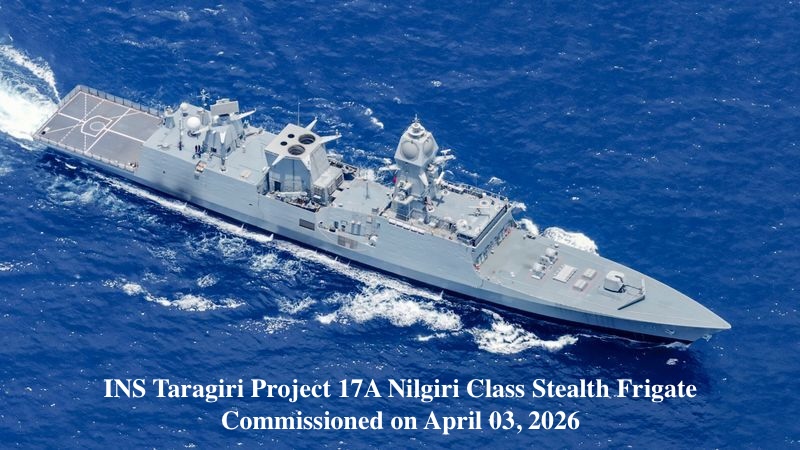
On April 3, 2026, the Indian Navy officially commissioned INS Taragiri (F41), the fourth vessel of the advanced Project 17A (Nilgiri-class) stealth guided-missile frigates. The ceremony took place at the Naval Dockyard in Visakhapatnam and was presided over by Defence Minister Rajnath Singh.
Built by Mazagon Dock Shipbuilders Limited (MDL) with over 75% indigenous content, INS Taragiri represents a major milestone in India’s journey toward self-reliance in warship design and construction under the ‘Make in India’ and Aatmanirbhar Bharat initiatives.
Specifications, Features and RoleBasic Specifications
The following specifications are available in the public domain (critical and specific details remain classified):
- Displacement: 6,670 tonnes (full load)
- Length: 149 metres
- Beam: 17.8 metres
- Propulsion: Combined Diesel and Gas (CODAG/CODOG) plant, enabling a maximum speed of 28 knots and excellent endurance for blue-water operations.
Sensors and Stealth Features
The ship boasts a world-class sensor suite led by the Israeli EL/M-2248 MF-STAR S-band AESA multi-function radar, HUMSA-NG sonar, and the indigenous CMS-17A Combat Management System. Advanced stealth design — including reduced radar cross-section, radar-absorbent materials, and an integrated mast — significantly enhances survivability and detection capabilities.
Upon commissioning, INS Taragiri will join the Indian Navy’s Eastern Fleet. It will significantly boost India’s ability to protect vital sea lanes, conduct escort missions for high-value assets, and project maritime power across the Indo-Pacific region.
Primary Role
A multi-role stealth frigate optimised for multi-dimensional maritime warfare, including anti-surface warfare (ASuW), anti-air warfare (AAW), anti-submarine warfare (ASW), and escort duties in high-threat environments.Key Weapons Suite
- 8 × BrahMos supersonic cruise missiles in 2 × 4-cell Vertical Launch System (VLS) — capable of anti-ship and land-attack roles at speeds of Mach 2.8–3 with sea-skimming flight profile.
- 32 × Barak 8 (MRSAM/LR-SAM) surface-to-air missiles in 4 × 8-cell VLS — providing medium-to-long-range air and missile defence with a range of up to 100 km.
- 1 × 76 mm OTO Melara Super Rapid Gun Mount (SRGM).
- 2 × AK-630 close-in weapon systems (CIWS) along with 12.7 mm remote-controlled guns.
- Anti-Submarine Warfare: 2 × triple torpedo tubes (compatible with Varunastra torpedoes) and 2 × RBU-6000 anti-submarine rocket launchers (72 rockets).
Criticism Sparks Debate on Firepower
The commissioning has triggered lively and passionate discussions on social media, reflecting strong public interest in India’s naval modernisation.
One user criticised the ship’s offensive capability, stating: “only 8 BrahMos missiles won’t help much. It is already outdated against Chinese Type 054 or 055 destroyers.”
Senior NDTV defence editor Vishnu Som responded thoughtfully: “The problem isn’t in the BrahMos load out — the ship lacks enough SAMs in my opinion. Just 32 Barak 8s doesn’t cut it in the context of evolving drone and missile threats. Sad because the sensor set up is world class.”
This exchange clearly highlights ongoing concerns in Indian defence circles regarding magazine depth (the total number of missiles a ship can carry and fire) versus the quality and sophistication of its systems.
It is worth noting that many online discussions on military matters tend to focus heavily on raw numbers while sometimes overlooking the fundamental differences in ship class, intended operational roles, and broader naval strategy.
Modern naval warfare is rarely about one ship facing another in isolation; it depends on coordinated fleet operations, layered defences, networked sensors, and task-group tactics. A more nuanced understanding of these aspects helps appreciate the strengths and limitations of platforms like the Project 17A frigates in their proper context.
Frigate vs Destroyer: Understanding the Difference
To put the criticism in perspective, it is important to understand the fundamental differences between frigates and destroyers in modern naval warfare.
Frigates, such as INS Taragiri, are medium-sized warships typically displacing between 3,000 and 7,000 tonnes. They are designed as versatile, multi-mission platforms with a strong emphasis on escort duties, patrol operations, and balanced capabilities across anti-surface, anti-air, and anti-submarine warfare. Because they are relatively more affordable to build, navies can deploy them in greater numbers.
In contrast, destroyers like the Chinese Type 055 are significantly larger vessels, often weighing between 5,000 and 15,000 tonnes or more. They feature much greater firepower, usually equipped with a far higher number of Vertical Launch System (VLS) cells — often ranging from 48 to 128 or beyond. This gives them superior magazine depth, allowing for heavier missile salvos, extended air defence coverage, and more flexible offensive strikes. Destroyers are primarily tasked with providing robust fleet air defence, conducting high-intensity operations, and serving as command platforms for task groups.
While frigates excel in stealth, advanced sensors, and well-rounded multi-role performance, destroyers stand out for their massive firepower and ability to sustain prolonged engagements through greater saturation power.
Frigates like INS Taragiri serve as the reliable “workhorses” of modern navies — agile, cost-effective, and well-suited for escorting larger task groups. Destroyers, on the other hand, deliver the heavier punch required for intense combat scenarios. Importantly, a single frigate is not intended to engage a large destroyer in a one-on-one duel. Contemporary naval warfare depends on coordinated fleet actions, networked sensors, layered defences, and combined operations involving multiple ships, submarines, and aircraft working together.
Why Vishnu Som Is Right on the Core Point
Vishnu Som’s assessment is balanced and realistic. The BrahMos loadout (8 missiles) is not the primary weakness — the missile remains one of the world’s most potent supersonic anti-ship weapons due to its speed, manoeuvrability, and penetration capability.
The more pressing limitation he highlights is defensive magazine depth: only 32 Barak 8 SAMs. While the ship’s world-class sensors (especially the MF-STAR AESA radar) combined with these 32 missiles are quite capable against traditional aerial threats — such as a handful of enemy aircraft or cruise missiles — they fall short in the face of modern drone saturation attacks.
In today’s evolving threat environment, adversaries can unleash swarms of hundreds of low-cost drones (“flooded drones”) alongside missiles. Once the 32 Barak 8s are expended, the ship would have to rely on shorter-range systems like the 76 mm gun, AK-630 CIWS, electronic warfare, and decoys. These are useful but not ideal for dealing with massed, low-cost drone waves.
His remark, “Sad because the sensor set up is world class,” perfectly captures the frustration: the ship can detect and track a large number of incoming threats very effectively, but it lacks enough high-end defensive missiles — and, more importantly, the right mix of additional counter-drone solutions — to handle the volume of modern swarm attacks.
The Ship Itself: A Solid Step Forward, Not a Flawless Super-weapon
INS Taragiri and the Project 17A class represent genuine progress in India’s indigenous warship programme. With high indigenous content, stealth features, superior sensors, and a capable multi-role weapons suite, these frigates are excellent escorts that strengthen the Navy’s overall fleet. They are not meant to match larger Chinese destroyers one-on-one but contribute meaningfully in networked task-group operations alongside destroyers, submarines, and aircraft.
That said, legitimate concerns about magazine depth (both offensive and defensive) remain valid in peer-level competition. Evolving threats favour quantity alongside quality, and future designs or upgrades could address this through more VLS cells or layered counter-drone systems.
In conclusion, today’s commissioning is a proud achievement for the Indian Navy and Mazagon Dock Shipbuilders. While no warship is perfect, Project 17A represents solid momentum in India’s maritime defence journey, with room for evolution to meet emerging threats.
About the Author
Praveen Chand is an infrastructure and energy professional with over 38 years of experience across large-scale EPCC projects, including oil & gas, civil infrastructure, and emerging sectors such as renewable energy. He has held senior leadership roles such as Project Director, SBU Head, and Country Head, and has worked across West to East Asia in multiple international assignments.
He holds a Bachelor’s degree in Civil Engineering from NIT Trichy and a Master’s degree in Construction Law from Robert Gordon University, Aberdeen (UK), bringing a practitioner’s perspective to global developments at the intersection of geopolitics, energy security, infrastructure, and economic strategy.
Having travelled to over 30 countries, his writing reflects a broad, ground-level understanding of geopolitics, international systems, policy environments, and regional dynamics, along with practical insights into international travel and on-ground logistics.