The Battle for the Indian Ocean: Geography, Power and the New Maritime Great Game
Part I: The Ocean That Powers the World
For centuries, great powers have risen and fallen on the strength of their ability to command the seas, and the Indian Ocean has remained a pivotal arena in the enduring struggle for maritime dominance. For more than two millennia, it has served as a highway of commerce, culture and power. Indian merchants and seafarers established trading networks stretching from East Africa to Southeast Asia, while the Chola Empire demonstrated in the eleventh century that naval power could shape political outcomes across the Bay of Bengal, reaching as far as eastern Java. In the centuries that followed, Arab and Persian traders transformed the region’s commercial and cultural landscape, contributing to the gradual spread of Islam across much of maritime Southeast Asia. European colonial powers later inherited these same sea routes, recognising that control of the Indian Ocean was essential to global influence. The strategic rivalry among today’s great powers is therefore not a new phenomenon, but the latest chapter in a contest that has evolved over more than two thousand years.
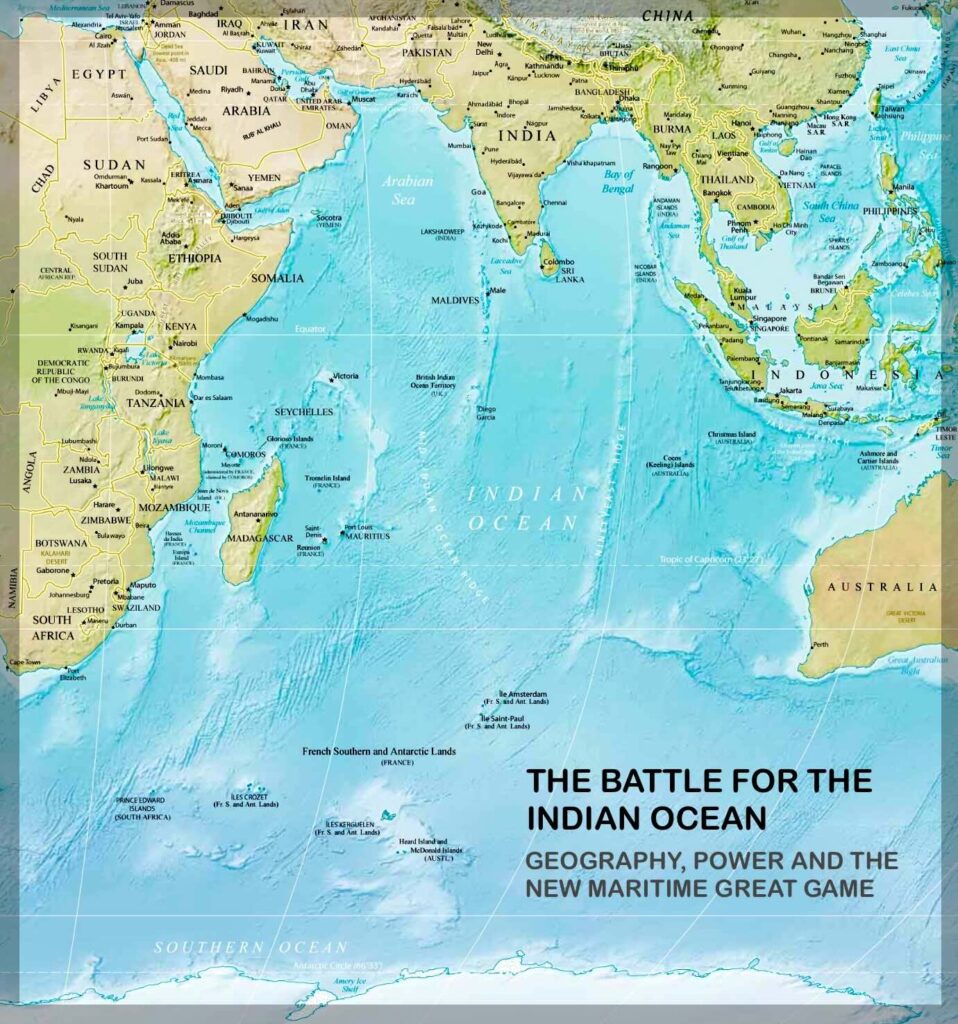
The reasons are evident. Stretching from the eastern coast of Africa to the western shores of Australia, the Indian Ocean is the world’s most strategically important maritime theatre. Nearly one-third of global seaborne trade passes through its waters, while much of Asia’s energy imports transit its vital sea lanes. Crude oil and liquefied natural gas from the Persian Gulf, China’s rare earth elements, bulk manufactured consumer goods and high-technology exports, together with critical minerals and raw materials from Africa, all depend on this vast maritime highway to reach markets across Europe, South Asia and the wider Indo-Pacific.
The ocean is also home to some of the world’s most critical maritime chokepoints. The Strait of Hormuz carries a significant share of globally traded crude oil. The Bab el-Mandeb links the Indian Ocean with the Red Sea and the Suez Canal, while the Strait of Malacca serves as the principal maritime gateway between the Indian and Pacific Oceans. Any disruption at these narrow passages would reverberate through global supply chains, energy markets and international trade.
This strategic reality has transformed the Indian Ocean into an arena of growing competition among major powers. Unlike the Cold War, when maritime rivalry was largely bipolar, today’s contest is more complex. China is extending its naval reach beyond the western Pacific. The United States continues to maintain its extensive network of alliances and forward military presence. Russia is seeking renewed access through strategic logistics agreements. At the centre of this evolving geopolitical landscape sits India, whose geography provides an advantage that no rival can replicate.
The contest is no longer about establishing colonial possessions or building the largest fleet. It is about securing access to ports, logistics hubs, surveillance networks, island territories and strategic partnerships that enable sustained military operations far from home waters. Commercial infrastructure increasingly carries strategic significance, while dual-use facilities blur the line between civilian investment and military capability.
This new maritime competition is already reshaping the Indo-Pacific security architecture.
The New Maritime Great Game
The phrase “Great Game” was originally used to describe the nineteenth-century rivalry between the British and Russian Empires across Central Asia. Today, geopolitical competition has shifted from mountain passes to maritime trade routes, but the underlying objective remains remarkably similar: securing influence over the passages that sustain economic prosperity, energy security and military dominance.
China’s rapid naval modernisation has fundamentally altered the regional balance. Over the past two decades, the People’s Liberation Army Navy (PLAN) has evolved from a force focused primarily on coastal defence into the world’s largest navy by hull numbers. Its ambitions now extend well beyond the South China Sea under the doctrine of “Far Seas Protection”, which seeks to safeguard China’s expanding overseas interests, maritime trade and energy supplies.
The United States, meanwhile, remains the pre-eminent global maritime power. Rather than relying solely on permanent overseas bases, Washington combines expeditionary naval forces with an extensive network of allies and partners stretching from the Middle East to the western Pacific. This architecture allows the US Navy to maintain a continuous presence across the Indian Ocean while supporting operations in multiple theatres simultaneously.
Russia‘s role is more limited but strategically significant. Although Moscow lacks an extensive network of overseas naval bases, it has sought to strengthen its reach through defence partnerships and logistics agreements. Its Reciprocal Exchange of Logistics Support (RELOS) agreement with India represents one such effort, enabling reciprocal military access without the political and financial costs associated with establishing permanent foreign bases.
For India, the challenge is fundamentally different. Unlike the other major powers, India is not seeking to enter the Indian Ocean. It is already there, occupying a central geographical position that naturally overlooks many of the region’s vital sea lanes. The question facing New Delhi is not how to establish a presence, but how to translate geography into sustained maritime influence.
China’s Expanding Maritime Footprint
China’s growing presence in the Indian Ocean is frequently described through the String of Pearls theory, a term that refers to a network of commercial ports, infrastructure investments and strategic partnerships extending from the South China Sea to the eastern coast of Africa. Although Beijing rejects the characterisation of these facilities as a coordinated military strategy, the cumulative effect has significantly expanded China’s ability to sustain naval operations far from its mainland.
The cornerstone of this network is China’s first overseas military base in Djibouti, inaugurated in 2017. Located near the Bab el-Mandeb Strait, the facility occupies one of the world’s most strategically important maritime locations, where shipping from the Indian Ocean enters the Red Sea before transiting the Suez Canal.
Officially described as a logistics support base for anti-piracy operations, humanitarian missions and peacekeeping deployments, the installation possesses capabilities that extend well beyond routine logistics. It includes a deep-water pier capable of accommodating large naval vessels, maintenance facilities, ammunition storage and accommodation for an estimated 1,000 to 2,000 personnel. The base has substantially improved the PLAN’s ability to maintain a continuous presence in the western Indian Ocean and the Gulf of Aden.
Unlike the United States, however, China has generally avoided establishing multiple sovereign military bases abroad. Instead, it has pursued access through commercial investments that may provide strategic flexibility during periods of heightened tension.
Pakistan’s Gwadar Port represents one of the most important elements of this strategy. Developed under the China-Pakistan Economic Corridor, Gwadar offers Beijing direct access to the Arabian Sea while strengthening its strategic partnership with Islamabad. Although the port currently functions primarily as a commercial facility, Chinese naval vessels have made port calls in Pakistan, and the Pakistan Navy increasingly operates Chinese-built warships while inducting Hangor-class submarines based on Chinese designs. In a crisis, Gwadar could provide valuable logistics and replenishment support for Chinese naval deployments in the western Indian Ocean.
Further south, Sri Lanka’s Hambantota Port has become one of the most debated examples of China’s overseas investments. Operated under a 99-year lease by a Chinese state-owned enterprise, the port remains a commercial transshipment and industrial hub rather than a Chinese naval base. Nevertheless, its location close to major east-west shipping routes gives it considerable strategic value should Beijing obtain expanded access during future contingencies.
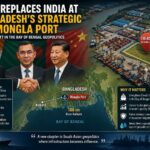
China’s presence is also growing along the Bay of Bengal, and Bangladesh has now emerged as an increasingly important node in China’s maritime strategy. In June 2026, Dhaka awarded the development of the Mongla Port Economic Zone to a Chinese state-owned enterprise, replacing an earlier India-backed proposal. Although the project is officially commercial rather than military, it significantly expands China’s economic footprint in the Bay of Bengal and adds another strategically located node to Beijing’s growing network of ports and logistics infrastructure across the Indian Ocean Region.
Further, the deep-sea port at Kyaukphyu in Myanmar forms an important component of the China-Myanmar Economic Corridor, providing a direct connection between China’s Yunnan Province and the Indian Ocean through oil and gas pipelines and transport infrastructure. Although there is no confirmed Chinese military base at Kyaukphyu, analysts widely regard the port as possessing dual-use potential because of its location and infrastructure.
Nearby, Myanmar’s Coco Islands continue to attract significant attention from defence analysts. Satellite imagery and open-source intelligence have identified runway extensions, radar installations and other infrastructure upgrades at military facilities on Great Coco Island. While there is no publicly available evidence confirming a Chinese military base, numerous assessments suggest that China has provided technical assistance and surveillance-related support. Given the islands’ proximity to India’s Andaman and Nicobar Islands, any enhancement of intelligence-gathering capabilities naturally attracts close scrutiny in New Delhi.
China’s maritime investments extend beyond South Asia. Across East Africa, Chinese companies have invested in major port infrastructure projects, including facilities in Kenya and Tanzania. While these remain commercial developments, they contribute to a broader logistics network capable of supporting China’s expanding economic and maritime interests across the western Indian Ocean.
Collectively, these facilities do not constitute a chain of traditional overseas military bases. Rather, they form an evolving network of commercial access, logistics infrastructure and strategic partnerships that enhances China’s operational flexibility. Whether this network eventually matures into a more permanent military architecture will depend not only on Beijing’s ambitions but also on the political choices of host nations and the evolving strategic environment across the Indo-Pacific.
Coming Next in the Series
The Battle for the Indian Ocean is presented in four parts, tracing the historical evolution, strategic realities and future implications of maritime competition across the Indo-Pacific.
- ✔️ Part I: The Ocean That Powers the World (Current Article)
- Part II: America, Russia and India’s Geographic Advantage
- Part III: The Islands That Could Shape the Indo-Pacific
- Part IV: Can India Shape the Future Maritime Balance?
China’s expanding maritime footprint has fundamentally altered the strategic landscape of the Indian Ocean, but Beijing is far from the only power shaping this vital region. The United States continues to anchor its presence through a vast military network, Russia is quietly extending its reach through strategic partnerships, and India possesses a geographical advantage that no rival can replicate.
In Part II, we examine how these competing strategies are reshaping the balance of power across the Indo-Pacific.
Also Read:
Great Nicobar Island Project: India’s Strategic Development with Tribal Welfare