China Replaces India at Bangladesh’s Strategic Mongla Port
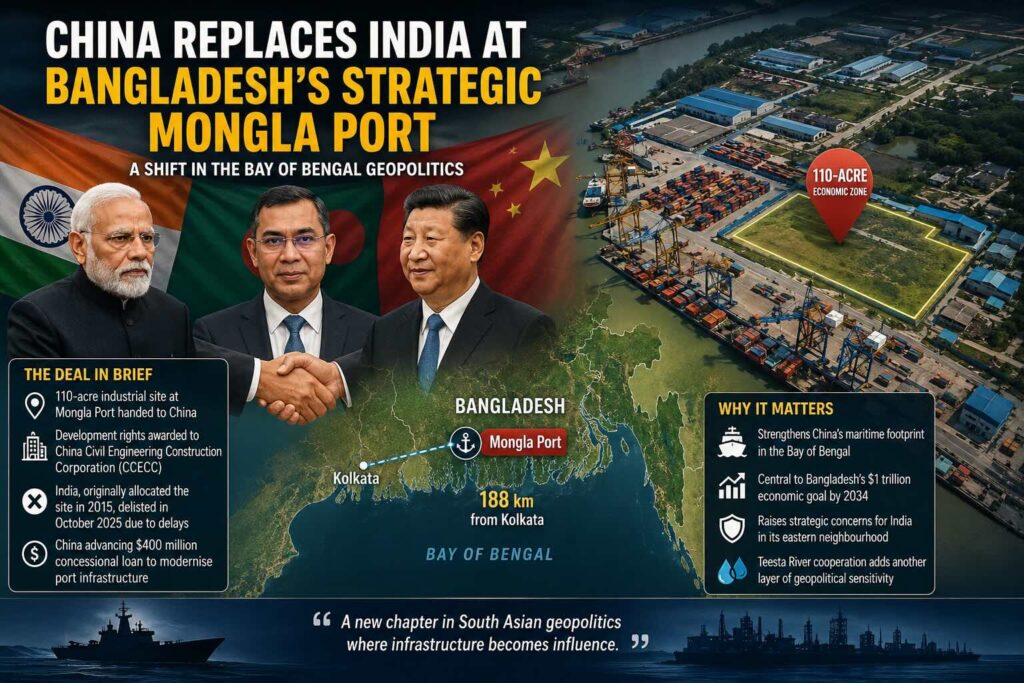
In a major geopolitical realignment that could reshape South Asian maritime dynamics, Bangladesh has officially awarded development rights for a key economic zone at Mongla Port to China, replacing India, which had originally been awarded the project.
The agreement was formalised at the Great Hall of the People in Beijing during the state visit of newly elected Bangladeshi Prime Minister Tarique Rahman. The decision marks a significant shift in Dhaka’s foreign policy, reflecting its growing reliance on Chinese investment and infrastructure financing while compelling New Delhi to reassess its strategic posture in the Bay of Bengal.
The Mongla Port Shift
Bangladesh has transferred a strategically located 110-acre industrial site adjacent to Mongla Port, its second-busiest seaport, to the state-owned China Civil Engineering Construction Corporation (CCECC). The development represents one of the most consequential infrastructure decisions taken by Dhaka in recent years.
The site lies approximately 188 km from Kolkata and occupies a strategically important position on the Bay of Bengal.
The Deal: Out with New Delhi, In with Beijing
The memorandum of understanding (MoU) grants CCECC development rights over the industrial zone, where China plans to establish a specialised economic zone focused on high-tech manufacturing, telecommunications, logistics and advanced warehousing.
The decision effectively ends a decade-long Indian proposal. The land had originally been allocated to India in 2015 under a bilateral friendship initiative. However, following years of implementation delays by Indian-nominated companies, Bangladesh quietly removed India from the project in October 2025.
Alongside the industrial zone, Beijing is also advancing a concessional loan package worth approximately $400 million to modernise Mongla Port’s terminal infrastructure.
Bangladesh’s Economic Blueprint: Aiming for a $1 Trillion Economy
According to financial data compiled from Bangladeshi sources, including The Business Standard, Prime Minister Rahman is using his first overseas visits to aggressively attract foreign direct investment.
Facing mounting pressure from non-performing loans in the banking sector, Bangladesh has set an ambitious objective of expanding its economy from approximately $501 billion to $1 trillion by 2034. Achieving that goal will require raising national investment from 28 per cent of GDP to 40 per cent, while increasing foreign direct investment from around 1 per cent of GDP to 2.7 per cent.
Key Economic Targets
- Current GDP: US$501 billion
- Target GDP by 2034: US$1 trillion
- Current Investment: 28% of GDP
- Target Investment: 40% of GDP
- Current FDI: Approximately 1% of GDP
- Target FDI: 2.7% of GDP
During bilateral talks, Rahman also urged Chinese President Xi Jinping to help reduce the significant trade imbalance between the two countries. While China exports tens of billions of dollars’ worth of goods to Bangladesh annually, it imports only about $1.3 billion, primarily consisting of human hair for wig manufacturing (approximately $153 million) and raw jute (around $78 million).
In response, Beijing announced a 100 per cent zero-tariff arrangement covering all Bangladeshi exports.
Geopolitical Friction: Three Capitals, Three Perspectives
Dhaka: A Partnership of Equals
Addressing Chinese investors at the Invest Bangladesh Seminar in Beijing, Prime Minister Rahman pledged to provide a more responsive and investor-friendly business environment.
Bangladeshi officials maintain that replacing India with China was a purely commercial decision driven by prolonged implementation delays, portraying the new arrangement as a partnership between equal economic partners rather than a geopolitical shift.
New Delhi: Strategic Alarm in India’s Eastern Backyard
The development has generated significant concern within India’s strategic community.
Mongla Port lies only about 188 km from Kolkata and sits close to the ecologically sensitive Sundarbans region. Although the project is officially commercial, Indian security analysts fear it could provide Beijing with long-term operational leverage near India’s eastern naval infrastructure and maritime approaches.
The setback comes amid already strained India-Bangladesh relations following the political exit of former Prime Minister Sheikh Hasina.
Beijing: Expanding Its Indian Ocean Footprint
Chinese state media reported that President Xi Jinping reaffirmed China’s long-term commitment to Bangladesh, declaring that Beijing “will never waver” in supporting bilateral cooperation regardless of changing global circumstances.
For China, Mongla represents another strategic component of its Maritime Silk Road initiative, strengthening logistics networks linking the China-Myanmar-Bangladesh Economic Corridor while providing greater access to shipping routes that reduce dependence on the strategically vulnerable Malacca Strait.
The Next Flashpoint: Teesta River Cooperation
The Mongla agreement was not the only major outcome of the visit.
Bangladesh and China also agreed to expand cooperation in integrated water management for the Teesta River, one of the most politically sensitive transboundary rivers shared with India.
Chinese participation in future Teesta water-management projects would further deepen Beijing’s strategic presence along India’s eastern frontier, reinforcing Dhaka’s message that Bangladesh’s infrastructure partnerships are no longer centred exclusively on New Delhi.
The Bigger Picture
China’s acquisition of the Mongla economic zone reflects more than a commercial investment. It represents a broader geopolitical shift in the Bay of Bengal, where infrastructure, trade, maritime logistics and strategic influence are becoming increasingly intertwined.
For Bangladesh, the move promises faster investment, improved infrastructure and greater access to Chinese capital as it pursues its ambitious economic targets.
For India, however, it marks another erosion of long-standing regional influence in a maritime neighbourhood traditionally regarded as part of its strategic sphere.
How New Delhi responds through renewed economic engagement, accelerated infrastructure delivery or enhanced regional diplomacy may determine whether this development becomes an isolated setback or the beginning of a broader strategic realignment across the Bay of Bengal.