BRICS Foreign Ministers Converge in New Delhi: Iran’s Fiery Calls for Condemnation, UAE Clash, and India’s Push for Stability Dominate Proceedings
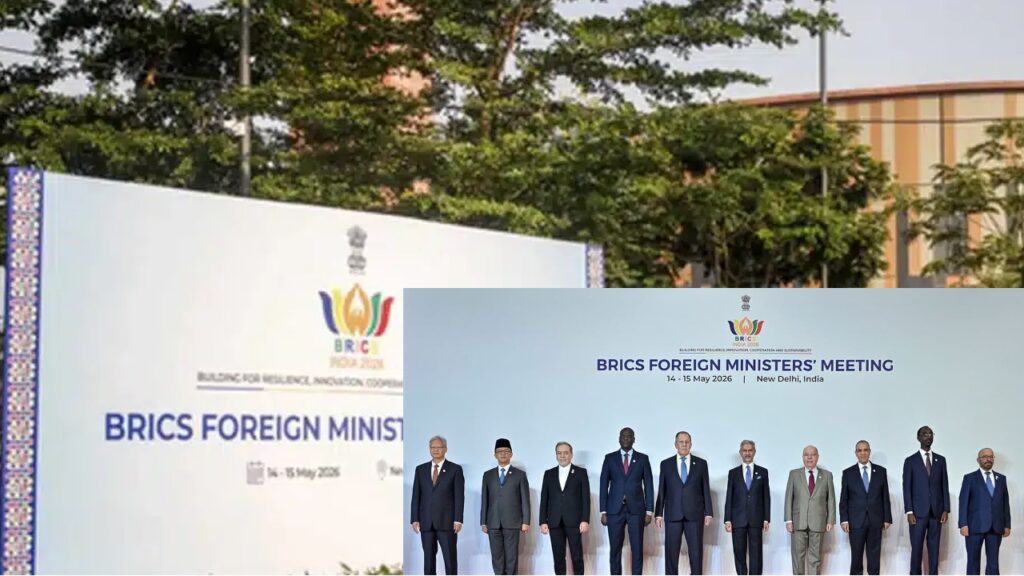
New Delhi, May 14, 2026 | Bharat Mandapam has become the focal point of global South diplomacy as India hosts the BRICS 2926 Foreign Ministers Meeting under its 2026 chairmanship. The two-day gathering, chaired by External Affairs Minister Dr. S. Jaishankar, brings together senior diplomats from the expanded bloc amid escalating West Asian tensions, surging oil prices, and debates over multipolarity. This meeting serves as a critical precursor to the BRICS Leaders Summit in September.
Jaishankar Sets a Pragmatic Tone for BRICS 2026
In his opening remarks, Jaishankar highlighted the considerable flux in international relations, marked by ongoing conflicts, economic uncertainties, and challenges in trade and technology. He stressed a growing expectation for BRICS to play a constructive and stabilising role, calling for safe and unimpeded maritime flows, stronger cooperation against terrorism, and dialogue over confrontation. India continues to position itself as a bridge-builder, emphasising practical outcomes in health financing, climate resilience, and innovation rather than bloc politics.
Key Participants and Expanded Membership
The meeting features representatives from BRICS’s eleven member states: Brazil, Russia, India, China, South Africa, Egypt, Ethiopia, Iran, United Arab Emirates, Indonesia, and Saudi Arabia along with partner nations such as Belarus, Bolivia, Kazakhstan, Cuba, Malaysia, Nigeria, Thailand, Uganda, Uzbekistan, and Vietnam.
Notable attendees include Russia’s Sergey Lavrov, Iran’s Abbas Araghchi, Brazil’s Mauro Vieira, South Africa’s Ronald Lamola, Egypt’s Badr Abdelatty, Ethiopia’s Gedion Timothewos, UAE’s Reem Al Hashimy (or senior representative Khalifa Shaheen Al Marar), and Indonesia’s Sugiono. China is represented by Ambassador Xu Feihong, with Foreign Minister Wang Yi absent due to scheduling. Saudi Arabia’s participation remains at a senior diplomatic level.
Iran’s Strong Statements and Direct Clash with UAE
Iranian Foreign Minister Abbas Araghchi delivered one of the most assertive interventions, urging BRICS members to explicitly condemn the United States and Israel for what he described as unlawful aggression against Tehran. He called for practical steps to stop warmongering, an end to impunity for violations of the UN Charter, and stronger collective action against the politicization of international institutions. Araghchi noted appreciation for existing BRICS support but pushed for more decisive measures, stating that it is necessary for all of us to intensify our efforts to end this sense of superiority and impunity on the part of the United States.
Tensions escalated publicly when Araghchi directly accused the UAE of involvement in attacks on Iran. I didn’t name the UAE in my [BRICS] statement for the sake of unity. But the truth is that the UAE was directly involved in the aggression against my country, he said, claiming Abu Dhabi provided bases, airspace, intelligence, and other facilities. He added that the UAE failed to condemn the initial strikes. The remarks came in response to comments by the Emirati representative and exposed sharp divisions within the expanded bloc.
Russia and India’s Positions
Russia’s Sergey Lavrov, who held extensive bilateral with Jaishankar, emphasised BRICS as the genuine voice of the Global Majority. He expressed confidence in achieving ambitious intra-BRICS trade targets and assured partners of steady Russian energy supplies amid disruptions. Lavrov highlighted the richness of Russia-India ties, underscoring strategic partnership and coordination ahead of the September summit.
India, through Jaishankar, has maintained a balanced approach focused on maritime security and energy stability. New Delhi recently completed Operation Urja Suraksha, safely evacuating 15 LPG tankers from the Strait of Hormuz under naval protection. Jaishankar’s emphasis on safe, unimpeded maritime flows directly addresses these concerns without naming parties in the conflict.
No detailed public rebuttal from the UAE delegation has been widely reported beyond the on-site exchange, though the bloc’s newer Gulf members are navigating careful diplomacy between energy interests and regional alliances.
Broader Agenda: Energy, Economy, and Global Reform
Beyond the West Asia crisis, discussions cover de-dollarisation through local currency trade, boosting intra-BRICS investment, reforming global institutions like the UN and IMF, and advancing digital and sustainable development. Maritime security in the Strait of Hormuz and Red Sea remains a priority, with Araghchi affirming the strait’s openness to cooperating vessels.
Sideline Engagements and Outlook
Prime Minister Narendra Modi received several delegations, while intense bilateral meetings including Araghchi’s meetings with Jaishankar, Ajit Doval, and others continue alongside the formal sessions. A joint statement is expected by the close on May 15, though the Iran-UAE rift may lead to measured language.
As the meeting unfolds, BRICS faces a pivotal test: Can it translate growing relevance into unified action on crises, or will internal fault lines limit its ambitions? India’s stewardship will be closely watched for its ability to foster consensus in a fractured world.