Updated on May 06, 2026
Nepal’s Silent Shift: Conversion, Demography, and the Urgent Price of a Weak State
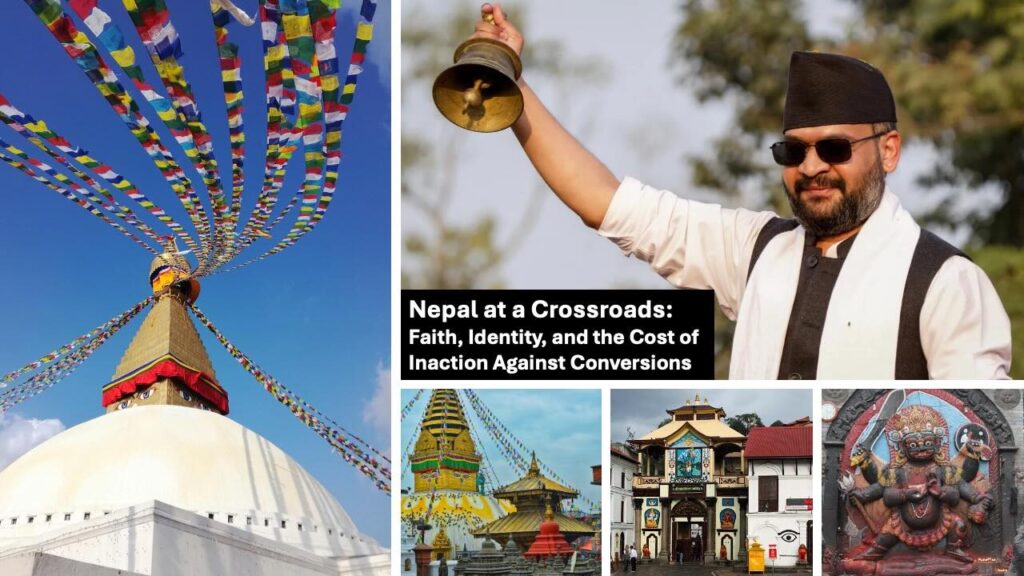
Nepal at a Crossroads: Faith, Identity, and the Cost of Inaction Against Conversions
Nepal religious conversion and demographic shift is an ongoing issue.
Nepal is not just another developing nation grappling with poverty and politics. It is a civilisational homeland where
geography, faith, and history have created a unique cultural continuity for centuries. The sacred presence of
Pashupatinath, Lumbini, Swayambhu and Boudhanath represents more than tourist
sites—they form the living grammar of Nepali identity.
For most of its history, this cultural coherence—rich in heritage, pride, and syncretic traditions—endured without
needing constant assertion. That era is ending.
Nepal is undergoing a quiet but accelerating transformation. No single explosion marks it. Instead, census trends,
localized demographic shifts, and institutional voids reveal a steady erosion of the traditional religious balance. The
state’s failure to respond decisively is turning manageable change into a structural challenge.
This is not alarmism. It is the observable trajectory.
The Data Behind the Nepal Religious Conversion
On paper, Nepal remains overwhelmingly Hindu.
The 2021 census records Hindus at 81.19%, with Buddhists at 8.21%.
Yet the longer-term trend tells a clearer story. The Hindu share has declined from 86.51% in 1991 (and
89.5% in 1981) to 81.19% today — a drop of roughly 5–8 percentage points over three
decades.
Meanwhile, the Muslim population has risen to 5.09% (up from 4.39% in 2011), largely concentrated in
the Terai through higher fertility rates and cross-border patterns.
Christianity, statistically negligible two decades ago, now stands at 1.76% officially (over 512,000
people), up from 1.41% in 2011 — a more than 35% increase in a single decade. Independent surveys and
church reports suggest even higher effective numbers in several districts.
These are not neutral shifts. Islam’s growth is largely organic and demographic. Christianity’s expansion is organised
conversion-driven, often concentrated among economically vulnerable hill communities, Dalits, indigenous groups, and
post-disaster areas. Faith-based networks frequently fill the vacuum left by absent state services—schools, healthcare,
relief—creating conditions where “choice” occurs amid structural dependence.
Conversion in a Fragile State
Nepal’s 2017 Penal Code explicitly bans religious conversion through coercion, allurement, or inducement, with penalties
up to five years in prison. The law exists for a reason: to safeguard genuine belief from exploitation in a poor
country.
Yet enforcement is weak, episodic, and directionless. Arrests and deportations of foreign missionaries occur
occasionally, but grey-zone activities—aid tied to evangelism, informal networks, opaque foreign funding—persist across
districts. There are no consistent directives from the centre to local administration. Hotspots see recurring patterns,
while other areas face lax oversight. This selective implementation protects neither religious freedom nor national
cohesion. It breeds resentment and allows the problem to grow.
The result is segmentation in what was once a syncretic society: family tensions over rituals, disputes over burial vs.
cremation, friction in shared festivals. These are still localised, but they signal deeper erosion of social trust.
The Terai and Broader Vulnerabilities
In the Terai, demographic consolidation meets an open border. Muslim population growth has altered local dynamics in
parts of Madhesh Province—electoral shifts, identity assertion, new infrastructure. Combined with Christian outreach in
vulnerable pockets, this tests Nepal’s traditional pluralism.
Foreign footprints compound the issue. Networks from the West, South Korea, and elsewhere operate with limited
transparency. The state’s inability to audit NGOs, enforce visa rules strictly, or deliver neutral basic services
creates exactly the environment where external influence thrives.
Time for Decisive Action
Nepal is not on the verge of collapse, but drift in demography and identity carries long-term costs: sharper public
discourse, pressures on cultural tourism, and weakened national cohesion. Unmanaged change rarely stays neutral.
The newly elected Prime Minister Balen Shah has a mandate for reform and accountability. This must
include priority action on religious conversion and demographic management. Symbolic gestures are not
enough. The government needs to issue clear, nationwide directives for uniform enforcement of the 2017
law. Iron-fist implementation—systematic monitoring of hotspots, rigorous NGO audits, transparent foreign funding rules,
stronger border screening, and rapid neutral service delivery in vulnerable areas—is essential.
Resources wasted on peripheral issues (such as routine border trade disputes) should be redirected toward core
institutional priorities. Weak administration cannot plead ignorance when trends are visible in census data and ground
reports. The law is on the books; what is missing is political will and administrative spine.
A confident state does not fear belief. It ensures belief is not shaped by poverty, opacity, or external leverage.
Nepal’s challenge is not diversity itself—it is the failure to govern change.
The window for correction is narrowing.
Drift must end. Strong, consistent governance is now urgent.
References
- Religions in Nepal – 2021 Census Thematic Report (National Statistics Office, Official PDF)
https://censusnepal.cbs.gov.np/results/files/result-folder/Religion%20in%20Nepal.pdf
(Primary source for 81.19% Hindu, 8.21% Buddhist, 5.09% Muslim, 1.76% Christian.) - Pedalling Out of Sociocultural Precariousness: Religious Conversions amongst the Hindu Dalits to
Christianity in Nepal by Bishnu Pariyar et al. (2021) – MDPI Religions Journal
https://www.mdpi.com/2077-1444/12/10/856 - U.S. Department of State – 2023 International Religious Freedom Report: Nepal (Official PDF)
https://www.state.gov/wp-content/uploads/2024/04/547499-NEPAL-2023-INTERNATIONAL-RELIGIOUS-FREEDOM-REPORT.pdf - USCIRF 2023 Country Update on Nepal (PDF)
https://www.uscirf.gov/sites/default/files/2023-08/2023%20Nepal%20Country%20Update.pdf - International Christian Concern (ICC) – The Declining State of Religious Freedom in Nepal (2025
Report)
https://persecution.org/wp-content/uploads/2025/06/Nepal-Report.pdf - UNESCO World Heritage Site – Kathmandu Valley (Pashupatinath, Boudhanath, Swayambhunath)
https://whc.unesco.org/en/list/121/