The 2026 Iran War Lessons for India: Why Warfare Must Be Rethought at Scale
The 2026 Iran war is not merely a regional conflict—it is a defining demonstration of how industrial-scale warfare, cost asymmetry, and hardened survivability can challenge even technologically superior adversaries. The 2026 Iran war lessons are immediate and consequential. For India, this is not a distant geopolitical event, but a preview of the battlefield it may confront across both the Line of Control (LoC) and the Line of Actual Control (LAC).
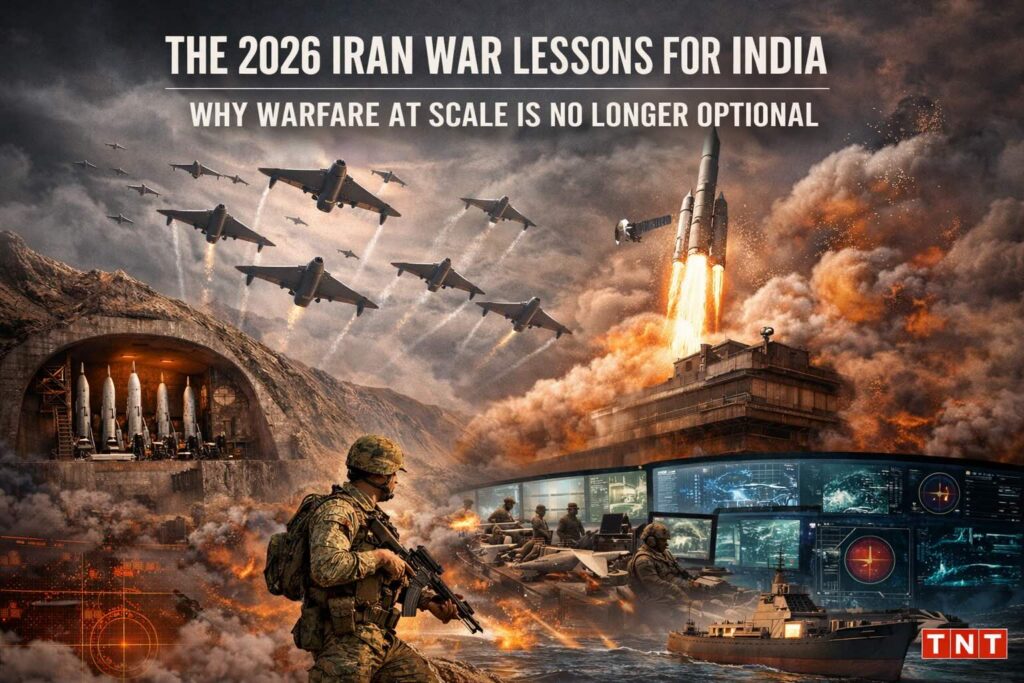
Iran’s ability to sustain prolonged saturation attacks despite intense US-Israeli strikes was not incidental. It was the outcome of deliberate design—industrial-scale production of low-cost systems combined with deeply buried infrastructure that ensured continuity under fire. Pre-war intelligence assessments suggested Iran could produce roughly 400 Shahed-class drones per day, enabling sustained operational pressure. Even after strikes degraded a significant portion of known production capacity, decentralised facilities and pre-existing stockpiles ensured continued, though reduced, output.
Equally critical was Iran’s extensive network of underground “missile cities”—hardened facilities embedded deep within mountainous terrain, in some cases hundreds of metres below the surface. These complexes enabled protected storage, assembly, and launch capabilities, allowing assets to survive initial strikes and return to operation quickly.
Together, these elements enabled a sustained saturation-plus-attrition strategy: overwhelming defences with waves of low-cost systems to exhaust interceptors, followed by the selective use of higher-value assets when defensive gaps emerged. Without such depth in production and survivability, Iran’s operational tempo would likely have collapsed early.
For India, where current production capacities remain aligned with peacetime requirements, the lesson is stark. Future conflicts will not be decided solely by technological superiority, but by the ability to sustain operations under relentless pressure. This demands a shift toward wartime industrial scalability, supported by dispersed manufacturing, hardened infrastructure, and survivable storage.
Also Read:
Zelenskyy Gulf Tour and Defence Agreements: 10-Year Pacts with Saudi Arabia, Qatar and UAE
Tier 1: Immediate Operational Priorities
Drone Warfare as the New Centre of Gravity
The conflict underscores that drone warfare is no longer auxiliary—it is central. Coordinated swarms flooded defended airspace in volumes sufficient to overwhelm even advanced systems, while simultaneously creating a persistent psychological effect on civilian and military populations.
For defenders, the challenge was economic as much as tactical. High-cost interceptors were repeatedly expended against low-cost drones, creating an unsustainable cost-exchange ratio. Once defensive inventories were strained, windows opened for precision strikes.
India has made progress in indigenous drone development and counter-UAS systems, but scale remains the defining gap. Wartime readiness requires the ability to field thousands of attritable systems monthly, potentially scaling to hundreds per day. Defensive architecture must evolve into a layered ecosystem integrating directed-energy weapons, interceptor drones, electronic warfare systems, and AI-enabled detection.
Also Read:
The Dawn of the Drone Swarm and Saturation Strike: How Yesterday’s Wars Are Already Obsolete
Electronic Warfare: The Battle Before the Battle
Electronic warfare shaped the conflict from the opening moments. Radar systems were blinded, communication networks disrupted, and command chains destabilised, enabling kinetic operations to proceed with reduced resistance.
Spectrum dominance effectively determined the battlespace before physical engagement began.
India must strengthen both defensive and offensive electronic warfare capabilities. Protecting its own sensors and communication systems is as critical as developing the ability to degrade those of an adversary. Integration of electronic warfare into operational planning must be treated as foundational, not supplementary.
Cyber Warfare as a Parallel Battlefield
Cyber operations ran in parallel with physical strikes, targeting infrastructure, communications, and command networks. Disruptions extended into civilian domains, amplifying the overall impact of military operations.
India must expand its offensive cyber capabilities while simultaneously hardening critical infrastructure, including power grids, healthcare systems, financial networks, and military command structures. The Defence Cyber Agency requires rapid scaling in both capability and operational integration.
Tier 2: Structural Capability Building
Multi-Domain Operations: From Doctrine to Execution
The conflict validated that victory lies in seamless integration across land, air, sea, space, cyber, and cognitive domains. Real-time coordination across these spheres produced compounded effects that no single domain could achieve independently.
India’s Joint Doctrine for Multi-Domain Operations reflects this understanding. However, doctrinal articulation must now translate into operational reality. The transition from coordination to true domain fusion remains incomplete and requires urgent acceleration.
Space and ISR: The Invisible Backbone
Persistent intelligence, surveillance, and reconnaissance capabilities proved indispensable. Satellite networks enabled real-time targeting and decision-making, while also exposing vulnerabilities to jamming and anti-satellite threats.
India must expand its low-Earth orbit satellite constellation to ensure redundancy and resilience, while simultaneously developing counter-space capabilities to protect these assets.
Precision vs Volume: Rethinking the Balance
Precision-guided munitions delivered high-impact results, particularly in initial strikes. However, their cost and limited availability constrained sustained operations.
A hybrid model—combining inexpensive systems with selective deployment of advanced weapons—proved more effective over time.
India must maintain its qualitative edge while building large inventories of cost-effective, mass-producible systems capable of sustaining prolonged engagements.
Cost Asymmetry and Industrial Warfare
The conflict highlighted the structural advantage of exploiting cost asymmetry. Low-cost systems forced the use of expensive defensive responses, creating a strategic imbalance.
India must prioritise indigenous, scalable production across both offensive and defensive systems. Industrial depth—supported by dispersed manufacturing and hardened infrastructure—will be decisive in ensuring endurance under sustained attack.
Tier 3: Strategic and Doctrinal Shifts
Pre-Emptive Strategy Under a Nuclear Shadow
The conflict unfolded under a persistent nuclear overhang, with rapid escalation leaving little room for prolonged restraint. Traditional doctrines that emphasise delayed response may prove inadequate in scenarios involving imminent threats.
India must consider evolving its posture to include credible pre-emptive options when supported by clear and reliable intelligence. Such a posture must remain tightly bound to credible intelligence thresholds, political oversight, and escalation control mechanisms to avoid unintended destabilisation.
Information and Cognitive Warfare
The psychological dimension extended far beyond physical destruction. Coordinated information operations amplified fear, shaped perception, and influenced both domestic and international narratives.
India must strengthen capabilities in psychological operations, social media resilience, and narrative control. The ability to shape perception is increasingly intertwined with battlefield outcomes.
Energy Security and Maritime Vulnerabilities
Threats to shipping routes and energy flows highlighted vulnerabilities in maritime infrastructure. Attacks on strategic chokepoints underscored the fragility of global supply chains.
For India, this necessitates enhanced naval capabilities, including unmanned systems, improved maritime surveillance, and sea-denial strategies. Diversification of energy sources must also be treated as a strategic imperative.
Endurance Will Decide the Next War
The 2026 conflict demonstrates that future wars will not be decided by technological superiority alone, but by the ability to endure, adapt, and sustain operations under pressure. Industrial-scale production, hardened survivability, and multi-domain integration are no longer optional—they are prerequisites.
India has strong foundations in indigenisation and doctrinal reform. However, the uncomfortable question is whether its current production models and force structures are designed for wars of attrition—or remain anchored in peacetime assumptions.
Identifying and compiling the “2026 Iran war lessons” is not enough. The real test is whether they are translated into capability, infrastructure, and doctrine—before it is too late.
In future wars, victory will not belong to the most advanced military, but to the one that can endure, adapt, and out-produce its adversary under fire—because success will depend less on sophistication, and more on the ability to sustain, replace, and protect capability under relentless attack.