KP Sharma Oli Arrest Marks Historic Shift in Nepal Politics
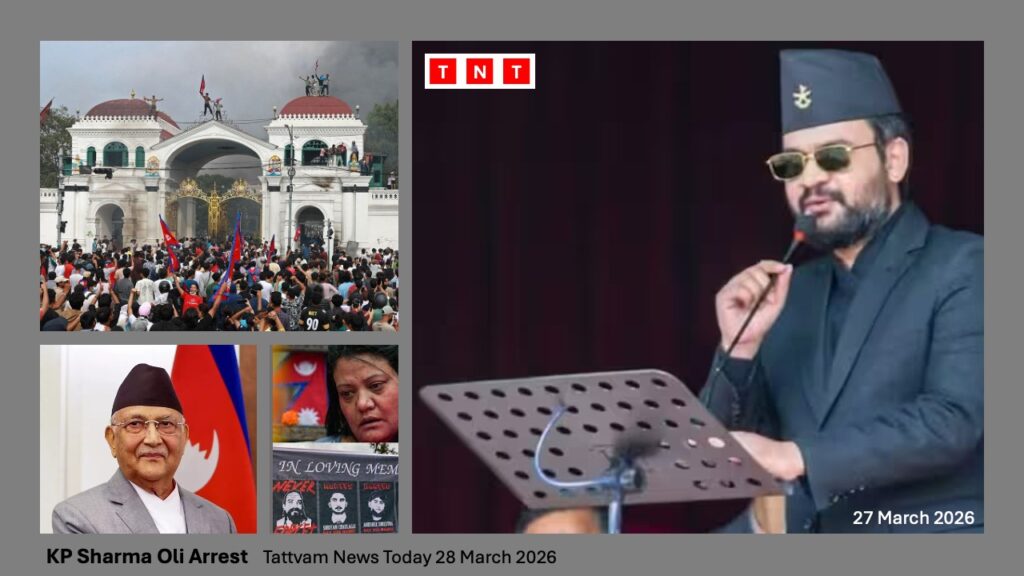
Kathmandu, March 28, 2026 — The KP Sharma Oli Arrest has triggered a political earthquake in Nepal, marking one of the most dramatic accountability moves in the country’s recent history. Former Prime Minister K. P. Sharma Oli was taken into custody early Saturday in connection with the deadly 2025 Gen Z protest crackdown that left at least 76 people dead.
The arrest comes just a day after Balendra Shah, widely known as Balen Shah, assumed office as Nepal’s youngest Prime Minister following a landslide electoral victory powered by youth anger and anti-establishment sentiment.
Early Morning Operation and Heightened Security
The KP Sharma Oli Arrest unfolded around 5 a.m., when police teams detained Oli from his residence in Bhaktapur. Former Home Minister Ramesh Lekhak was also arrested from a nearby location. Both were transported to the Kathmandu Police Office amid tight security deployment across the capital Kathmandu.
Oli, 74, who has a history of serious health issues including kidney transplants, was later shifted to a hospital under police supervision. Authorities confirmed that both leaders are expected to be presented before court proceedings on Sunday, Nepal’s official working day.
Commission Findings Behind KP Sharma Oli Arrest
The KP Sharma Oli Arrest stems from the findings of a high-level investigative panel led by former judge Gauri Bahadur Karki. The commission report, adopted swiftly by the new cabinet, recommended prosecution under Sections 181 and 182 of Nepal’s National Penal Code.
The panel concluded that leadership failed to prevent excessive use of force despite prior intelligence warnings. It highlighted that no effective attempt was made to control firing during protests, resulting in fatalities, including minors. If convicted, those charged could face up to 10 years in prison.
The report also implicated former police chief Chandra Kuber Khapung and suggested disciplinary action against several serving officials.
The 2025 Gen Z Protests That Changed Nepal
The KP Sharma Oli Arrest cannot be understood without revisiting the protests that reshaped Nepal’s political landscape. In September 2025, nationwide demonstrations erupted following a brief government-imposed social media blackout.
What began as digital dissent quickly escalated into mass protests against corruption, unemployment, and political favoritism. On September 8 and 9, security forces opened fire on demonstrators in multiple locations, including Kathmandu.
At least 19 people were killed on the first day alone, with the death toll rising to 76–77 within 48 hours. The unrest also saw large-scale destruction of public infrastructure, including parliament buildings and government offices. Even Oli’s private residence was targeted.
The scale of violence forced Oli to resign on September 9, setting the stage for fresh elections.
Rise of Balen Shah and the Politics of Accountability
The KP Sharma Oli Arrest is also a political statement by Prime Minister Balendra Shah, whose campaign centered on justice for protest victims.
At just 32, Shah represents a generational shift in Nepal’s leadership. A former rapper turned politician, he built his popularity through anti-corruption messaging and direct engagement with young voters.
His party’s landslide victory in March 2026 elections reflected widespread frustration with traditional political elites, particularly figures like Oli, who served multiple terms as prime minister.
Implementing the Karki Commission report became one of Shah’s first major decisions in office, signaling a break from Nepal’s long-standing culture of political impunity.
Government vs Opposition: Justice or Political Revenge?
The KP Sharma Oli Arrest has sharply divided Nepal’s political spectrum.
New Home Minister Sudan Gurung defended the move, stating that the arrests are about justice, not revenge. Officials insist the action strictly follows the commission’s recommendations.
However, Oli’s legal team has challenged the arrest as unnecessary and politically motivated. His lawyer argued there was no risk of flight or evidence tampering, calling the detention improper.
Oli himself has previously dismissed the investigation as politically driven. His party, Communist Party of Nepal (Unified Marxist–Leninist) (CPN-UML), has announced nationwide protests, describing the arrests as a threat to democratic norms.
Senior party leaders have urged supporters to mobilize, raising concerns about potential unrest.
A Defining Moment for Nepal’s Democracy
The KP Sharma Oli Arrest represents a rare moment in South Asian politics, where a former head of government faces swift legal consequences over protest-related deaths.
Legal experts say the case is unprecedented in Nepal’s history. While the commission cleared lower-level personnel of direct responsibility, it held top leadership accountable for negligence and failure to act.
This distinction could set a significant legal precedent, redefining accountability standards for political leadership during crises.
What Lies Ahead
As Nepal braces for possible protests and political instability, the impact of the KP Sharma Oli Arrest remains uncertain.
For victims’ families, the arrests offer a long-awaited sense of justice. For the political establishment, it signals a shift toward stricter accountability. For the new government, it is both an opportunity and a risk.
Nepal’s fragile political system, often marked by short-lived governments and street mobilization, now faces a critical test. Whether this moment leads to institutional strengthening or deeper polarization will depend on how the legal process unfolds in the coming weeks.
What is clear, however, is that the KP Sharma Oli Arrest has already altered the trajectory of Nepal’s politics—placing accountability, youth power, and justice firmly at the centre of national discourse.