India Edges Closer to Testing K-6 SLBM with 8,000 Km Range
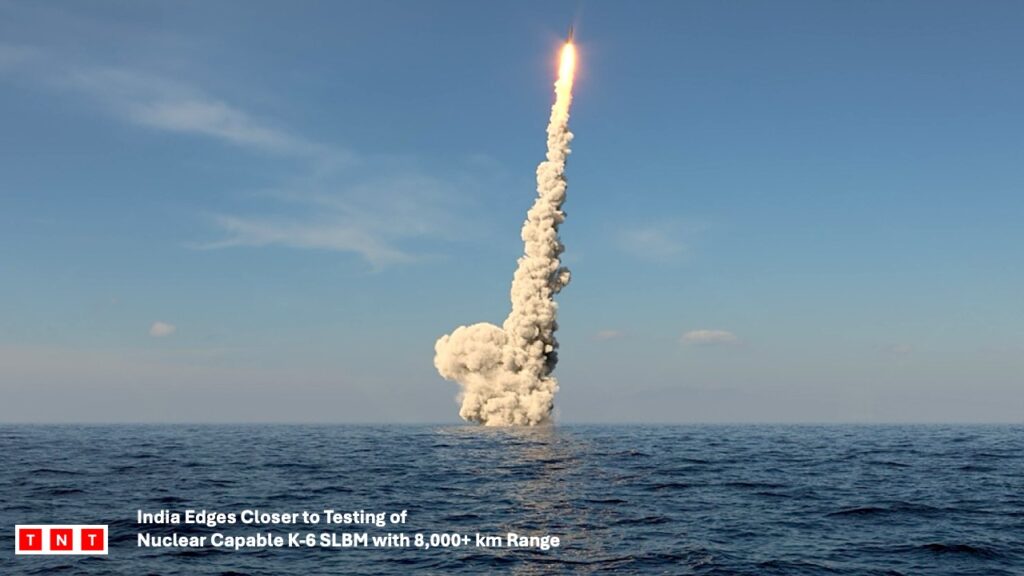
India’s K-6 SLBM is emerging as the most consequential upgrade to its sea-based nuclear deterrent since the operationalisation of the Arihant-class submarines and the testing of the K-4 SLBM. Developed by DRDO as a submarine-launched, nuclear-capable ballistic missile with a range of about 8,000 km, the K-6 is now widely reported to be nearing its testing phase, signalling a decisive step beyond the current Kalam-series capability.
From K-15 and K-4 to the K-6 SLBM
India’s sea-based deterrent has so far revolved around shorter and medium-range SLBMs such as K-15 “Sagarika” and K-4, both designed primarily around the constraints and size of the Arihant-class SSBNs. K-15, with a range of around 750 km, and K-4, with a reach of about 3,500 km, allow nuclear-armed submarines to target adversaries in the region but still require Indian boats to operate relatively closer to hostile shores for strategic coverage.
In late 2025, India successfully conducted user-related tests of the K-4 from INS Arighaat, underlining that the medium-range SLBM is moving firmly towards regular operational deployment. Reports of a follow-on K-5 system with a range in the 5,000–6,000 km band and multiple independently targetable re-entry vehicle (MIRV) capability have further indicated a gradual extension of reach and sophistication in the K-series.
What Sets the K-6 SLBM Apart
Open-source assessments describe the K-6 SLBM as a three-stage, solid-fuel missile, over 12 metres long and roughly 2 metres in diameter, engineered to carry a payload in the 2–3 tonne class. The missile is expected to field full MIRV capability, with the ability to deliver several independently targetable nuclear warheads against different targets from a single launch, significantly complicating an adversary’s missile defence planning.
In terms of performance, the K-6 is categorised by multiple analysts as a hypersonic SLBM, with reported terminal speeds in the region of Mach 7 or more and a strike range around 8,000 km, placing it in the intercontinental bracket in practical terms. Some speculative estimates suggest a potential range of up to 10,000–12,000 km under optimised payload conditions, though such figures remain unconfirmed and should be treated cautiously.
Platforms: Arihant to Future S-5 SSBNs
While K-15 and K-4 were tailored to the displacement and hull form of the ~6,000–7,000 tonne Arihant-class, the K-6 SLBM is clearly aimed at a new generation of larger ballistic missile submarines. The existing boats can carry a mix of 12 K-15s or four K-4s, but they are widely considered too small to house the much larger K-6.
To unlock the full potential of the K-6, India is reported to be working on the S-5 class of nuclear-powered ballistic missile submarines, projected at around 13,000 tonnes submerged and equipped with up to 16 missile tubes. With K-6 SLBMs loaded, an S-5 SSBN on patrol in the Indian Ocean could hold at risk targets across China and Eurasia without approaching contested waters.
Development Status and Testing Trajectory
Public information remains limited, but open reports through 2025 and early 2026 indicate that the K-6 SLBM has moved beyond the conceptual stage. A former senior DRDO-associated scientist has confirmed work on an 8,000 km-class SLBM, suggesting that key subsystems and ground-testing phases are advanced.
Analysts describe K-6 as nearing the testing phase, implying upcoming full-flight tests from submerged platforms before the end of the decade. As with earlier missiles in the K-series, multiple developmental and user trials would be expected before induction.
Strategic Impact on India’s Nuclear Triad
The arrival of an 8,000 km K-6 SLBM would significantly strengthen India’s sea-based nuclear deterrent. It would enhance survivable second-strike capability by allowing SSBNs to operate from secure Indian Ocean zones while still covering distant strategic targets.
This extended range reduces the need for submarines to move near hostile waters, improving survivability against anti-submarine warfare systems and aligning with India’s doctrine of credible minimum deterrence and no-first-use policy.
Regional and Global Signalling
The emergence of the K-6 SLBM will be closely observed by regional and global powers, as it places India in a more advanced category of sea-based nuclear capability. While India will not match major nuclear powers in scale, the qualitative improvement significantly strengthens deterrence stability in Asia.
India continues to frame such developments as responses to evolving regional capabilities, particularly advancements in Chinese submarine-launched ballistic missiles and SSBN fleets. The future deployment of K-6 and S-5 submarines will therefore play a key role in shaping long-term strategic balance in the region.