Saudi Airstrikes on STC Positions Signal New Phase of Yemen Conflict
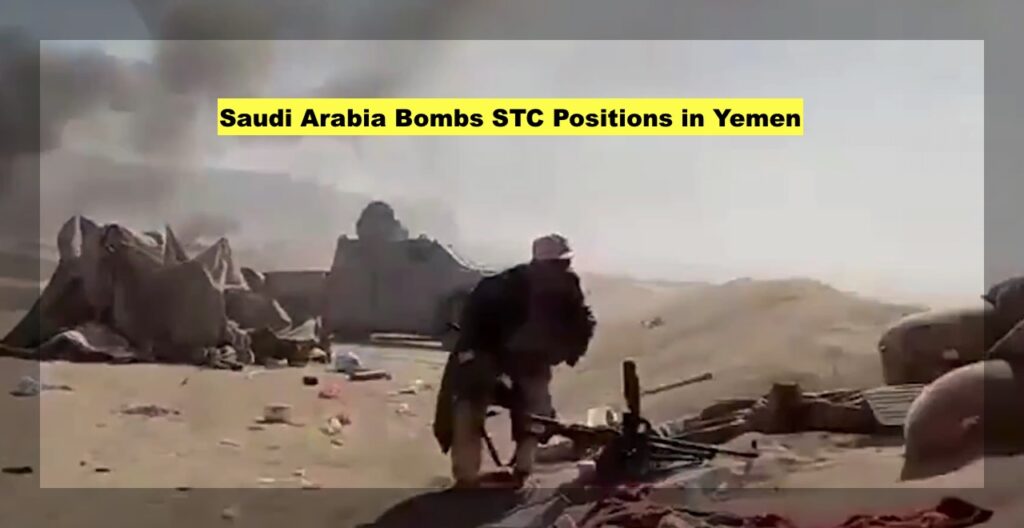
Saudi-led airstrikes hit positions held by the UAE-backed Southern
Transitional Council (STC) in Yemen’s Hadramout province on January 2, 2026, killing at least
seven fighters and injuring more than twenty, according to reports. The strikes targeted areas around Seiyun airport and
nearby military facilities, which had recently come under STC control.
Footage circulating online shows multiple explosions consistent with air-launched
munitions. Eyewitnesses cited by regional media confirmed intense bombardment in and around the airport complex. The
incident marks a rare and overt military confrontation between Saudi Arabia and forces backed by its long-time
coalition partner, the United Arab Emirates.
In the meantime, the United Arab Emirates confirmed that its last troops had already
left Yemen and called for de-escalation as some separatist forces were hit by deadly airstrikes on Friday.
Competing Narratives From Riyadh and the STC
Saudi officials framed the airstrikes as a move to reclaim military bases from
unauthorised control and restore them to forces aligned with Yemen’s internationally recognised government. Riyadh
maintains that the operation was necessary to preserve institutional authority and prevent unilateral territorial
changes.
The STC rejected this account. In a statement, it accused Saudi Arabia of
unprovoked aggression, claiming the strikes deliberately targeted southern
forces that have played a central role in countering both the Houthis and jihadist groups. The STC warned that the
attacks threaten already fragile power-sharing arrangements in southern and eastern Yemen.
Saudi-UAE Rift Comes Into the Open
The airstrikes have laid bare the long-simmering rift between Saudi Arabia and
the UAE over Yemen’s future. While both states intervened together in 2015 to
roll back the Houthi takeover of Sana’a, their objectives have increasingly diverged.
Saudi Arabia continues to support the Presidential Leadership Council
(PLC) and favours a unified Yemeni state that can stabilise its southern border. The UAE, by contrast, has backed the
STC, which seeks to revive an independent South Yemen and exerts growing
control over strategic ports and oil-producing regions.
The STC’s recent expansion in Hadramout, a
province Riyadh views as strategically vital, appears to have triggered Saudi military action. Analysts quoted by
the Guardian note that Saudi Arabia sees STC advances there as a direct challenge to coalition understandings
reached since 2019.
A Multi-Sided War Growing More Fragmented
The Yemen conflict, which erupted in 2014 after the Houthi movement seized the capital,
has evolved into a deeply fragmented war involving rival governments, separatist movements, tribal militias, and
extremist groups. External backers have amplified these divisions rather than resolved them.
Saudi strikes on STC positions highlight how the conflict has shifted from a simple
government-versus-Houthi struggle into a contest among competing visions of Yemen itself. Power struggles within the anti-Houthi camp have repeatedly undermined military
coordination and political negotiations.
Strategic Consequences and Houthi Advantage
Observers warn that clashes between Saudi-backed and UAE-backed forces risk
weakening the anti-Houthi front at a critical moment. The Houthis retain
control over much of northern Yemen and key population centres, while their opponents remain divided.
Middle East Eye noted that internal fighting among coalition-aligned factions
historically allows the Houthis to consolidate territorial and political gains. The latest violence in Hadramout
follows this pattern, raising concerns that the war is drifting further from any negotiated settlement.
What the Hadramout Strikes Signal
The Saudi airstrikes underscore the fragility of Yemen’s existing power-sharing
mechanisms and the limits of coalition unity. They also complicate UN-led efforts to stabilise ceasefires and revive
peace talks.
More broadly, the events suggest that Yemen’s conflict is entering a new and more
volatile phase, shaped not only by the Houthi-government divide but by open rivalry among regional
sponsors and their local proxies.