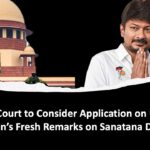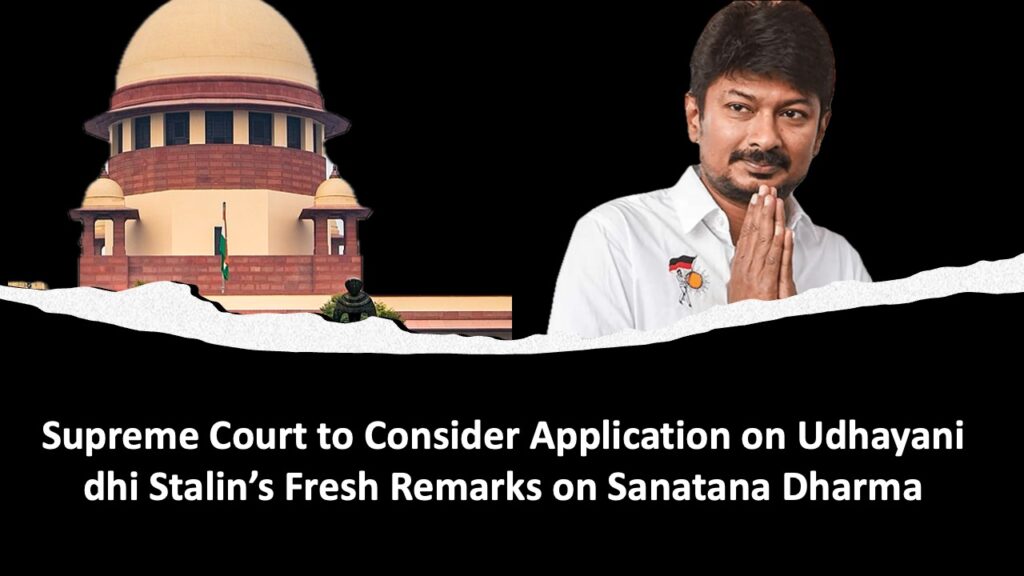
Supreme Court to Consider Application on Udhayanidhi Stalin’s May 12 Remarks Calling for Abolition of Sanatana Dharma
New Delhi, May 16, 2026: Advocate Amita Sachdeva has filed an interlocutory application (IA) in the Supreme Court of India, drawing the court’s attention to fresh remarks made by Tamil Nadu Leader of Opposition Udhayanidhi Stalin during the first session of the Tamil Nadu Legislative Assembly on May 12, 2026. According to the application, Udhayanidhi Stalin stated, “Sanatana Dharma, which divides people, must certainly be abolished.”
The IA has been filed in Contempt Petition (c) No. 1235/2023 titled Amita Sachdeva v. Udhayanidhi Stalin. This contempt petition stems from the Supreme Court’s directions in Shaheen Abdulla v. Union of India (Writ Petition (Civil) No. 940/2022), where the apex court on October 21, 2022, directed police authorities across the country to register FIRs suo motu in cases of hate speech without waiting for formal complaints. The contempt petition alleges that authorities failed to act against Stalin in accordance with these directions.
The Supreme Court admitted the contempt petition on April 29, 2026, before a bench comprising Justices Vikram Nath, Sandeep Mehta, and Vijay Bishnoi. The petitioner contends that Stalin’s May 12 remarks demonstrate a wilful disregard of the judicial process, given the pendency of the contempt petition and the court’s earlier observations on his 2023 statements.
The Supreme Court is scheduled to consider the interlocutory application on May 19, 2026.
Background of the 2023 Remarks and Legal Proceedings
The current application references Stalin’s earlier remarks delivered on September 2, 2023, at a conference titled ‘Abolition of Sanatana’ organised by the Tamil Nadu Progressive Writers and Artists Association in Chennai. At the event, Stalin, who was then Deputy Chief Minister of Tamil Nadu and a leader of the Dravida Munnetra Kazhagam (DMK), stated: Few things cannot be opposed, they should be abolished. We can’t oppose dengue, mosquitoes, malaria or corona. We have to eradicate them. In the same way, we have to eradicate Sanatana, rather than opposing it.
He further argued that Sanatana Dharma is against social justice and equality, claiming it promotes divisions based on caste and historical discrimination. The remarks triggered multiple FIRs across states including Maharashtra, Bihar, and Jammu and Kashmir. Several petitions were filed in the Supreme Court seeking clubbing of cases and action against Stalin.
Stalin approached the Supreme Court seeking protection and consolidation of the FIRs. The court granted him exemption from personal appearance before lower courts. On March 6, 2025, a bench of the Supreme Court ruled that no fresh FIRs or complaints could be registered against him on the same issue without the court’s prior permission. The order was passed while hearing an application highlighting a new FIR filed in Bihar.
In separate proceedings, the Madras High Court on January 21, 2026, observed that Stalin’s 2023 remarks amounted to hate speech and constituted a clear attack on Hinduism. The High Court noted that the statements carried implications akin to genocide or cultural eradication and questioned the lack of action by authorities in Tamil Nadu, even as cases were registered in other states.
The contempt petition by advocate Amita Sachdeva, filed in 2023, specifically invokes the Supreme Court’s 2022 directions in the Shaheen Abdulla matter, emphasising the obligation of state police to act suo motu. The petitioner has maintained that the failure to register cases in Tamil Nadu, despite the nature of the remarks, amounts to contempt.
Udhayanidhi Stalin, son of Tamil Nadu Chief Minister M.K. Stalin, currently serves as Leader of Opposition in the Tamil Nadu Assembly following a change in his role within the DMK government. The DMK has historically positioned its ideology around social justice and opposition to caste-based discrimination, often framing critiques of traditional practices within that context.
Chronology of Key Developments
- October 21, 2022: Supreme Court in Shaheen Abdulla v. Union of India directs suo motu FIR registration in hate speech cases.
- September 2, 2023: Udhayanidhi Stalin makes remarks at the Abolition of Sanatana conference.
- September 2023 onwards: Multiple FIRs registered in various states; petitions filed in Supreme Court and Madras High Court.
- November 29, 2023: Supreme Court declines to pass immediate orders in the contempt petition but keeps proceedings alive.
- March 6, 2025: Supreme Court bars fresh FIRs against Stalin without its permission.
- January 21, 2026: Madras High Court observes that the 2023 remarks amount to hate speech and a clear attack on Hinduism.
- April 29, 2026: Contempt petition admitted by Supreme Court bench of Justices Vikram Nath, Sandeep Mehta, and Vijay Bishnoi.
- May 12, 2026: Stalin’s remarks in Tamil Nadu Legislative Assembly.
- May 16, 2026: Interlocutory application filed bringing the fresh remarks on record.
- May 19, 2026: Scheduled date for Supreme Court to consider the application.
The interlocutory application argues that the repetition of similar statements, despite ongoing judicial scrutiny and prior court observations expressing disapproval, underscores a pattern that requires the court’s intervention to uphold its directives on hate speech.
This development occurs amid broader national debates on the balance between free speech under Article 19(1)(a) of the Constitution and restrictions under Article 19(2), particularly when statements are made by public office holders. The Supreme Court has previously noted in related proceedings that ministers and public figures bear a higher responsibility in their utterances.
The matter remains pending before the apex court, with the outcome of the May 19 hearing expected to address whether the fresh remarks warrant further action under the contempt petition.